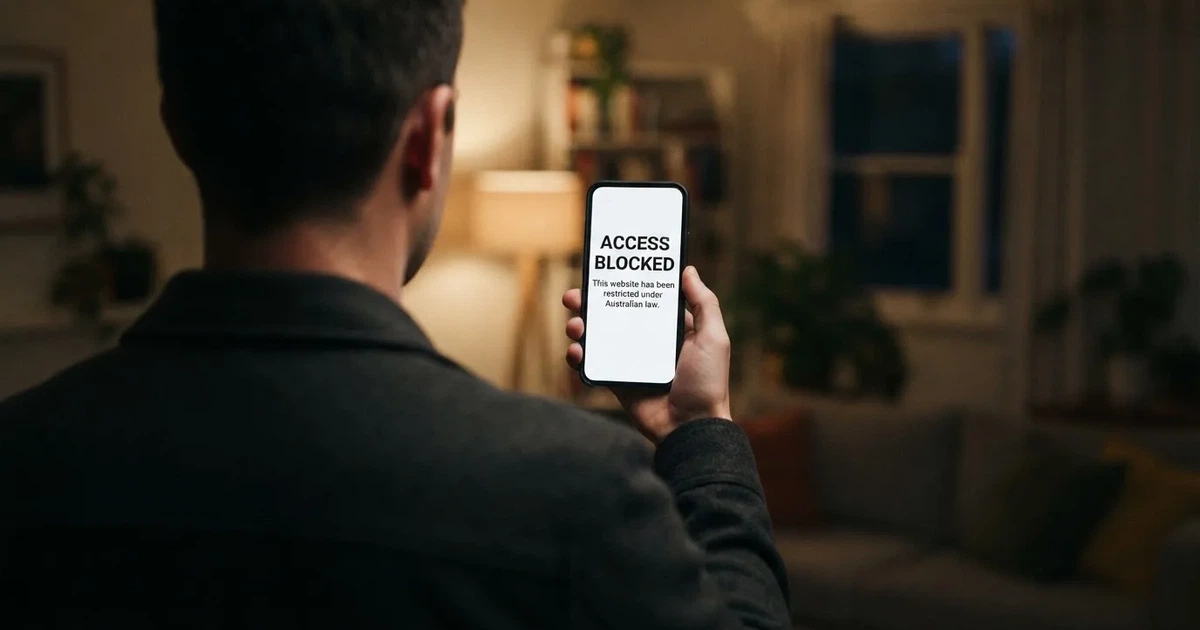
The aussie online casino market is a list of people the ACMA has told to stop
 Available in US
Every brand that shows up when you search “best aussie online casino 2026” has one thing in common: the Australian Communications and Media Authority has issued a formal warning over it for providing prohibited interactive gambling services to people in Australia. That is the throughline for this page. There is no locally licensed online casino to recommend, no shortlist of vetted operators, no operator to sign up with. What follows is a working account of why that is, what the regulator has done about it, and what someone weighing the search results should know before clicking through.

Currency stamp: as of 23 September 2026, every operator licence claim and ACMA action was cross-checked against the ACMA register and the Australian Securities and Investments Commission’s published warnings.
Table of Contents
- How Australian law treats online casino in practice
- Where to turn if online gambling stops feeling like a choice
- Paying an offshore site — and why the rails matter
- What a bonus really is — and what it costs
- What a mobile site looks like — and why the app question is moot
- What “new” means in this market
- How to read a comparison in this market
- Reading the offshore market in 2026
- Frequently asked questions
How Australian law treats online casino in practice
The Interactive Gambling Act 2001, strengthened by the Interactive Gambling Amendment Act 2017, makes it an offence to provide online casino games or online pokies to a person who is physically in Australia. No state or territory issues a licence for them. The Australian-licensed online gambling market is restricted to wagering on racing and sport placed before the event, lotteries and keno — products that run under Northern Territory oversight in practice, with the Northern Territory Racing and Wagering Commission supervising 52 online bookmakers including Sportsbet, Bet365 and Ladbrokes.

Minimum age is 18. The individual player is not prosecuted under the IGA; the law targets the provider. The practical consequence is that every online casino offering table games, slots or live dealer play to an Australian customer is doing so from offshore, outside Australian law. The offshore site displays whatever licence it holds — Curaçao, Anjouan, a Costa Rica registration — but no such licence authorises it to take Australian play. Two facts sit underneath that distinction. First, Australian-licensed wagering services have been banned from accepting credit cards or credit-related products for online play since 11 June 2024, and operators who breach that face penalties up to A$247,500. Second, the ACMA’s enforcement actions between November 2019 and June 2026 led to 1,751 illegal gambling and affiliate marketing websites being blocked at ISP level, and more than 230 unlicensed services leaving the Australian market since 2017.
What “best” can mean on this search
Honesty here is brief. If the search is for a licensed Australian casino, there is no answer — no such licence exists. If the search is for an offshore site that will accept Australian customers, the ACMA’s own publication is the only honest shortlist, because it lists the operators it has formally warned over and the month it did so. Each of those warnings is published on the ACMA’s website with the operator’s company name, the brand, the month and the statute relied on. The 11 operators examined below are drawn from that record. They are not the best. They are the ones the regulator has named.

What the regulator’s enforcement figures cost an offshore site
The arithmetic the ACMA’s record invites is straightforward. From November 2019 to June 2026 — roughly six and a half years — the authority directed Australian ISPs to block 1,751 websites. That is the running total the ACMA reported in the round published on 26 June 2026. Divide it out and the blocking cadence runs somewhere around 250 to 270 sites per year on average, more in the years after 2023 when the round sizes grew, and the May 2025 round alone added another 12 names: 7Signs, ChromaBet, Donbet, Duospin, Freshbet, Slots Gem, Jacks Club, Lucky Start, Pointsbetz, Spinrise, Vinyl Casino and Wildsino. The rate is the information: it is not one raid a year, it is a rolling programme, and a brand warned this month can expect to be blocked at Australian ISPs within weeks rather than quarters.
Where to turn if online gambling stops feeling like a choice
The responsible-gambling apparatus in Australia is built around the licensed wagering market, not the offshore casino market, and that gap matters.
BetStop — the National Self-Exclusion Register — has been live since August 2023 and binds every Australian-licensed online and phone wagering service. Register once, and the exclusion applies across every licensed operator. An offshore casino is not connected to BetStop. Self-excluding through the register closes the legal route; the illegal route remains open until the offshore site itself chooses to act on a request, and there is no obligation for it to do so.
The National Gambling Helpline on 1800 858 858 is free, operates 24 hours a day and connects callers to Gambling Help Online, which also runs a live chat service. The helpline is staffed for people in Australia and is the right contact whether the behaviour concerns licensed wagering, an offshore site or both. The most useful point to remember is that the helpline is confidential, and a single call does not commit a caller to anything beyond that conversation.
Player protection at the bank level is the third layer. Westpac’s gambling block refuses authorisation of transactions registered under the merchant category code “Betting/Casino Gambling” on eligible personal credit and debit cards. ANZ runs a comparable block through its app that also stops gambling transactions routed through a digital wallet such as Apple Pay on an eligible card, and removing ANZ’s block once set requires a 48-hour cooling-off period. Commonwealth Bank lets customers apply a gambling lock to eligible cards via the CommBank app. Each bank is explicit that the block cannot guarantee every gambling-related purchase will be stopped and that some non-gambling transactions can be blocked in error. That uncertainty is honest: MCC codes are merchant self-reported, an offshore operator may register under a different code, and a card block stops what it catches, not everything.
Paying an offshore site — and why the rails matter
The first thing to say about payments to an offshore online casino is that the methods pitched on the landing page are not the methods the law routes Australian money through. The credit-card ban that took effect for Australian-licensed wagering on 11 June 2024 — covering credit cards, credit-related products and digital currency — does not bind an offshore site, so a brand can still ask for a Visa deposit and take it. The Australian-licensed equivalent could not. That asymmetry is the practical difference between the two markets and the reason the marketing pitch on an offshore casino reads so differently from anything a Sportsbet or a Ladbrokes will write.
PayID and Osko
PayID and Osko sit on the New Payments Platform, which became accessible to the public on 13 February 2018 and is owned by New Payments Platform Australia Ltd — a non-profit with thirteen shareholders including the Reserve Bank of Australia and the major banks. By April 2025 more than 25 million PayID identifiers had been registered, and over 100 Australian financial institutions now offer PayID-based instant transfers. An Osko transfer between participating banks arrives in under a minute, 24/7, including weekends, regardless of whether it is addressed to a BSB and account number or to a PayID. Participants in the platform must keep monthly outages to no more than two minutes.
The warning that matters for this page sits inside PayID itself. Paying to a PayID shows the name of the account holder before the transfer is sent; AP+ warns that being asked to transfer money to a PayID on an illegal gambling site almost certainly means a scam site. That is the most useful safety message in the Australian payments stack for this subject, because it triggers before money moves.
Apple Pay and the digital-wallet question
Apple Pay, Google Pay and Samsung Pay collectively accounted for around 45% of all card payments in Australia by number at the end of 2025. Apple does not charge consumers a fee for using Apple Pay in stores, online or in apps — any surcharge is the merchant’s own card-processing cost, not Apple’s. Transaction limits and PIN requirements are set by the card issuer or merchant, not by Apple. The point of relevance to this page is that ANZ’s gambling block stops a gambling transaction made through a digital wallet on an eligible card, and the credit-card ban under the Interactive Gambling Act constrains gambling use of a linked digital wallet on the licensed side as well. An offshore site accepting Apple Pay through a credit card is in the same position as one accepting the card directly: it is taking a payment that an Australian-licensed operator is barred from taking.
American Express and the surcharge question
The Reserve Bank of Australia’s July 2025 review proposes removing surcharges only on eftpos, Mastercard and Visa card transactions, leaving American Express outside the scope of the proposed surcharge ban. Amex’s own structure explains the carve-out: it issues cards and processes transactions itself rather than operating as a four-party network like Visa or Mastercard, and that closed-loop model is why a surcharge prohibition drafted around open-loop networks does not reach it. For an Australian customer, the practical upshot is that an Amex deposit to any site carries whatever surcharge the merchant chooses to add, and that surcharge is not in the sights of the RBA’s proposed reform.
BPAY and bank transfer
BPAY has operated in Australia since 1997, is available in the online banking of more than 140 banks and financial institutions, and is offered by over 95,000 businesses. It is a bill-payment service: the payer enters the Biller Code and the Customer Reference Number printed on the bill, and the funds clear through the payer’s banking session. BPAY is run by Australian Payments Plus, the same operator that runs PayID and Osko, and it was brought under the AP+ holding entity alongside eftpos and NPP Australia after the ACCC authorised the merger in September 2021. For an offshore casino, BPAY is a closed door: it requires the casino to be registered as a biller with AP+, and AP+ does not enrol offshore interactive gambling operators. A standard bank transfer by BSB and account number is the fallback that most offshore sites advertise alongside PayID, and the AUSTRAC threshold-transaction-report rule that applies to transfers of A$10,000 or more covers physical cash only — not electronic bank transfers, which carry no equivalent per-transaction reporting trigger regardless of the amount sent.
What a bonus really is — and what it costs
The marketing line on an offshore casino reads like the marketing line on any other gambling product. A welcome package, a deposit match, free spins attached to a named slot. The arithmetic behind that line is the same arithmetic it carries on the licensed side and the same arithmetic the law in Australia does nothing to soften for the offshore consumer, because no Australian consumer protection regime reaches the offshore site.
A deposit-match bonus carries a wagering multiple. A bonus of A$100 at a 35x multiple requires A$3,500 of qualifying turnover before the bonus and any winnings tied to it become withdrawable. At a slot stake of A$1 per spin that is 3,500 spins. At five seconds per spin that is roughly 4.9 hours of continuous play, and the player has not yet wagered any of their own deposit during that window — only the bonus amount, if the bonus terms restrict wagering to the bonus alone. Slot machines return on average well below 100% of what is wagered across a session; even an RTP in the high 90s leaves a real expected loss on 3,500 spins. The expected loss over the clearing period, on the bonus turnover alone, sits in the low hundreds of dollars at typical RTP ranges. The bonus is the headline. The cost is the number behind it.
Free spins attached to a welcome package carry a per-spin cap on what they can produce and often a maximum cashout from spin winnings, sometimes as low as A$100. The spins themselves are priced at whatever the slot’s smallest stake is, the wins come back as bonus money rather than cash, and they inherit the same wagering multiple as the deposit match. A package that “looks like” A$500 plus 200 free spins is, on the small print, a long play requirement, a capped upside and an expected loss that the casino’s own RTP tables would predict.
The honest reading: a bonus is a way to extend the time a player spends on the site, not a way to extract cash. The law does not require an offshore operator to disclose the expected loss; it requires disclosure of the wagering multiple, the eligible games, the time limit, the maximum cashout and the deposit rule. None of those numbers, on their own, tells a reader what the offer is worth. The expected loss calculation does, and that calculation is the part of the offer the marketing page does not run.
What a mobile site looks like — and why the app question is moot
The mobile offering on an offshore casino is the desktop offering through a browser tab sized for a phone, plus the option to add a web app shortcut to the home screen. Australian Apple and Google stores do not carry real-money casino apps in the same way they carry wagering apps, because the IGA’s prohibition applies to the supply of prohibited services and the major app-store policies reflect that. An offshore casino that markets a downloadable app is distributing it through its own site, and the consumer installs it from there. The risks of installing software sourced outside the official stores are the risks of any sideload: the publisher is the operator, the update channel is the operator, and there is no app-store review standing between the player and the binary.
The mobile payments question is the more useful one. Apple Pay on a debit card routed through an offshore casino does not change the legal position of the deposit — the underlying transaction is still a card payment to an unlicensed recipient — and ANZ’s gambling block, when active, intercepts that transaction at the issuer level regardless of the wallet in front of it. The mobile experience is convenient. The legal and consumer-protection position behind it is unchanged.
What “new” means in this market
A “new aussie online casino” is a new offshore site targeting Australian customers, not a fresh Australian-licensed option. The licensing landscape in Australia has not opened up to new entrants for online casino in any state or territory; the IGA prohibits the product itself. A brand launched this year is launched outside Australia, and its target audience is reached through affiliate marketing rather than through an Australian registration.
The turnover in the offshore market is high. The ACMA blocking total of 1,751 websites since November 2019 implies that the appearance of new sites has consistently outpaced the regulator’s capacity to block them, even with the 12-name rounds that have become routine in 2025 and 2026. A reader looking for a “new” brand is therefore likely looking at one that has been live for a small number of months, has not yet accumulated a public ACMA warning or a blocked-ISP status, and is being marketed by affiliate pages whose revenue model depends on the sign-up, not on the player’s experience afterwards.
How to read a comparison in this market
A fair comparison of “best aussie online casino” brands would weigh five things: the regulator’s record against the operator, the payment methods the site actually accepts, the bonus terms on the welcome package, the withdrawal experience as reported by Australian customers, and the dispute route if a withdrawal is refused. None of these is a specification the offshore market carries transparently.
The regulator’s record is the only one of those five a reader can check from outside the site. The ACMA publishes each formal warning with the company name, the brand and the date. The table below summarises the record for the eleven brands named earlier; the rest of the comparison has to be done at the deposit and withdrawal screen, and the reader’s leverage after a refusal is the offshore operator’s own complaints procedure, because there is no Australian complaints body with jurisdiction over an offshore site.
| Brand | ACMA action and date | Operator named by the ACMA | Subject support |
|---|---|---|---|
| RocketPlay | Formal warning, March 2026 | Pulsup Ltd | Listings only — Gambling Insider mentions the brand |
| Level Up Casino | Formal warning, May 2022 | Dama N.V. | Listings only — Westpac references the brand in a card-blocking context |
| Woo Casino | Formal warning, March 2025 | Dama N.V. | — |
| Spirit Casino | Formal warning, May 2025 | Dama N.V. | — |
| National Casino | Formal warning, July 2025 | Consolutetish S.R.L. | Listings only — ACMA, AUSTRAC and BetStop records carry the name |
| Bizzo Casino | Formal warning, July 2025; earlier 2022 warning | Consolutetish S.R.L.; earlier TechSolutions | Listings only — Gambling Insider carries the brand |
| Ignition Casino | Formal warning, July 2025 | Bamboo Media | — |
| Instant Casino | Formal warning, February 2025 | EOD Code SRL | Listings only — EcoPayz and PayID |
| Jackbit | Formal warning, April 2026 | Ryker B.V. | — |
| Casino Intense | Formal warning, April 2025 | Sterplay Holding Ltd | Listings only — AUSTRAC, BetStop and Gambling Insider |
| Sky Crown | Formal warning, September 2022 | Hollycorn N.V. | — |
The “subject support” column records where the brand appears in public listings outside the ACMA’s own register — in third-party payment or compliance pages rather than in marketing material. An em dash in that column means the brand surfaces only in ACMA records and has no useful public footprint to point to. The pattern is that the brands appearing in third-party listings do so because they have been named in a regulatory or compliance context, not because they have an Australian consumer-facing presence to recommend.
What the spread looks like
Five of the eleven warnings fall inside the last fourteen months — RocketPlay, Woo Casino, Spirit Casino, National Casino, Bizzo Casino, Ignition Casino, Instant Casino, Jackbit, Casino Intense, Sky Crown. The regulator’s monthly output in this market is steady. A brand at the top of an affiliate ranking this month is, more often than not, a brand the ACMA has either already warned over or will warn over within a few months. The July 2025 round alone covered four of the brands on the list — National Casino, Bizzo Casino and Ignition Casino as new entries, and the earlier 2022 warning over Bizzo to a different operator, which is the pattern the regulator follows when a brand is sold or rebranded: the new owner is warned afresh rather than the old warning being treated as ongoing.
Dama N.V. is the operator that recurs most heavily, appearing as the warned party for RocketPlay’s 2022 action, Level Up Casino, Woo Casino and Spirit Casino. A reader who has come across any of those four brands has come across the same operator behind three of them at least, and the warning record against the operator — not just the brand — is what matters when the brand is later sold and the same site reopens under a new label.
Reading the offshore market in 2026
The wider market reading is short and the arithmetic quantifies the reality of the offshore sector. Two figures matter. First, H2 Gambling Capital’s 2025 report estimates that Australians lose about A$3.9 billion a year to illegal gambling sites. Second, the share of gambling going through legal channels fell from 74% in 2021 to 64% by the time of the 2025 estimate. The first figure quantifies the offshore market. The second quantifies the erosion of the licensed one. The loss to illegal sites is the negative space the licensed wagering market has not been able to close.
The Interactive Gambling Amendment (Gambling Reform) Bill 2026 passed Parliament on 19 August 2026. Its advertising and inducement measures commence on 1 January 2027 — law with a start date, not yet in force on a page written in 2026. The direction of travel is toward stricter advertising rules and stronger consumer messaging, but for a reader comparing options today, the offshore casino offering remains what it was: prohibited by statute, warned against by the regulator, and unsupported by any Australian consumer-protection body.
The Northern Territory Racing and Wagering Commission’s role is the structural fact underneath that. It supervises 52 of Australia’s online bookmakers — the licensed wagering market — and meets once a month in Darwin with no full-time staff. The bookmakers it licences are licensed in the Territory for tax reasons, not because the Territory has a gambling-tourism strategy. A reader who finds a Sportsbet or a Ladbrokes and treats it as a casino will be disappointed: those brands take wagers on races and sport, not casino games. The licensed product in Australia is narrow on purpose. The unlicensed product is broad because the operator behind it is unconstrained by Australian law.
The honest verdict on the search itself
A search for “best aussie online casino 2026” returns the names of operators the ACMA has told to stop offering their service to Australians. The search ranking on that term is a measure of how aggressively each operator markets into Australia through affiliate pages, not of how trustworthy the operator is. The two measures point in opposite directions. A brand that appears at the top of an affiliate ranking and at the top of the ACMA’s recent warning list is being marketed because it is currently findable, not because it is currently defensible.
The closest legitimate analogue in Australia is licensed online wagering — racing and sport, pre-event only — which carries the protections the offshore casino does not: Australian-licensed operation, BetStop coverage, bank-level gambling blocks, AUSTRAC reporting, and a regulator whose enforcement against providers is matched by a complaints route for players. A punter looking for the product the offshore casino sells does not have a licensed Australian option to go to. A punter looking for a product the licensed Australian market sells does, and the licensed version is the version with a complaints body behind it.
Frequently asked questions
Is there a licensed online casino based in Australia that Australians can legally join?
No. The Interactive Gambling Act 2001 prohibits the supply of online casino games and online pokies to anyone in Australia, and no state or territory issues a licence for them. The Australian-licensed online gambling market is restricted to wagering on racing and sport placed before the event, lotteries and keno, overseen in practice by the Northern Territory Racing and Wagering Commission.
What does “best” mean when every option being compared is an offshore, unlicensed site?
It can only describe marketing aggressiveness, recent warning history or affiliate-page visibility, none of which is a recommendation. The ACMA publishes a register of formal warnings over offshore operators that have offered prohibited services to Australians, and that register is the closest thing to a comparable dataset.
How does the ACMA decide which offshore casino sites to warn about or block?
The ACMA investigates complaints, intelligence from Australian ISPs and referrals, then issues formal warnings under the Interactive Gambling Act and, where sites do not stop offering services to Australian customers, directs Australian ISPs to block them at the network level. The June 2026 update reported a running total of 1,751 blocked sites since the first blocking request in November 2019.
Can an offshore casino site legally register an Australian-style web address and call itself Aussie?
No. The .com.au namespace is reserved for entities with an Australian presence, and the ACMA treats a brand using “Aussie” or “.com.au” to imply an Australian connection as a misleading representation under Australian Consumer Law. The Australian-registered domain does not change the offshore operator’s underlying legal position.
What legal, licensed alternative exists for someone wanting a casino night in Australia?
Licensed land-based casinos operate in every state and territory under their own casino control regimes, with an 18-plus entry requirement and on-premises responsible-gambling obligations. Crown Melbourne, The Star Sydney and SkyCity Adelaide are the largest venues. Online, the only licensed option is wagering on racing and sport with a Northern Territory-licensed bookmaker.
Does any state or territory issue online casino licences to operators serving Australians?
No. The Interactive Gambling Act 2001 applies across all states and territories and prohibits the supply of online casino games and online pokies to anyone in Australia, irrespective of where the operator is incorporated. State and territory gambling regulators licence wagering, lotteries, keno and land-based casinos, not online casino games.
Created by the ”Casino Ratings Info” editorial team.