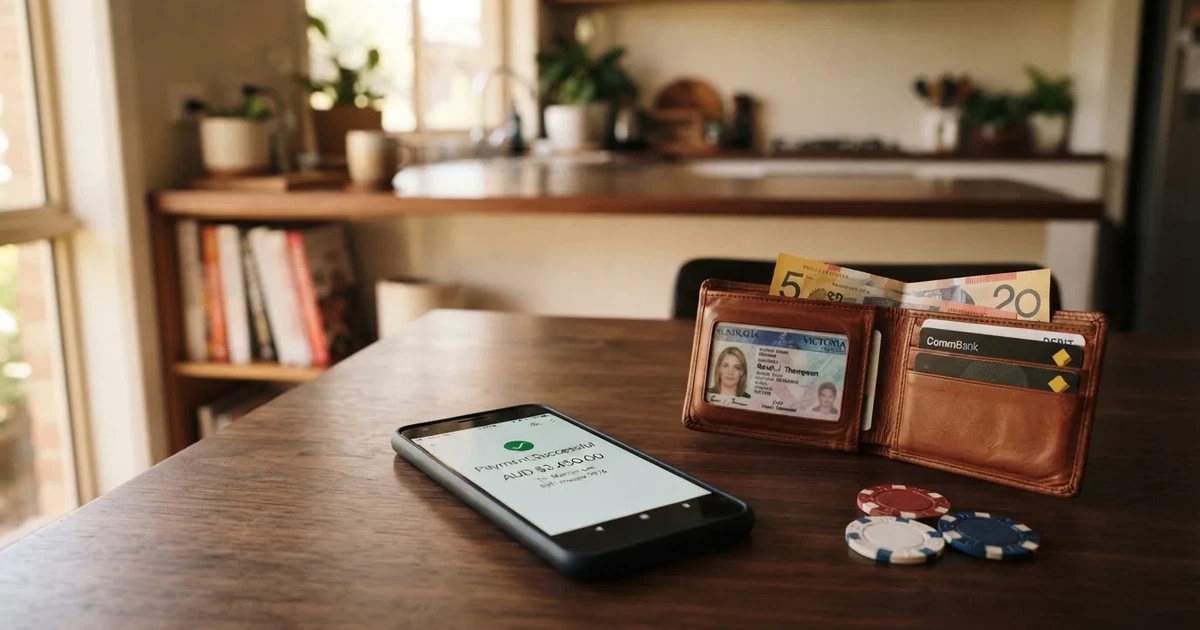
A $10 PayID no-deposit casino bonus is not an Australian offer
 Available in US
Currency stamp: checked against ACMA, AP+ and ASIC public registers as of 23 September 2026.
The phrase sounds native. A $10 top-up that asks nothing more than a PayID, payable the moment the registration form is filed, and aimed squarely at Australians — it reads like a product of the same banking system that runs the rest of a household’s money. It is not. No casino operating legally in Australia offers one, because no casino operating legally in Australia offers casino games at all. The Interactive Gambling Act 2001 (the IGA) prohibits online casino games and online pokies as interactive gambling services to anyone in Australia, and no state or territory issues a licence for them. Anything sold under the “$10 PayID no-deposit” label reaches the reader through an offshore operator that PayID itself warns its users about.
What follows is what that phrase really means once the marketing copy is set aside: what PayID is and is not, what a no-deposit bonus actually costs the person who claims one, how the ACMA has been enforcing against the offshore brands running these campaigns, and what the legal deposit routes for a licensed Australian wagering account look like. The angle through this page is consequence — what follows from the offer once the search result is closed and the form is filled in.
Table of Contents
- The landscape this offer is sold inside
- Why the offer cannot exist on a licensed Australian site
- Getting help when the offer stops being a search result
- What PayID is, and what an offshore casino does with it
- What the ACMA has actually done to the brands behind the pitches
- How the eleven formal warnings line up
- What a “$10 no-deposit bonus” costs in plain arithmetic
- Where a PayID payment is and is not legitimate
- What the payments picture actually looks like at the bank
- Tax and bookkeeping consequences of taking the offer
- The legal frame, in one place
- Frequently asked questions
The landscape this offer is sold inside
An offer of free credit in exchange for a PayID sits inside an offshore marketing machine rather than a regulated Australian market. Three figures set the scale.

According to the ACMA, as reported in June 2026, a total of 1,751 illegal gambling and affiliate marketing websites had been blocked since the first blocking request in November 2019, and more than 230 unlicensed gambling services had left the Australian market since enforcement was strengthened in 2017. In a single round reported on 26 June 2026, the ACMA asked Australian internet service providers to block 12 more sites: 7Signs, ChromaBet, Donbet, Duospin, Freshbet, Slots Gem, Jacks Club, Lucky Start, Pointsbetz, Spinrise, Vinyl Casino and Wildsino.
H2 Gambling Capital’s 2025 report estimates that Australians lose about A$3.9 billion a year to illegal gambling sites, and that the share of gambling going through legal channels fell from 74% in 2021 to 64%. That is the market the $10 PayID pitch is fishing in.
A blocking-rate calculation: between November 2019 and the June 2026 round, the ACMA’s blocking programme removed 1,751 illegal sites across roughly 79 months, an average close to 22 sites a month. The condition that matters is enforcement variability — single rounds have cleared 12 sites, others have cleared none, and the average is the only honest way to state a rate that swings that widely. At a steady 22 a month, more than 250 further sites would be expected to land on the block list in the year ahead, which is a useful estimate of how many similar pitches the reader can expect to see filtered out of Australian search results.
| Brand | ACMA action and date | Operator named by the ACMA | Subject support |
|---|---|---|---|
| RocketPlay | Formal warning — March 2026; May 2022 | Pulsup Ltd; Dama N.V. | no-data |
| Level Up Casino | Formal warning — May 2022 | Dama N.V. | listings-only |
| Woo Casino | Formal warning — March 2025 | Dama N.V. | no-data |
| Spirit Casino | Formal warning — May 2025 | Dama N.V. | no-data |
| National Casino | Formal warning — July 2025 | Consolutetish S.R.L. | listings-only |
| Bizzo Casino | Formal warning — July 2025; 2022 | Consolutetish S.R.L.; TechSolutions | no-data |
| Ignition Casino | Formal warning — July 2025 | Bamboo Media | no-data |
| Instant Casino | Formal warning — February 2025 | EOD Code SRL | listings-only |
| Jackbit | Formal warning — April 2026 | Ryker B.V. | no-data |
| Casino Intense | Formal warning — April 2025 | Sterplay Holding Ltd | listings-only |
| Sky Crown | Formal warning — September 2022 | Hollycorn N.V. | no-data |
The licence that does exist sits on the wagering side and is narrower than the search term suggests. The Northern Territory Racing and Wagering Commission (NTRWC) regulates 52 of Australia’s online bookmakers — including Sportsbet, Bet365 and Ladbrokes — for tax reasons; the commission has no full-time staff and meets once a month in Darwin. What it licenses is pre-event wagering on races and sport, lotteries and keno. Casino games and online pokies are out of scope entirely.
Why the offer cannot exist on a licensed Australian site
The Interactive Gambling Act 2001, tightened by the Interactive Gambling Amendment Act 2017, makes it an offence to provide online casino games, online pokies or in-play betting to a person physically in Australia. No state or territory issues a licence that would let an Australian operator accept a PayID deposit and credit casino play. The minimum age for any gambling product is 18.
What the IGA does not do is prosecute the individual player. The offence sits with the provider, which is why the ACMA’s tools are warnings, blocking requests to Australian internet service providers, and negotiated exits from the market. The consequence for the player is not criminal but consumer: an offshore site offers no Australian consumer protection, no local complaints body and no recourse if a withdrawal is refused. If the site is blocked, any balance still on it becomes harder to recover, not easier.
The most recent change to the frame, the Interactive Gambling Amendment (Gambling Reform) Bill 2026, passed Parliament on 19 August 2026. Its advertising and inducement measures commence 1 January 2027 — a law on the books with a start date, not yet in force on a page read in 2026. The reader who sees inducement-style language in an offer before then is reading a campaign that has one year to become illegal by statute, rather than being illegal already under the IGA’s prohibition on providing the underlying product.
Where the marketing term falls short
“No deposit” describes what the reader does not pay up front. It does not describe what is taken later: a wagering multiple that has to be worked through before any winnings are withdrawable, a maximum cashout cap on what a free credit can ever turn into, a games list that excludes most of what the site advertises, and a verification step that often requires documents an offshore operator may not be set up to handle. AP+ — the Australian domestic payments provider that runs PayID — states the position plainly: if a reader is asked to transfer funds to a PayID on an illegal gambling site, it is almost certainly a “scambling” website, its term for an illegal online gambling platform advertised on social media and messaging apps that tricks people into gambling on a scam site. Anyone who suspects they have been scambled is told to contact their financial institution.
The payoff from a “free $10” is, in plain terms, the chance to spend a stranger’s money on a house-edge product for long enough to clear a wagering requirement — and the wagering requirement is precisely calibrated to make that unlikely. That is not cynicism, it is how the product is priced.
Getting help when the offer stops being a search result
The reason the responsible-gaming section sits at the top of this page, rather than at the bottom, is that the offer on screen and the help line are both Australian and both free, and the one most readers will reach first is the offer. Free confidential support is available around the clock through Gambling Help Online (chat online) and the National Gambling Helpline on 1800 858 858.
BetStop, the National Self-Exclusion Register, has been live since August 2023. It binds Australian-licensed online and phone wagering services — not offshore casinos. Registering with BetStop will block a person from licensed Australian wagering accounts; it will not reach an offshore site that has never asked for an exclusion. For a reader who has been answering “$10 PayID no-deposit” ads, the registered exclusion is one tool, and the helpline is the other.
A self-imposed block is also available at the bank level. Westpac’s gambling block refuses authorisation of transactions registered under the merchant category code ‘Betting/Casino Gambling’ on eligible personal credit and debit cards. ANZ’s gambling transaction block, activated in the ANZ app, blocks gambling transactions made through a digital wallet such as Apple Pay on an eligible card, not just the physical card; once turned on, removing the block requires a 48-hour waiting period. The bank warns that not all gambling transactions will be blocked and that some non-gambling transactions might be blocked in error. ANZ’s note matters because the merchant category code is set by the merchant, not by the bank, and an offshore casino is under no obligation to register itself honestly.
The credit-card ban for licensed wagering, in force since 11 June 2024, also shapes what the legal routes look like. Penalties for an Australian-licensed operator accepting a credit card reach $247,500. Digital currency sits in the same restricted set. Legal deposit routes for a licensed Australian wagering account are debit card, bank transfer, PayID/Osko and BPAY. A site asking an Australian player for a credit card or a crypto deposit is operating outside the rules the licensed market runs on, and that fact alone narrows what is on offer.
What PayID is, and what an offshore casino does with it
PayID is a real, regulated Australian payment service. It is an easy-to-remember identifier — a mobile number, an email address, an ABN or an Organisation Identifier — linked to a bank account, operated by Australian Payments Plus (AP+). Over 100 Australian financial institutions offer it, and it is built into their online banking. As of April 2025, more than 25 million PayIDs were registered in Australia.
PayID runs on Australia’s New Payments Platform (NPP), which launched in February 2018. The Reserve Bank of Australia is the regulator and overseer of the NPP and separately owns and operates the Fast Settlement Service used to settle NPP transactions individually in close to real time, 24 hours a day. Through Osko, a bank transfer between participating Australian banks arrives in under a minute, 24/7 including weekends, whether it is addressed to a BSB and account number or to a PayID. When paying to a PayID, the payer is shown the name linked to it before sending — the check that protects against scams and mistaken payments.
The marketing use of PayID on an offshore casino is a different act. The reader is being asked to treat an Australian identifier as proof that the operator is local and safe. PayID proves neither. It proves that a bank account somewhere in the Australian banking system is willing to receive the transfer, which can be true of any account the offshore operator has been able to open. PayID itself warns of exactly this case. The legitimate banking check (the name display before sending) is the only Australian infrastructure an offshore operator gets to use by piggybacking on a local bank relationship.
AP+ defines “scambling” as slang for illegal online gambling platforms advertised on social media and messaging apps that trick people into gambling on a scam website. The same AP+ page tells anyone who thinks they have been scambled to contact their financial institution. PayID will never contact a customer directly, and emails or text messages claiming to be from PayID are a scam; PayID never asks anyone to send money in order to receive money or to “upgrade” an account. A reader who has been contacted by someone claiming to be PayID about a casino bonus has been contacted by a scam, not by PayID.
Where the speed claim falls short
The instant-settlement pitch leans on Osko’s near-real-time transfer. Osko delivers close to real-time transfer between Australian banks; it does not change the legal status of the receiving account. A $10 PayID credit that arrives in under a minute is still a credit issued by an offshore operator that has no Australian licence to issue it. The payment infrastructure works exactly as advertised; the operator using it does not.
What the ACMA has actually done to the brands behind the pitches
The eleven brands below are not a ranking and not a recommendation. Each one is listed because the ACMA itself issued a formal warning over it for offering prohibited interactive gambling services to Australians. No bonus terms are given — the only sources for those terms are affiliate marketing pages, and the legal status of the underlying product makes those terms beside the point. The page closes with a comparison table covering the same set.
RocketPlay — the brand the ACMA warned twice in five months
The ACMA issued a formal warning to Pulsup Ltd over Rocketplay in March 2026, building on an earlier warning to Dama N.V. in May 2022. Two formal warnings over one brand, in regimes run by two different operators, are not the same brand simply being careless — they are evidence that the brand has been re-laundered through successive corporate vehicles. Online casino games cannot be licensed anywhere in Australia, whatever licence the site displays. A reader landing on RocketPlay via a search ad is not landing on a re-licensed Australian product.
Level Up Casino — same operator, different brand, same warning
Level Up Casino was the subject of the same May 2022 Dama N.V. warning that covered six casino brands at once. The Subject support token in research for this entry is listings-only — there is no operator statement to carry, only what third-party listings report. The point that holds is the legal one: a brand whose parent has been on the receiving end of a formal ACMA warning is not a neutral party.
Woo Casino — Dama N.V. returns under a fresh name
Dama N.V. picked up a further formal warning in March 2025 over Woo Casino. The reader who sees a “$10 PayID no-deposit” pitch attached to this brand is being pitched by an operator the ACMA has put on formal notice in the past year. The marketing site may be new; the company behind it is not.
Spirit Casino — same Dama N.V. parent, second 2025 warning
A second 2025 warning to Dama N.V. followed in May, this time over Spirit Casino. Two warnings in three months to the same operator on different brands are a clearer signal than either one alone.
National Casino — a new operator, the same prohibition
The July 2025 ACMA warning named Consolutetish S.R.L. as the operator behind National Casino. The Subject support token is listings-only — research carries third-party listings rather than an operator statement. What the listings cannot soften is the IGA itself: the brand is offering a product no Australian licence covers.

Bizzo Casino — warned twice under different corporate shells
Consolutetish S.R.L. took a warning over Bizzo Casino in July 2025, but Bizzo had already been the subject of an earlier 2022 warning to TechSolutions (CY) Group Limited and TechSolutions Group N.V. Two corporate identities, one product pitch, and the regulator has had to warn both.
Ignition Casino — the operator and the product line, formally separated by Bamboo Media
The July 2025 warning named Bamboo Media as the operator of Ignition Casino. The brand name is the same one a reader may have seen advertised under different corporate paperwork in earlier years. The legal position is unchanged: the product is prohibited.
Instant Casino — the brand AP+’s scambling warning was written for
EOD Code SRL took the February 2025 warning over Instant Casino. The Subject support token is listings-only; the brand has appeared in payment-method listings rather than in any operator-side confirmation. That alignment with the listings is itself part of the picture: Instant Casino has been marketed through payment-rail referral pages rather than through any disclosed operator statement.
Jackbit — the most recent of the April 2026 warnings
The April 2026 warning to Ryker B.V. covered Jackbit and CasinOK as a pair. The timing matters: the warning was issued under the same regulatory frame that produced the 1,751-site blocking total, and the operator has had no opportunity since April 2026 to come into compliance with the IGA, because the IGA does not allow the offering in the first place.
Casino Intense — an April 2025 warning over a Sterplay-operated brand
Sterplay Holding Ltd was named in the April 2025 warning over Casino Intense. The Subject support token is listings-only — the brand surfaces in payment-rail and registry listings rather than through any operator statement. A reader who arrived at this brand through one of those listings should weigh the warning alongside the listing.
Sky Crown — a Hollycorn N.V. brand alongside Blue Leo
The Hollycorn N.V. warning covered its Sky Crown and Blue Leo casino services together. A single warning over two brands is two pitches under one regulator action, and both pitches carry the same legal exposure.
How the eleven formal warnings line up
| Brand | ACMA action and date | Operator named by the ACMA | Subject support |
|---|---|---|---|
| RocketPlay | Formal warning — March 2026 (earlier May 2022) | Pulsup Ltd; earlier Dama N.V. | — |
| Level Up Casino | Formal warning — May 2022 | Dama N.V. | Westpac and AP+ listings only |
| Woo Casino | Formal warning — March 2025 | Dama N.V. | — |
| Spirit Casino | Formal warning — May 2025 | Dama N.V. | — |
| National Casino | Formal warning — July 2025 | Consolutetish S.R.L. | AUSTRAC and Wikipedia listings only |
| Bizzo Casino | Formal warning — July 2025 (earlier 2022) | Consolutetish S.R.L.; earlier TechSolutions | — |
| Ignition Casino | Formal warning — July 2025 | Bamboo Media | — |
| Instant Casino | Formal warning — February 2025 | EOD Code SRL | EcoPayz and PayID listings only |
| Jackbit | Formal warning — April 2026 | Ryker B.V. (with CasinOK) | — |
| Casino Intense | Formal warning — April 2025 | Sterplay Holding Ltd | AUSTRAC, ITnews and NAB listings only |
| Sky Crown | Formal warning — September 2022 | Hollycorn N.V. (with Blue Leo) | — |
Eleven warnings, distributed across two regulators’ worth of corporate vehicles, is not a scattered picture. Two operators — Dama N.V. (four of the eleven entries) and Consolutetish S.R.L. (two) — account for more than half the warnings on this list. The brand on the search result is the brand the regulator has had to name more than once; the corporate shell around it changes more often than the pitch does.
What a “$10 no-deposit bonus” costs in plain arithmetic
The pitch leads with the dollar figure. The cost lives in the conditions.
A no-deposit bonus of $10 typically carries a wagering requirement — a multiple the bonus (and sometimes the deposit that came with it) has to be turned over before any winnings become withdrawable. A 40x wagering multiple on a $10 bonus is $400 of required turnover. At a stake of $0.10 a spin on a single payline, that is 4,000 spins. At a five-second interval between spins, 4,000 spins is 20,000 seconds, which is close to five and a half hours of continuous play. The house edge on a typical online pokie sits in the 3% to 5% range, so an expected loss on $400 of turnover at a 4% edge is $16. The arithmetic is an estimate averaged across many spins, not a promise for any one session — a player can win more or less than the expected figure in a single run.
The same numbers work the other direction. The bonus is $10. The expected cost to the player over the clearing period is in the same neighbourhood. That is what the marketing copy leaves out: the headline figure is the size of the gift; the wagering requirement is the size of the spend.
A maximum cashout cap is the second term that bites. If the cap is $50, then even after a player clears the wagering requirement and is theoretically free to withdraw, the operator will pay out no more than $50 from what was a “free” starting balance. Anything the player wins above that stays on the site. The cap is the point at which the bonus stops behaving like a gift and starts behaving like a retention mechanic.
The third term is the games list. Wagering requirements are usually weighted by game: pokies count 100%, table games count 10% or 0%, live dealer games often 0%. The reader who imagined the $10 would let them try the live blackjack they had been curious about is, by the weighting, being told to spend it on the games the house has the largest edge on. That is the offer, written into the fine print.
The wagering multiple, the maximum cashout cap and the games weighting are the three numbers that decide whether a no-deposit bonus is worth the time it takes to clear. Affiliate marketing pages publish the headline figure and rarely the others. The audit on those terms — what is the multiple, what is the cap, what counts — is the only arithmetic the offer genuinely rewards.
Where a PayID payment is and is not legitimate
PayID is the right payment method for a licensed Australian wagering account. It is not a credential that proves an offshore casino is regulated.
A licensed Australian online wagering service accepts PayID because the service is licensed by the NTRWC (or by a state regulator for lotteries and keno) and is bound by the Interactive Gambling Act and the 11 June 2024 credit and crypto ban. An offshore casino asks for PayID because the operator has a bank account that supports it, not because any Australian regulator has approved the product it sells. PayID proves the rail; the rail is not the regulation.
The credit-card ban in force since 11 June 2024 cuts both ways for the reader. An Australian-licensed operator cannot accept a credit card or a credit-related product for wagering. An offshore casino may not be set up to refuse one, which means the offer to “use any payment method you like” is a marker of an unlicensed product rather than a sign of flexibility. The same applies to crypto: an Australian-licensed operator cannot take digital currency as payment, and an offshore casino that does is taking a payment method the licensed market is forbidden to use.
Digital wallet surcharging is a side issue the reader may meet at a licensed Australian operator. The Reserve Bank of Australia’s July 2025 review proposes removing surcharges only on eftpos, Mastercard and Visa card transactions, explicitly leaving American Express outside the scope of the proposed surcharge ban. The point is that surcharging rules are tied to the licensed market, and an offshore operator is under no obligation to follow them.
What the payments picture actually looks like at the bank
A $10 PayID top-up at an offshore casino moves through the same banking rails as a $10 transfer to a friend’s mobile number. The difference is at the merchant end.
A licensed Australian wagering operator is on the merchant category codes the banks monitor. ANZ’s gambling transaction block, activated in the ANZ app, blocks gambling transactions made through a digital wallet such as Apple Pay on an eligible card; Westpac’s gambling block refuses authorisation of transactions registered under the merchant category code ‘Betting/Casino Gambling’. By the end of 2025, Apple Pay, Google Pay and Samsung Pay transactions collectively accounted for around 45% of all card payments in Australia by number — a large share of which sits behind a card-level block that an offshore merchant may not trigger correctly.
Apple does not charge fees to consumers for using Apple Pay in stores, online or in apps; any surcharge comes from the merchant’s own card-processing fees, not from Apple. Apple also states that transaction limits and PIN requirements for Apple Pay purchases are set by the card issuer or merchant, not by Apple itself. The bank controls the gambling block; the wallet does not.
The settlement speed is real. With Osko, a bank transfer between participating Australian banks arrives in under a minute, 24/7 including weekends, whether it is addressed to a BSB and account number or to a PayID. Speed is the property the marketing copy leans on, and it is a genuine property of the Australian payments system. The product the speed is moving money toward is the part the marketing copy leaves out.
Tax and bookkeeping consequences of taking the offer
A recreational player’s gambling winnings are not assessable income in Australia (section 6-5 of the Income Tax Assessment Act 1997), and losses are not deductible, unless the person is carrying on a business of gambling. A $10 bonus credited by an offshore operator and any winnings from it fall on the recreational side of that line for almost every reader. The ATO does not need to be told about a $10 free credit, and the bank statement is the only paper trail most readers will keep.
The situation changes for a reader whose gambling activity crosses into something the ATO would treat as a business — frequent play, professional-level staking, a track record of profit-taking that resembles a trade. That reader should check with the ATO or a tax adviser. The offshore status of the operator does not move a recreational win onto the wrong side of the line; the size and pattern of the play does.
The legal frame, in one place
The product offered is prohibited; the rail offered is legitimate; the offer as a whole is not. The Interactive Gambling Act 2001, as amended in 2017 and again in 2023, makes it an offence to provide online casino games and online pokies to a person in Australia. The ACMA enforces it through warnings and blocking requests; the individual player is not prosecuted. BetStop has been live since August 2023 and binds Australian-licensed wagering services; it does not bind an offshore casino. The National Gambling Helpline (1800 858 858) and Gambling Help Online are free, confidential and available 24/7. The Interactive Gambling Amendment (Gambling Reform) Bill 2026 passed Parliament on 19 August 2026 and its advertising and inducement measures commence 1 January 2027.
The deposit routes for a licensed Australian wagering account are debit card, bank transfer, PayID/Osko and BPAY. Credit cards, credit-related products and digital currency are banned as payment for Australian-licensed wagering since 11 June 2024.
That is the frame. The arithmetic is the $10 bonus at a 40x multiple on a typical pokie weighting, which is in the order of $16 of expected loss to clear it. The comparison is between that arithmetic and any other use of the same $10 — a quieter frame than the search result, and a more honest one.
Frequently asked questions
Can a casino really credit $10 to my account the moment I share a PayID?
No licensed Australian casino can credit a casino bonus at all, because no licensed Australian casino exists for casino games or online pokies. What an offshore site advertises as instant credit is an offer from an unlicensed operator, and PayID does not change that.
Is PayID itself a legitimate, regulated Australian payment service?
Yes. PayID is operated by Australian Payments Plus, runs on the Reserve Bank-regulated New Payments Platform, and is offered by over 100 Australian financial institutions. The service is legitimate; the operator using it for an illegal gambling offer is not.
Why would an offshore site ask for a PayID before paying out a $10 bonus?
Because a PayID-linked Australian bank account is what lets the offshore operator accept Australian dollars from Australian customers and pay Australian dollars back. The PayID proves the rail, not the regulation; it is the convenience of Australian banking without the licence that would let an Australian casino use it.
What is the catch with a $10 no-deposit bonus that only needs a PayID?
The catch is in the conditions: a wagering multiple (commonly 30x to 50x) that must be worked through before any winnings are withdrawable, a maximum cashout cap that limits what a free credit can ever become, and a games weighting that directs play toward the games the house has the largest edge on. A $10 bonus cleared at a 40x multiple on a 4% house-edge pokie is in the order of $16 of expected play, which is more than the bonus itself.
Does using PayID with an offshore casino count as banking with an Australian institution?
PayID runs on Australian banking rails, but the operator receiving the funds is an offshore entity with no Australian licence for the product it sells. The bank on the sending side may be Australian; the merchant on the receiving side is not. AP+ warns directly that being asked to transfer funds to a PayID on an illegal gambling site is almost certainly a “scambling” website — its term for an illegal gambling platform advertised on social media.
Prepared by the Casino Ratings Info editorial staff.