best 3 reel slots australia 2026 — what follows from the rules
 Available in US
The three-reel slot is the oldest mechanical format still in circulation, and most of what an Australian punter meets on a club floor or in a casino is a direct descendant of the 1890s Liberty Bell. The question this page answers is what that format looks like in 2026 — and, more importantly, what it does and does not mean to play it online from Australia, where every offshore site offering it operates outside Australian law. The question on a serious reader’s mind is straightforward: where can I find a three-reel slot, what does its paytable tell me, and what is the regulator actually doing about the sites that advertise one? The honest answer to the first of those ends with a list the reader was not expecting.
Currency data current as of 23 September 2026; ACMA actions cross-checked against the formal-warning register on acma.gov.au.
Table of Contents
- What “3 reel slots” actually means — the format, before the marketing
- The legal frame, written plainly
- What the ACMA has been doing — and at what rate
- Responsible play — and the limits of what Australian tools can do
- What “3 reel bonus slots” and “free 3 reel slots with bonus” actually refer to
- Where the three-reel format sits in the wider slot landscape
- What the offshore sites the ACMA has warned actually offered
- How to read a three-reel paytable, briefly
- What a fair comparison of three-reel slots would weigh
- Where this leaves an Australian player in 2026
- Frequently asked questions
What “3 reel slots” actually means — the format, before the marketing
A three-reel slot is exactly what it sounds like: three vertical reels, each carrying a strip of symbols, with a single payline (or a small handful) running horizontally across the middle. Charles Fey’s 1890s Liberty Bell machine carried five symbols per reel — horseshoes, diamonds, spades, hearts and the Liberty Bell — and paid ten nickels for three bells in a row. A mechanical three-reel machine with roughly ten symbols per reel offers about a thousand distinct combinations; a modern video slot with five or six reels and fifty-plus symbols per reel can run into combinations numbered in the hundreds of millions. That ratio is the entire reason the three-reel format survives at all. It is shorter, simpler, and the math behind any given spin is something a person can hold in their head.

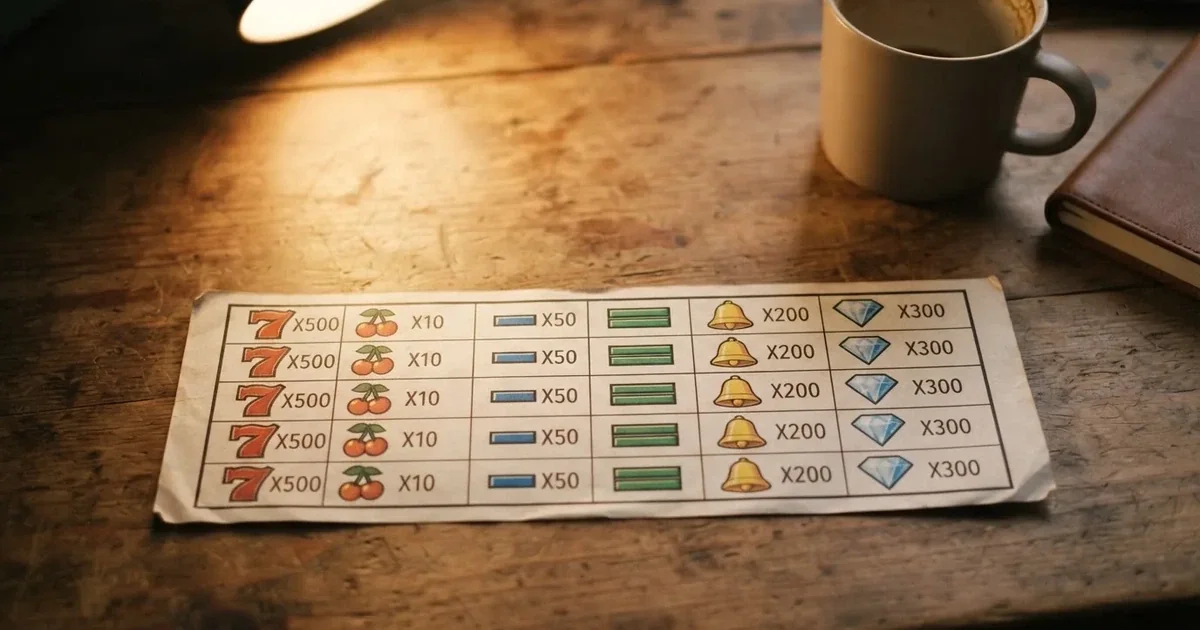
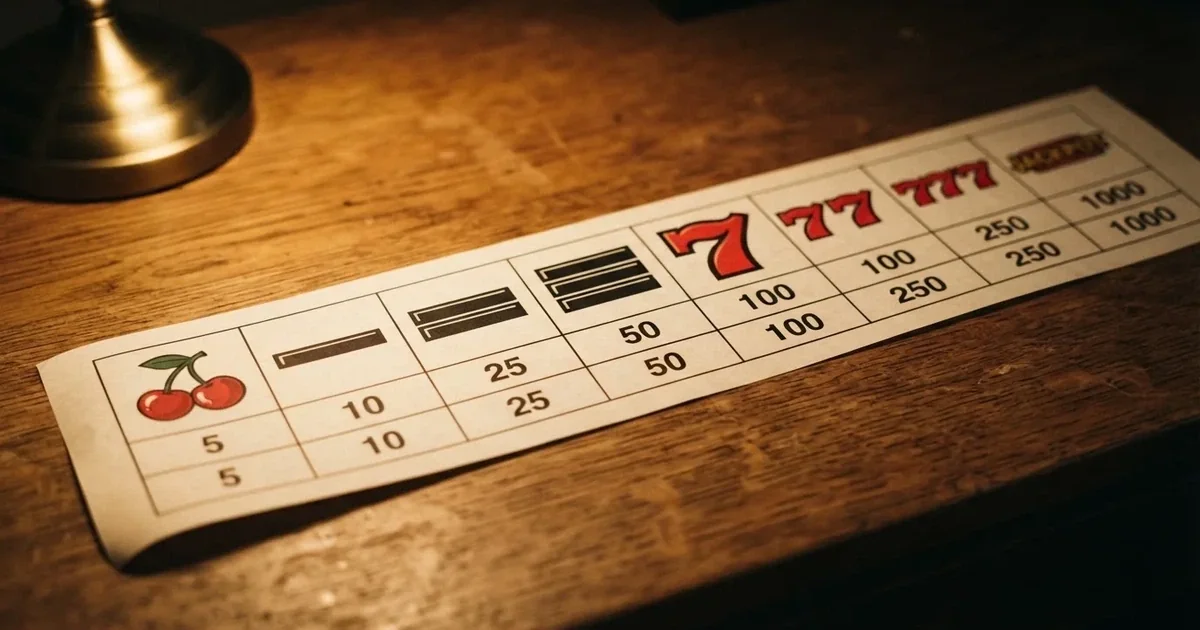
A paytable on a classic three-reel machine lists each symbol and what three-of-a-kind pays. The format usually offers a single coin denomination, a single line, and a top jackpot that pays out only when the bet is maxed. There are no scatter symbols, no free-spin rounds, no expanding wilds. What looks simple on the screen is what was simple in the mechanism. Bally’s “Money Honey” in 1963 replaced the need for an attendant by introducing a bottomless hopper that could pay up to 500 coins automatically; the video slot followed in 1976, and the three-reel format drifted into a niche occupied by players who like the older feel and the smaller combinations. None of that changes how the game plays. The reels stop, the line is read, the machine either pays or it doesn’t.
The consequences for a player are practical. A three-reel slot’s hit frequency is higher than a five-reel video slot’s, but the line pays smaller amounts on average. Volatility is a description, not a number stamped on the cabinet, and the same machine can be hit by two different players in two completely different ways. Slot volatility is described — not measured — by the spread between small and large wins; a game that pays its top prize rarely is described as high volatility, one that pays often and small is described as low. Three-reel machines, with their thousand-or-so combinations, sit mostly in the low-to-medium band, but a high-volatility three-reel machine is not impossible — it is a function of the paytable, not the reel count. The distinction between reel count and volatility is the one the marketing copy most often blurs.
Why the format still turns up in Australian venues
New South Wales legalised slot machines in 1956. By 2010 Australia operated an estimated 97,103 gaming machines outside casinos — roughly five per cent of the adult population, a per-capita rate about five times that of the United States.

| Jurisdiction | Machine count | Reference date |
|---|---|---|
| New South Wales | 87,298 | June 2023 |
| Victoria | 26,380 | 2021–22 |
| Queensland | 21,122 | October 2023 |
| South Australia | 11,672 | September 2023 |
| ACT | 3,587 | November 2023 |
A non-trivial slice of those machines is three-reel format, particularly in older clubs and in regional venues where the cabinet footprint favours the simpler design. A player who walks into a pub in Parramatta or a club in Townsville is more likely to meet a three-reel machine than a player who walks into a Crown property, where the floor skews towards multi-reel video cabinets.
The format is not the same as the game. A three-reel online slot rendered in HTML is a software simulation of the mechanical machine, with the RNG deciding the outcome on each spin. The visible reels, the symbols and the payline are a presentation layer over the random number generator underneath. A three-reel machine on a casino floor is a physical device with mechanical or electromechanical reels. The paytable can be identical; the mechanism cannot be.
The legal frame, written plainly
Under the Interactive Gambling Act 2001, strengthened by the Interactive Gambling Amendment Act 2017, it is an offence to provide online casino games, online pokies or in-play betting to a person physically in Australia. No state or territory licenses online casino games. The only gambling licensable online is wagering on races and sport placed before the event, lotteries and keno — and in practice most online bookmakers are licensed in the Northern Territory through the Northern Territory Racing and Wagering Commission, which regulates 52 of them, including Sportsbet, Bet365 and Ladbrokes, and which meets once a month in Darwin with no full-time staff. Minimum age is 18.
Three-reel online slot play only exists on offshore sites operating outside Australian law. The site’s own licence — Curaçao, Anjouan, whatever the footer says — is a foreign jurisdiction’s permission to operate in that jurisdiction; it is not Australian permission to take Australian money. The Interactive Gambling Amendment (Gambling Reform) Bill 2026 passed Parliament on 19 August 2026, with its advertising and inducement measures commencing 1 January 2027 — law with a start date, not yet in force. The page written today still sits under the 2017 regime.
The consequence for an Australian who plays offshore is structural rather than criminal. The individual player is not prosecuted — the IGA targets the provider, not the customer. What the player loses is the Australian consumer-protection layer: no complaints body, no Australian recourse if a withdrawal is refused, no guarantee that the site will not simply vanish. The site can be blocked in Australia with a balance still sitting in the account. The slot keeps spinning on the server; the punter cannot reach it. That is the practical cost of playing on the wrong side of the rule.
What the ACMA has been doing — and at what rate
The Australian Communications and Media Authority is the enforcement arm. Its tools are formal warnings, written directions to internet service providers to block illegal sites, and investigations that can result in civil penalties. According to the ACMA’s own figures as reported in June 2026, 1,751 illegal gambling and affiliate marketing websites had been blocked since the first blocking request in November 2019, and more than 230 unlicensed gambling services had left the Australian market since enforcement was strengthened in 2017. In one round alone — reported on 26 June 2026 — the ACMA asked Australian ISPs to block 12 more sites: 7Signs, ChromaBet, Donbet, Duospin, Freshbet, Slots Gem, Jacks Club, Lucky Start, Pointsbetz, Spinrise, Vinyl Casino and Wildsino.
The blocking rate is the page’s own calculation. Take the running total at the snapshot date (1,751 blocked sites) and divide by the elapsed time from the first blocking request in November 2019 to the snapshot date in June 2026 — roughly 79 months. That gives an average blocking rate of about 22 sites per month over the full enforcement window, though the actual pace has accelerated: the 12-site round alone works out to a higher monthly rate if it is treated as one of several rounds in a typical year. The honest statement is that the ACMA has averaged in the low-twenties per month since enforcement began, with year-on-year volume that has stepped up since the 2017 amendments. That figure is the regulator’s actual pace, not the regulator’s stated target — and a player who assumes a site they found this morning will be reachable next month is making an assumption the data does not support.
The ACMA’s formal-warning register — published on acma.gov.au — names the operators and the dates. The warnings that matter for this page:
- March 2026: Pulsup Ltd over Rocketplay.
- May 2022: Dama N.V. covering six casino brands — Bambet, Dazard, Level Up, Rocketplay, Wild Tornado and Cobra Casinos.
- March 2025 and May 2025: Dama N.V. again, this time over Woo Casino and Spirit Casino.
- July 2025: Bamboo Media over Ignition Casino, and Consolutetish S.R.L. over National Casino and Bizzo Casino — the last of which had already been the subject of a 2022 warning to TechSolutions (CY) Group Limited and TechSolutions Group N.V.
- February 2025: EOD Code SRL over Instant Casino.
- April 2026: Ryker B.V. over Jackbit and CasinOK.
- April 2025: Sterplay Holding Ltd over Casino Intense.
- September 2022: Hollycorn N.V. over its Sky Crown and Blue Leo casino services.
Some of those names are familiar to Australian-facing affiliate marketing; some are not. The list is not a ranking — it is a record of the regulator’s own actions.
What enforcement looks like to a player
A formal warning is published; an ISP blocking request is issued; the site becomes unreachable on most Australian networks within hours. The balance the player had on the site does not come back automatically. Some operators pay out under pressure; many do not. The site’s terms usually allow the operator to void balances and close accounts if the site is blocked in a jurisdiction — and the operator’s jurisdiction, not the player’s, is what governs. A player who reads the offshore site’s terms after a block is in for a discouraging experience.
The 2025 report from H2 Gambling Capital estimates that Australians lose about A$3.9 billion a year to illegal gambling sites, and that the share of gambling going through legal channels fell from 74% in 2021 to 64%. The decline in the legal share is the figure the report flags. It is not a measure of who is playing more — it is a measure of where the money is going. The illegal market is, on the report’s numbers, roughly A$1.4 billion larger than it was four years earlier in proportional terms. The consequence lands on the player who loses money on an offshore site and then discovers the protections they assumed were there do not exist.
Responsible play — and the limits of what Australian tools can do
Free, confidential help is available around the clock. Gambling Help Online runs a 24/7 chat service, and the National Gambling Helpline — 1800 858 858 — is free from anywhere in Australia. The conversation is with a trained counsellor, not a regulator, and the service is built for the moment a player realises play has stopped being a choice.
BetStop, the National Self-Exclusion Register, has been live since August 2023. It binds Australian-licensed online and phone wagering services — a self-excluded punter cannot open a new account or place a bet with Sportsbet, Bet365, Ladbrokes or any of the other NT-licensed bookmakers during the exclusion period. It does not bind an offshore casino. The offshore site has no Australian registration to revoke and no Australian obligation to honour the exclusion. A punter who self-excludes and then opens an account with an offshore operator has self-excluded from the legal market and remains exposed to the illegal one. That limitation is structural, not an oversight.
The same logic applies to deposit limits. Credit cards, credit-related products and digital currency have been banned as payment for licensed online wagering since 11 June 2024, with penalties up to A$247,500 for operators that take them. Legal deposit routes for licensed wagering are debit card, bank transfer, PayID/Osko and BPAY. An offshore casino asking for a credit card or a crypto deposit is operating outside the Australian rules. The deposit limit is a regulatory floor, not a personal budget — a player who sets their own ceiling at the offshore site has set it on a site that owes them nothing if it changes its mind.
The tools work for the licensed market. The unlicensed market is the gap. The honest framing is that the help exists and is excellent for anyone whose play has gone to a place they did not intend; the protections stop at the border the offshore site does not respect.
What “3 reel bonus slots” and “free 3 reel slots with bonus” actually refer to
The search terms that turn up alongside “3 reel slots” — free 3 reel bonus slots, 3 reel bonus slots, free 3 reel slots with bonus — describe a specific sub-genre: three-reel-format slot machines with a bonus feature bolted on, usually a pick’em round or a small free-spin set triggered by a specific symbol combination. The reason they exist is that pure three-reel games, with no bonus round, can feel thin to a player used to five-reel video slots. The bonus round is the compromise. The reel count stays at three; the symbol set and paytable stay simple; a feature round adds the moment of suspense that the bare three-reel format lacks.
The offer structure for these games on offshore sites is the same offer structure as for any other online slot: a deposit match, free spins tied to a specific game, a no-deposit bonus, a cashback percentage. What the offer costs the player does not change because the reels are three rather than five. The wagering multiple on a deposit match is the same; the cap on free-spin winnings is the same; the game-weighting rule — slots count 100%, table games count 10% or 0% — is the same. The reel count is a presentation choice; the offer economics are the operator’s choice, and they are independent.
The fair-comparison frame for bonus offers on three-reel slots looks the same as for any other slot game. The comparison would weigh: the wagering multiple, the maximum cashout cap, the game-weighting rule, the expiry window on the bonus, the deposit-method restriction, the country restriction, and the maximum-bet rule during wagering. None of those change because the underlying game is a three-reel slot. The relevant page on this site is the one that describes each of those terms in detail; the comparison on this page is the short version.
The practical consequence is that any offer’s value sits in the terms, not the reel count. A 100% match up to A$200 with a 40-times wagering multiple is the same offer whether it is attached to a three-reel classic or a five-reel video slot. The reel count is the surface; the wagering multiple is the substance.
Where the three-reel format sits in the wider slot landscape
The three-reel format occupies a small but durable corner of the slot market. Its niche is the player who values the simpler math, the higher hit frequency, the smaller jackpots and the older feel. It is not the format a casino floor uses to advertise its biggest prizes. It is the format that pays small amounts often and reads as a steady, predictable game to the player holding the wallet.
The volatility band is mostly low-to-medium for three-reel machines, but the descriptor is about the paytable spread, not the reel count. A high-volatility three-reel machine exists: a paytable that pays A$0.10 for the lowest combination and A$500 for three bells, with most combinations paying nothing, has a wide spread. The reel count is irrelevant to that description. What the reel count does affect is the combination count — and at roughly a thousand combinations, a three-reel machine can never be as low-frequency as a five-reel machine with fifty symbols per reel and combinations in the hundreds of millions.
A useful comparison is the one between three-reel machines and table games. A baccarat Player bet carries a 1.24% house edge; a Banker bet 1.06%; a Tie bet 14.36%. A blackjack game played with optimal strategy under liberal Las Vegas Strip rules carries a house edge of about 0.28%; under Atlantic City rules about 0.43%. Craps offers Pass/Come at 1.41%, Don’t Pass/Don’t Come at 1.36% and Any Craps at 11.11%. A slot machine, three-reel or otherwise, does not publish a house edge in those terms — the equivalent figure is the gap between the game’s RTP and 100%, and it sits somewhere between the baccarat Player bet and the craps Any Craps bet, depending on the machine. The numbers are not directly comparable across game types because the slot’s RTP is averaged over millions of spins and a single session can sit anywhere within the distribution, but the order of magnitude is the same.
The consequence is that a player choosing between a three-reel slot and a blackjack table is choosing between formats with comparable house edges, not choosing between a “good” game and a “bad” one. The format’s reputation for being “looser” or “tighter” than table games is folklore. The math is what the math is.
The history that explains the format’s persistence
Charles Fey’s late-19th-century three-reel machine with five symbols is the lineage. Bally’s Money Honey in 1963 removed the attendant from the payout. Fortune Coin Co. released the first video slot in 1976. The five-reel video format took over the casino floor in the 1990s and 2000s, and the three-reel format shrank into its niche. Online, the three-reel format became a software simulation — a presentation choice for game designers, not a mechanical limitation. The format persists online because some players like it, not because the technology requires it. A modern game studio can build a three-reel slot in HTML5 in a week and release it on the same platform as a five-reel blockbuster. The reel count is a creative decision.
What the offshore sites the ACMA has warned actually offered
The following brands have each been the subject of an ACMA formal warning under the Interactive Gambling Act 2001 for offering prohibited online casino services to Australians. They are listed here because the regulator’s register names them, not because they are recommended. Each one operates outside Australian law. None of them offers a path of recourse an Australian player can act on.
| Brand | ACMA action and date | Operator named by the ACMA | Subject support |
|---|---|---|---|
| RocketPlay | March 2026 | Pulsup Ltd | — |
| Level Up Casino | May 2022 | Dama N.V. | listings-only |
| Woo Casino | March 2025 | Dama N.V. | — |
| Spirit Casino | May 2025 | Dama N.V. | — |
| National Casino | July 2025 | Consolutetish S.R.L. | listings-only |
| Bizzo Casino | July 2025 (and 2022 to TechSolutions) | Consolutetish S.R.L. | — |
| Ignition Casino | July 2025 | Bamboo Media | — |
| Instant Casino | February 2025 | EOD Code SRL | — |
| Jackbit | April 2026 | Ryker B.V. | — |
| Casino Intense | April 2025 | Sterplay Holding Ltd | listings-only |
| Sky Crown | September 2022 | Hollycorn N.V. | — |
A cell reading “—” carries no figure from research and is not a denial. The “listings-only” cells reflect what third-party listings report; the underlying operator’s own statements on its three-reel catalogue are not in the record and are not affirmed here. The table’s point is the regulator’s register, not a feature comparison.
RocketPlay
Two formal warnings sit on the ACMA’s record for RocketPlay — May 2022 against Dama N.V., and March 2026 against Pulsup Ltd over the .com.au variant of the brand. The earlier warning did not stop the brand from continuing to market to Australians under a new corporate wrapper; the later warning names the new operator. The pattern is a familiar one: an offshore brand receives a warning, the operator entity changes, and the brand name reappears under a fresh corporate letterhead. The site’s own licence is a foreign one; the ACMA’s action is an Australian one; they are two independent authorities operating in separate systems.
Level Up Casino
The May 2022 warning to Dama N.V. covered six casino brands, of which Level Up Casino was one. The warning was issued for offering prohibited interactive gambling services to Australian customers. The site’s licence, again, is a foreign one. The brand has remained visible on affiliate lists for Australian-facing marketing since the warning — the warning has no mechanism to remove the brand from third-party promotional pages.
Woo Casino
The March 2025 warning to Dama N.V. over Woo Casino is the same pattern as Level Up, with a different brand name. The brand continues to operate in jurisdictions where it holds a licence; its accessibility from Australia is the ACMA’s enforcement question, not its own.
Spirit Casino
The May 2025 warning to Dama N.V. over Spirit Casino names the same operator as Woo Casino and the original May 2022 set. The corporate grouping is the link — Dama N.V. has accumulated a portfolio of warnings across multiple brands over four years.
National Casino
The July 2025 warning to Consolutetish S.R.L. covered National Casino and Bizzo Casino in the same formal action. Consolutetish S.R.L. is a different corporate entity from Dama N.V., and the warning is the regulator’s first published action against the operator; the brand itself has been visible on affiliate lists for Australian-facing marketing for several years.
Bizzo Casino
Bizzo Casino carries two ACMA warnings: a 2022 warning to TechSolutions (CY) Group Limited and TechSolutions Group N.V., and a July 2025 warning to Consolutetish S.R.L. The corporate history of the brand has changed hands, and the regulator’s register tracks each change with a separate entry.
Ignition Casino
The July 2025 warning to Bamboo Media over Ignition Casino names a different operator again. Ignition has been one of the longer-running brands visible on affiliate lists for Australian-facing marketing. The warning’s effect on its accessibility from Australia is the ACMA’s enforcement question.
Instant Casino
The February 2025 warning to EOD Code SRL over Instant Casino is the second of the year’s warnings to land on a brand relatively new to the Australian-facing affiliate list. The brand holds a foreign licence, which has no standing under Australian law.
Jackbit
The April 2026 warning to Ryker B.V. covered Jackbit and CasinOK in the same formal action. Jackbit has been visible on Australian-facing affiliate lists; the warning names the operator and the date and leaves the question of continued accessibility to the ACMA’s blocking process.
Casino Intense
The April 2025 warning to Sterplay Holding Ltd over Casino Intense is the seventh distinct operator named in the ACMA’s published register across the period covered by this page. The brand has carried its foreign licence through the warning; that permission has no Australian equivalent.
Sky Crown
The September 2022 warning to Hollycorn N.V. covered Sky Crown and Blue Leo. Sky Crown is the older of the two brands; Blue Leo is the newer. The corporate grouping has accumulated other Australian-facing brands since the warning.
What this list is and is not
The list is a regulator’s record. It is not a quality ranking, an offer comparison, a fairness assessment or a recommendation. The single fact each entry carries is that the ACMA itself named the brand and the operator and the date on its formal-warning register. Nothing on the list is harder to find than the regulator’s own publication; nothing on the list says anything about the games the brand offers beyond what the regulator’s reason for the warning already established — that the brand offered prohibited online casino services to Australians.
How to read a three-reel paytable, briefly
The paytable on a three-reel slot lists each symbol and the payout for three-of-a-kind on the active line. The first row is usually the top-paying symbol — the Liberty Bell in the original, the Lucky 7 or the bar symbol in most modern variants. The middle rows list the mid-payout symbols; the bottom row lists the lowest-paying symbol and the payout for one or two of that symbol on the line (which is usually a small consolation or a zero return). Some three-reel slots offer a “nudge” or “hold” feature, where the player can hold one or two reels in place and re-spin the others; the paytable usually notes the availability of that feature.
A paytable also lists the maximum payout and any jackpot conditions. On a classic three-reel slot, the top payout is usually achieved only when the bet is maxed — three credits, not one or two. A player who bets one credit per spin is paying for access to the lower half of the paytable and missing the top payout entirely. The consequence is that the effective RTP on a single-credit bet is lower than the headline RTP — and the gap can be material, particularly on older machines. A modern three-reel online slot usually pays the same amount regardless of bet size, but a player who finds themselves on a machine with a credit-multiplier jackpot is dealing with an older design and should read the paytable before they sit down.
The paytable does not list the house edge. The figure equivalent to a house edge on a slot is the gap between the game’s long-run RTP and 100%, and it is usually in the 2–10% range for a typical three-reel slot. The exact figure is rarely published on the cabinet and is not published on most offshore sites. A player who needs the number is reading a slot review rather than the paytable; the paytable gives the shape of the payouts, not their frequency.
What a fair comparison of three-reel slots would weigh
A comparison that treats reel count as a feature is comparing the wrong thing. A fair comparison of three-reel slot games — playable on a licensed Australian venue floor or simulated online — would weigh: the RTP (where published), the volatility descriptor, the paytable structure, the bonus feature availability, the line configuration, the bet range, and the max payout. None of those features is determined by the reel count alone. The reel count is one feature among many.
What the comparison cannot weigh, on a page like this, is the operator behind the offshore version of the game. The operator’s licence is a foreign jurisdiction’s; the operator’s withdrawal reliability is unknown; the operator’s responsiveness to a complaint is unknown; the operator’s terms can change. The game on the licensed club floor in Parramatta and the same game on the offshore site are the same game mathematically; the experience around the game is different. A player who weighs only the game’s features is comparing on half the criteria that matter.
Where this leaves an Australian player in 2026
The three-reel slot is alive in Australian venues — over 97,000 machines outside casinos at last count, with a meaningful share in three-reel format. The same game online sits on offshore sites that operate outside Australian law. The ACMA has named eleven of those sites in formal warnings since 2022, and the regulator’s blocking pace has averaged in the low twenties of sites per month since enforcement began. The blocking rate means a site an Australian finds today may be unreachable next month. The deposit rules that bind licensed bookmakers — no credit cards, no crypto, no in-play betting — do not bind the offshore casino; the protections the player assumes they have at the licensed bookmaker do not exist at the offshore casino.
The honest summary is that the three-reel format itself is not the problem. The problem is the gap between the game’s availability and the regulator’s reach. The game plays the same way mechanically; the operator behind the online version sits outside the rules the player assumes apply. A punter who wants to play three-reel slots in 2026 has the licensed Australian venues, with their protections and their limits, and the offshore sites, with their own rules and no Australian recourse. The arithmetic of the regulator’s blocking rate is one of the things the punter should weigh alongside the paytable.
Frequently asked questions
What makes a 3-reel slot different from a five-reel video slot?
A three-reel slot has three vertical reels, a small number of symbols per reel, and usually one or a handful of paylines. A five-reel video slot has five reels, often fifty-plus symbols per reel, and multiple paylines — frequently dozens. The combination count on a three-reel machine is roughly a thousand; on a five-reel video slot it can run into hundreds of millions. That ratio is the entire functional difference.
Can 3-reel slot machines be found in licensed Australian pubs and clubs?
Yes. Australia operated an estimated 97,103 gaming machines outside casinos as of 2010, with NSW alone carrying 87,298 machines at June 2023. A meaningful share of those machines is three-reel format, particularly in older venues and regional locations. The format is alive on the licensed Australian floor.
Do 3-reel slots typically pay out differently than five-reel formats?
The hit frequency is higher on a three-reel machine because there are fewer combinations to miss, but the individual line payouts tend to be smaller. The volatility descriptor — low, medium or high — is a description of the paytable spread, not the reel count. A three-reel machine with a wide spread between the lowest and highest payout is high-volatility regardless of the reel count.
Is a 3-reel slot online the same game as a 3-reel machine on a casino floor?
The paytable can be identical and the visual presentation can be the same, but the mechanism underneath is different. A casino-floor three-reel machine is a physical or electromechanical device. An online three-reel slot is a software simulation of that device, with the outcome decided by a random number generator. The game you play feels the same; the device you play it on is not.
Are 3-reel slots for real money available legally from an Australian-based site?
No. The Interactive Gambling Act 2001, as strengthened in 2017, prohibits the provision of online casino games — including three-reel online slots — to a person in Australia. No state or territory licenses online casino games. Online three-reel slots for real money only exist on offshore sites operating outside Australian law. The Australian-licensed online wagering market covers racing, sport, lotteries and keno; it does not cover casino games.
Do reel count and paytable structure affect how a slot’s volatility is described?
The reel count affects the combination count, but volatility is a description of the paytable spread — the gap between the smallest and largest payout and how often each is hit. A three-reel machine with a small spread and frequent payouts is low-volatility; one with a wide spread and rare top payouts is high-volatility. The reel count alone does not determine the descriptor.
Written by the editors at Casino Ratings Info.