
Casino dice games in Australia: house edges, the IGA prohibition and what the ACMA has done
Data current as of 28 October 2026, verified against the Australian Communications and Media Authority’s published register of formal warnings and blocking actions.
Table of Contents
- What a casino dice game actually is
- The two dice games that matter on a real casino floor
- House edge across the games a player actually meets
- Why the layout matters more than the dice
- Right bettors and wrong bettors in craps
- How the blocking rate has built up since 2019
- Where the offshore sites the ACMA has named sit in the picture
- ACMA action across the eleven brands at a glance
- What the prohibition actually covers
- How the ACMA enforces it
- Player protection that exists only on licensed wagering
- Payments an Australian-facing site should not be asking for
- Tax status of gambling winnings
- Two-up as the Australian coin-toss exception
- Baccarat and blackjack under the same approvals regime
- What an offshore dice game actually costs the player
- What the page is not for
- What the 2026 reform changes
- Where this leaves a reader
- Frequently asked questions
What a casino dice game actually is
A casino dice game is any table game whose outcome is decided by the throw of one or more dice, wagered against the house. The form most Australians would recognise is craps, played on a long felt table with two six-sided dice and a stickman calling the result, but the category stretches further than that. Sic bo uses three dice and a layout of betting options, baccarat is dealt from a shoe of cards, and blackjack is dealt from cards — neither is a dice game in the strict sense, though both sit on the same casino floor and are governed by the same approvals process as dice tables. Two-up, a coin-tossing game played with two coins, falls outside the dice category altogether but is governed under the same casino licensing regime when it appears on a licensed floor.
The reason house edge matters more than the choice of game comes from a single observation: craps, sic bo and the related table games on the same floor all run at different edges depending on which bet the player makes. The same dice, the same dealer, the same table — and a difference of nearly ten percentage points between one bet and another on the felt in front of the player. That is the feature of casino dice games that rewards the player who reads the layout, and it is the feature the marketing language around offshore dice products never mentions.
The two dice games that matter on a real casino floor
Craps is the better-known of the two. Two dice are rolled on each throw. Players bet on the result: a “Pass Line” bet wins on a come-out roll of 7 or 11 and loses on 2, 3 or 12, with other totals establishing a “point” that must be rolled again before a 7 for the bet to win. A “Don’t Pass” bet is the mirror, betting against the shooter. Both are multi-roll bets because of the point phase, and both sit below 1.5 per cent against the player. The contrast is the one-roll bets that look attractive at the table: Any Craps, hard-way hops, single-roll tallies on 2 or 12. These are paid out at much higher odds, because they hit much less often than the multi-roll bets, and the house edge on Any Craps is roughly eleven per cent.
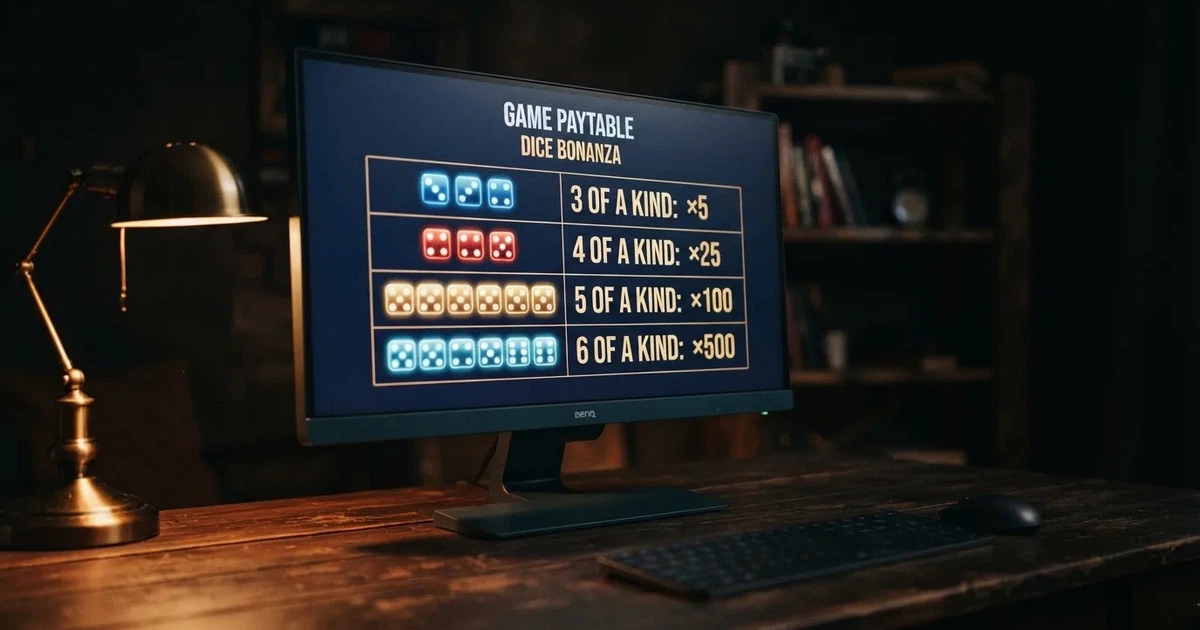
Sic bo is older. The name translates from Chinese as “precious dice,” and the game was brought to the United States by Chinese immigrants in the early twentieth century. Three dice are shaken in a small chest and revealed after the lid comes off. The layout offers wagers on the total of the three dice, on triples and on specific combinations; of the 216 equally likely outcomes, 56 are distinguishable. The simplest wagers — Big and Small, betting that the total will fall above or below a middle band — sit at around 2.78 per cent. Specific Triple wagers, which pay out at 180 to 1, run at much steeper edges depending on the ruleset.
Both games are part of the table-game offering at the licensed Australian casino floors, alongside baccarat and blackjack. They are not, under any reading of the Interactive Gambling Act 2001, available as an online product to a person in Australia. The distinction between what is on the felt at Crown Melbourne and what can be advertised offshore is the line that runs through the rest of this page.
House edge across the games a player actually meets
A house edge is the percentage of every dollar wagered that the casino keeps, on average, across a large number of rounds. The numbers that follow are from the Wizard of Odds house-edge tables, which compile reported rules and payouts for each game; they describe what the table pays back, not what any individual hand will return.

Craps anchors the low end. The Pass Line and Come bets sit at 1.41 per cent. Don’t Pass and Don’t Come, betting against the shooter rather than with, run at 1.36 per cent — slightly lower because the rules of the bet push one tie outcome toward the player rather than the house. Both are wagers that survive across multiple rolls because of the point phase. The steep edges at the same table are the one-roll bets: Any Craps at 11.11 per cent, hop bets and the proposition bets in the centre of the layout that pay 30 to 1 and worse. The size of the spread — from below 1.5 per cent to over 11 per cent on the same dice and the same dealer — is why the choice of bet matters more than the choice of game.
Sic bo, with three dice and a wider payout ladder, sits higher on average. Big and Small at 2.78 per cent. Specific Triple bets range from roughly 11.6 per cent to above 30 per cent depending on the ruleset, because the payout at 180 to 1 is below the true odds of 216 to 1. A player who treats sic bo as a “one bet at a time” game and stays on Big and Small loses less than one who chases triples.
Baccarat, dealt from cards rather than dice, sits on the same casino floor and offers the cleanest single-number contrast at a table. The Banker bet runs at 1.06 per cent, the Player bet at 1.24 per cent and the Tie bet at 14.36 per cent. The Tie pays 8 to 1, which sounds generous against the Player and Banker wagers that pay even money — and is the reason the house edge sits where it does. Punto banco, the variant on Australian floors, banks the game at all times and plays both hands by fixed drawing rules; the player does not draw.
Blackjack, dealt from cards, runs at lower edges than craps or sic bo under liberal rules. The Wizard of Odds calculation puts optimal strategy at about 0.28 per cent under liberal Las Vegas Strip rules — dealer stands on soft 17, double on any two cards, double after split, resplit aces, late surrender — and at roughly 0.43 per cent under Atlantic City rules. The edges depend heavily on the rule set; a six-deck shoe with the dealer hitting soft 17 is materially worse for the player than the same shoe with the dealer standing.
The takeaway across these four games: on the same casino floor, on the same night, the difference between the cheapest bet and the most expensive bet at a given table is bigger than the difference between the games themselves. The craps table is not cheaper than the blackjack table; the craps Pass Line bet is cheaper than the blackjack table under liberal rules, and the craps Any Craps bet is more expensive than almost anything else in the room.
Why the layout matters more than the dice
The mechanics of craps produce a particular kind of trap for a new player. The centre of the layout — where the stickman stands — advertises the highest payouts. Hard-way bets, single-roll bets and the seven proposition pay 30 to 1, 30 to 1 and 4 to 1 respectively. They look like the centre of the game because they are placed in the centre of the felt, and they are the worst bets on the table because the payouts do not match the odds. A player who learns craps from the layout rather than from the rules walks away with the worst possible picture of the game.
The same pattern appears on the sic bo layout. The board is built around the high-payout single-roll bets — specific triples, specific doubles, total-of-X wagers — and the two simplest bets, Big and Small, are placed in the lower corners of the board. A player who reads the board in order from top to bottom sees the worst bets first.
This is not a flaw of the games. It is the games. Dice games are designed to give the house an edge that the player can avoid by reading the layout, and the games are designed to make the layout easier to misread than the edges are to remember. The edge a sharp player keeps is the edge the table keeps from the player who never reads the payouts.
Right bettors and wrong bettors in craps
The two camps at a craps table are betting with the shooter or against the shooter. A “right” bettor wagers on the Pass Line and Come bets, winning when the shooter makes the point. A “wrong” bettor wagers on Don’t Pass and Don’t Come, winning when the shooter sevens out before making the point. Both camps place the same kinds of bets in mirror form, and both sit below 1.5 per cent against the player.
The mirror is not symmetric in every respect. On the come-out roll, where no point has been established, the Don’t Pass bet loses to a 12 rather than pushes. That single rule gives the Don’t Pass bet its slightly lower edge of 1.36 per cent against the Pass Line’s 1.41 per cent. A wrong bettor is also betting against every other player at the table, which is a social reality the game does not advertise but the table enforces: at a full craps table, the right bettors are a community and the wrong bettor is on the other side.
The mechanics matter less than the choice. A player who decides between right and wrong on any given night is choosing a bet with an edge below 1.5 per cent either way. The two-decimal-point difference between Pass and Don’t Pass is real but small. The choice between either and the Any Craps bet in the centre of the layout is the choice that decides what kind of night the table delivers.
How the blocking rate has built up since 2019
The ACMA’s enforcement tool against illegal offshore gambling sites is the blocking request, sent to Australian internet service providers under section 313 of the Telecommunications Act 1997. The first request was issued in November 2019; by June 2026, the running total of blocked sites and affiliate marketing pages sat at 1,751. More than 230 unlicensed gambling services had left the Australian market entirely since enforcement was strengthened in 2017 — some after a blocking request, others after a formal warning, others after a quiet decision that the cost of serving Australian customers was no longer worth it.
The arithmetic the page can offer is a band rather than a single number, because the count includes affiliate marketing pages as well as gambling sites and the running total is reported by the ACMA rather than calculated from a transparent list. Taking the published endpoints — 1 blocked site in November 2019, 1,751 in June 2026, 81 months apart — the rate of additions works out to roughly 21 sites blocked per month over the period as a whole, with the rate higher in the years since 2023 than it was in the first years of the regime. A site blocked one month may be replaced by an unrelated domain the next, and the running total counts each separately. The band this leaves the reader is: somewhere between fifteen and twenty-five new entries per month, on average, with the recent rate sitting closer to the upper end.
This is not a measure of how many Australians play at illegal sites. It is a measure of how many illegal sites the regulator has been able to put behind an Australian internet provider. A site blocked once can reappear under a new name; a site the ACMA never names in a blocking request because it does not need to be blocked is not counted at all.
Where the offshore sites the ACMA has named sit in the picture
Eleven brands appear in the operator cards below. Each one has been the subject of a formal warning from the ACMA for offering prohibited interactive gambling services to Australians — online casino games, online pokies or in-play betting. The list is not a recommendation; it is the ACMA’s own record, and the page describes what the warning means rather than what the brand offers.
The brands overlap heavily on the same operator groups. Dama N.V. has been warned over Rocketplay, Level Up, Woo Casino, Spirit Casino and four other brands across separate rounds since 2022. Consolutetish S.R.L. was warned in 2025 over National Casino and Bizzo Casino; Bizzo had already been the subject of a 2022 warning to TechSolutions Group N.V. Hollycorn N.V. has been warned over Sky Crown and Blue Leo. The pattern across these names is the same offshore operator group running dozens of brands under different licences, all of them advertising to Australian players in breach of the IGA, and the ACMA working through the group one warning at a time.
A formal warning is not a fine and is not a prosecution. It is a notice, published on the ACMA website, that the operator has been found offering prohibited services and that further action — civil penalty proceedings, referral to the Australian Federal Police, further blocking requests — may follow. A site that has been warned once and continues to accept Australian players is now operating in the open after a published notice, which is a different posture from a site that has never been contacted.
RocketPlay
RocketPlay was warned twice. Pulsup Ltd received a formal warning over RocketPlay in March 2026. The same brand had been the subject of an earlier warning to Dama N.V. in May 2022, alongside five other Dama brands. The site displays a Curaçao licence in its footer and accepts Australian players through that licence; the ACMA’s position is that no offshore licence authorises the supply of prohibited interactive gambling services to a person in Australia.
The site’s claim that it operates under a recognised gaming jurisdiction does not change what is on offer. Online casino games and online pokies cannot be licensed in Australia under the IGA, and an offshore licence does not bridge that gap. The brand has now been warned under two operator groups and continues to advertise to Australian customers, which is the open-and-continued posture described above.
Level Up Casino
Level Up Casino was the subject of the May 2022 warning to Dama N.V. alongside Bambet, Dazard, Rocketplay, Wild Tornado and Cobra Casinos. The site’s own marketing references BGaming content, which the BGaming listings name as a software provider used by the brand; that is a listings claim and not a statement by the ACMA. The brand’s status under the IGA is the same as every other operator on this list: online casino games cannot be licensed in Australia, and the ACMA has published a formal warning over the brand.
Woo Casino
Woo Casino was the subject of a further formal warning to Dama N.V. in March 2025, the third round of ACMA action against the same operator group. The pattern is the same: a Curaçao-licensed brand, a published warning, no Australian licence available. A player considering the brand after the warning is choosing a site that the ACMA has named in writing for offering prohibited services to Australians.
Spirit Casino
Spirit Casino drew the May 2025 warning to Dama N.V., the fourth round of action against the same group. The site has no separate operator entity from the other Dama brands; the same group runs the brand under a different name and a different licence, and the ACMA has published the warning by brand name.
National Casino
National Casino was the subject of the July 2025 warning to Consolutetish S.R.L. alongside Bizzo Casino. The site is described in Wikipedia listings as a casino with a particular game catalogue; that is a listings claim rather than a confirmation by the ACMA. The brand has been named in a published warning, which puts it in the same posture as the rest of the list.
Bizzo Casino
Bizzo was the subject of the July 2025 warning to Consolutetish S.R.L. and had previously been named in the 2022 warning to TechSolutions (CY) Group Limited and TechSolutions Group N.V. Two warnings, two different operator groups, the same brand — and the brand continues to be advertised to Australian customers under both operator shells.
Ignition Casino
Ignition Casino was the subject of the July 2025 warning to Bamboo Media, alongside other Bamboo Media brands. The site is the offshore-facing counterpart to a brand of the same name that operates under a different licence in other markets, but the ACMA’s warning is over the Australian-facing service: the same name, a different legal entity, the same IGA breach.
Instant Casino
Instant Casino was the subject of the February 2025 warning to EOD Code SRL. The site is among the more heavily marketed offshore brands in the Australian market and has been the subject of a single published warning to date. A single warning is not the same as a resolved matter; the ACMA names the operator in a warning because further action is contemplated.
Jackbit
Jackbit was the subject of the April 2026 warning to Ryker B.V., alongside CasinOK. Ryker B.V. is the operator group running the brand, and the warning is the first published ACMA action against that group. The brand is one of the more recent additions to the offshore brands actively targeting Australian customers.
Casino Intense
Casino Intense was the subject of the April 2025 warning to Sterplay Holding Ltd. The site’s history includes references in Australian media coverage of the offshore market, and the ACMA’s formal warning is the regulator’s own published action. The brand operates under an offshore licence and has no Australian authorisation; the warning is the published fact.
Sky Crown
Sky Crown was the subject of the formal warning to Hollycorn N.V., published in September 2022, alongside Blue Leo casino. Hollycorn is one of the larger operator groups in the offshore market, and the warning is the published ACMA action against that group over the Sky Crown brand.
ACMA action across the eleven brands at a glance
The table below sets out the ACMA action against each of the eleven brands in the order they appear above. The “operator named by the ACMA” column records the corporate entity the warning was published against, not the brand. The “subject support” column records what the available listings say about casino dice game coverage on each brand, where the research notes a listing source.
| Brand | ACMA action and date | Operator named by the ACMA | Subject support |
|---|---|---|---|
| RocketPlay | Formal warning, March 2026; earlier warning May 2022 | Pulsup Ltd (2026); Dama N.V. (2022) | — |
| Level Up Casino | Formal warning, May 2022 | Dama N.V. | BGaming (listings only) |
| Woo Casino | Formal warning, March 2025 | Dama N.V. | — |
| Spirit Casino | Formal warning, May 2025 | Dama N.V. | — |
| National Casino | Formal warning, July 2025 | Consolutetish S.R.L. | Wikipedia listings only |
| Bizzo Casino | Formal warning, July 2025; earlier 2022 | Consolutetish S.R.L. (2025); TechSolutions (2022) | — |
| Ignition Casino | Formal warning, July 2025 | Bamboo Media | — |
| Instant Casino | Formal warning, February 2025 | EOD Code SRL | — |
| Jackbit | Formal warning, April 2026 | Ryker B.V. | — |
| Casino Intense | Formal warning, April 2025 | Sterplay Holding Ltd | Listings only |
| Sky Crown | Formal warning, September 2022 | Hollycorn N.V. | — |
The — marker in the subject support column means that no listing source for casino dice game coverage was found in the research. Where a listing source is named, the cell reflects what that listing reports and not the operator’s own claim about its catalogue. The pattern across the table is consistent: the ACMA has named the brand in a formal warning, and the brand’s own status as an Australian-facing casino is unchanged by any offshore licence it displays.
What the prohibition actually covers
The Interactive Gambling Act 2001 makes it an offence to provide online casino games — which includes dice games such as craps and sic bo, table games such as baccarat and blackjack, and slots — to a person in Australia. The 2017 amendments closed the “click-to-cancel” loophole that had allowed some operators to argue their service was not “provided” to Australians. Since the amendments, providing an interactive gambling service to a person physically in Australia is the offence, and the question is where the player is, not where the server is.
The IGA does not prohibit wagering on racing or sport placed before the event, lotteries and keno. Those products are licensable in Australia and are licensed in practice through the Northern Territory Racing and Wagering Commission, which regulates fifty-two online bookmakers — including Sportsbet, Bet365 and Ladbrokes — from a commission that meets once a month in Darwin and has no full-time staff. The bookmakers are licensed in the Territory for tax reasons, but they offer only wagering products and not casino games.
The player is not prosecuted under the IGA. The offence is the provider’s. A person in Australia can place a bet at an offshore casino site without committing an offence themselves, although the site is operating illegally to accept the bet. The consequence for the player is the absence of consumer protection: an offshore site gives no Australian complaints body, no recourse if a withdrawal is refused, and the site can be blocked by an ISP with a balance still sitting on it. A blocked site is not obliged to return balances.
How the ACMA enforces it
Three tools. Formal warnings, published on the ACMA website, naming the operator and the breach. Blocking requests, sent to Australian ISPs under section 313 of the Telecommunications Act, asking the ISP to make the named domain unreachable for Australian customers. Civil penalty proceedings in the Federal Court, brought against operators who continue to offer prohibited services after a warning.
In a single round reported in June 2026, the ACMA asked ISPs to block twelve further sites: 7Signs, ChromaBet, Donbet, Duospin, Freshbet, Slots Gem, Jacks Club, Lucky Start, Pointsbetz, Spinrise, Vinyl Casino and Wildsino. The cumulative count of blocked sites and affiliate marketing pages reached 1,751 by the same report. A site blocked once can reappear under a new name; a site the ACMA names in a blocking request is one the regulator has decided is operating in breach of the IGA and is worth the cost of a request to the ISPs.
H2 Gambling Capital’s 2025 report estimates that Australians lose about A$3.9 billion a year to illegal offshore gambling sites. The same report puts the share of gambling going through legal Australian channels at 64 per cent, down from 74 per cent in 2021. The trend is a fall in the legal share — not because legal wagering has shrunk but because the illegal market has grown.
Player protection that exists only on licensed wagering
BetStop, the National Self-Exclusion Register, has been live since August 2023. It binds Australian-licensed online and phone wagering services — the licensed bookmakers, not the offshore casinos. A punter who registers with BetStop is excluded from every Australian-licensed wagering site at once, and the exclusion applies across operators rather than one site at a time. The register does not reach an offshore casino. A person who self-excludes through BetStop can still open an account at an offshore site, and the offshore site will accept the bet because the register has no jurisdiction over it.
The National Gambling Helpline is 1800 858 858, free, twenty-four hours a day, with web chat at Gambling Help Online. The helpline is the same regardless of whether the gambling is legal or illegal, and it is the appropriate first call for a punter who needs to talk about what is happening with their gambling. State-level services — Gambler’s Help in Victoria, Gambling Help in NSW, Gambling Help Queensland and the equivalent in each other state and territory — are reachable through the same national number.
State-level self-exclusion registers operate separately from BetStop. A person excluded from a Crown casino floor in Melbourne is excluded from that floor under the casino’s own arrangements and from the other state-regulated casino floors under the corresponding state scheme; an offshore site has no connection to either.
Payments an Australian-facing site should not be asking for
The payment rules under the IGA and the 2024 amendments: credit cards, credit-related products and digital currency are banned as payment for licensed online wagering since 11 June 2024. Penalties for licensed operators that breach the rule run up to A$247,500. The legal deposit routes for licensed wagering are debit card, bank transfer, PayID/Osko and BPAY. A site asking an Australian customer for a credit card deposit or a crypto deposit is operating outside the Australian rules, which is consistent with operating outside the IGA altogether.
The credit-card ban applies to licensed wagering. An offshore casino accepting a credit card deposit from an Australian customer is in breach of the ban if it is also licensed in Australia, and is simply outside Australian jurisdiction if it is not. The practical effect for the player is the same: the credit card was used to fund an unregulated gambling transaction with no Australian consumer protection.
Tax status of gambling winnings
Gambling winnings of a recreational player are not assessable income in Australia, under section 6-5 of the Income Tax Assessment Act 1997, and gambling losses are not deductible. A punter who wins A$5,000 on a craps session at Crown Melbourne does not declare it as income. A punter who loses A$5,000 does not claim it as a deduction. The position changes if the ATO finds that the person is carrying on a business of gambling — professional poker players, advantage-play sports bettors — in which case the income and expenses are assessable like any other business. The general position for a recreational player at a casino is that tax is not part of the picture.
Two-up as the Australian coin-toss exception
Two-up is not a dice game. It is played with two coins, tossed by a “spinner” while bets are called by “kipper” and the ring is fenced off by onlookers. The game evolved from the eighteenth-century English and Irish game “cross and pile” and was brought to Australia by convicts. It is illegal in Australia outside specific exceptions. New South Wales permits it on Anzac Day under the Gambling (Two-Up) Act 1998, played in RSL clubs and hotels. Kalgoorlie in Western Australia hosts Australia’s only year-round legal two-up school. Crown Perth and Crown Melbourne are the only licensed Australian casinos where two-up is offered, both since legalisation in Australian casinos began at Hobart’s casino in 1973.
Two-up is mentioned here because it sits on the same casino floor as craps, sic bo and baccarat under the same approvals process, and because the ACMA’s interest in dice and coin-toss games is the same: a casino game offered online to an Australian is a prohibited service. Two-up is not offered online anywhere in Australia for the same reason craps is not.
Baccarat and blackjack under the same approvals regime
Baccarat on the Crown Melbourne floor comes in three approved variants: Traditional Baccarat, Crown Baccarat and 2 to 1 Baccarat. The variants are approved under the Victorian Casino Control Act 1991 by the Victorian Gambling and Casino Control Commission (VGCCC), which replaced the VCGLR as Victoria’s casino regulator on 1 July 2022. The NSW Casino Control Act 1992 carries the parallel requirement: a casino operator must not permit a game such as baccarat to be played unless the regulator has approved the game and its rules, and the operator must make a copy of the approved rules available to patrons on request.
Blackjack on the same floor runs under the same approvals regime. The VGCCC’s public log of approved changes to Crown Melbourne’s blackjack variants includes renaming the “Perfect Pairs” side bet to “Crown Pairs” on 23 December 2024 and introducing a “Free Bet” option with a new “Pot of Gold” side bet on 25 March 2024. Each change required regulator approval before it could be introduced on the floor. The same approval process applies to craps and sic bo variants when a casino applies to change a rule.
These are the rules that govern what is on the felt at a licensed Australian casino floor. They are not the rules that govern what an offshore site advertises to Australians under a Curaçao or Anjouan licence. The offshore site has no approval requirement because it is not licensed in Australia. The licensed Australian floor has an approval requirement because it is.
What an offshore dice game actually costs the player
Three layers of cost stack up at an offshore dice site, beyond the house edge of the bet itself.
The first is the withdrawal layer. A withdrawal request sits with an offshore operator that has no Australian complaints body to escalate to. A site that declines a withdrawal, or applies a maximum cashout clause, or asks for additional verification at the moment of payout, can do so with the player having no recourse. A blocked site with an unpaid balance is the same position without the chance to argue the point.
The second is the rule layer. Offshore sites operate under their own house rules, which can include maximum bet sizes while a bonus is active, country-based exclusions from certain games, and wagering requirements on bonuses that the player does not see until the withdrawal is requested. A craps table offered under an offshore ruleset may run with edges different from the published Wizard of Odds numbers; the published numbers describe the game as it is played at Australian and US licensed floors, and the offshore site can amend payouts within the licence it holds.
The third is the regulatory layer. A balance held at an offshore site is held outside Australian jurisdiction. The site can be blocked with the balance on it, and the player has no claim under Australian consumer law. A licence displayed in the footer of the site is a licence to operate in the jurisdiction that issued it, not a guarantee of access to Australian players. The ACMA warnings over the eleven brands in this page are the regulator’s own statement that those sites are offering prohibited services to Australians, regardless of what their footers say.
What the page is not for
This is not a recommendation of where to play. Every brand named below is on the page because the ACMA has published a formal warning over it for offering prohibited interactive gambling services to Australians. The page describes what the warnings mean and what they cost the reader; it does not direct the reader to any site.
The page is also not a guide to the offshore market. The brands listed are the brands the ACMA has named in published formal warnings. Other offshore brands accept Australian customers without having been the subject of a formal warning yet, and the absence of a brand from the list below is not a clean bill of health.
A player who wants to play craps, sic bo, baccarat or blackjack at a real casino table in Australia is looking at a Crown Melbourne table, a Crown Perth table, a Star Sydney table, a SkyCity Adelaide table or the equivalent in the other state-regulated venues. The licensed Australian casino floor is the only place the IGA permits these games to be played.
What the 2026 reform changes
The Interactive Gambling Amendment (Gambling Reform) Bill 2026 passed Parliament on 19 August 2026. Its advertising and inducement measures commence on 1 January 2027 — law with a start date, not yet in force on a page written for 2026. The amendments extend the ACMA’s enforcement reach over advertising that targets Australian customers, including social media promotions and offshore affiliate marketing, and they tighten the penalties for providers that continue to operate after a warning.
The amendments do not change the IGA’s prohibition on online casino games. The prohibition has been in place since 2001 and tightened in 2017. The 2026 reform tightens the enforcement of the existing prohibition; it does not introduce a new one.
Where this leaves a reader
A reader who came to this page for casino dice games in Australia has reached four conclusions.
The first is that craps and sic bo are real table games on licensed Australian casino floors, with house edges that depend on the bet chosen rather than the game played, and with payouts that favour the multi-roll bets over the one-roll centre-of-layout bets.
The second is that the same games are not available as an online product to a person in Australia under the Interactive Gambling Act 2001, and no offshore licence changes that. The eleven brands named by the ACMA in published formal warnings are operating in breach of the IGA, regardless of the licence each displays.
The third is that the ACMA’s enforcement is ongoing. The blocking request count has reached 1,751 sites and affiliate pages since November 2019, the rate of additions has risen since 2023, and the 2026 reform expands the ACMA’s reach over advertising from January 2027.
The fourth is that consumer protection — BetStop, the National Gambling Helpline, state self-exclusion registers, the VGCCC’s approval regime — applies to licensed Australian wagering and casino floors and not to offshore sites. The player protection that exists is the player protection the IGA permits, and the IGA permits it for licensed products only.
Frequently asked questions
What is the house edge on a Pass Line bet in craps?
The Pass Line and Come bets in craps carry a 1.41 per cent house edge, calculated across the full life of the bet including the come-out roll and any point phase. The Don’t Pass and Don’t Come bets, betting against the shooter, run at 1.36 per cent because a roll of 12 on the come-out is a loss rather than a tie. Both are multi-roll bets because the point phase can run for several throws before the bet is decided.
Why does the Any Craps one-roll bet carry a much higher house edge than Pass Line?
Any Craps pays 7 to 1 on a roll of 2, 3 or 12 and is decided on a single throw. The true odds of rolling any of those three results on two dice are 8 to 3 against, and the 7-to-1 payout is well below the true odds. The Pass Line bet, by contrast, runs across multiple rolls because of the point phase, and the payouts and rules are calibrated to the multi-roll structure. The difference is the difference between a payout matched to the odds and a payout that is not.
Are dice games like craps offered on licensed Australian casino floors?
Yes. Craps, sic bo and two-up are part of the table-game offering at licensed Australian casino floors, including Crown Melbourne, Crown Perth, Star Sydney and SkyCity Adelaide. Each game and its rules require approval from the state regulator — the VGCCC in Victoria, Liquor and Gaming NSW in New South Wales, the relevant authority in each other state — before it can be introduced on the floor. The licensed Australian casino floor is the only place these games can be played legally.
What’s the difference between a ‘right’ bettor and a ‘wrong’ bettor in craps?
A right bettor wagers with the shooter on the Pass Line and Come bets, winning when the shooter makes the point. A wrong bettor wagers against the shooter on the Don’t Pass and Don’t Come bets, winning when the shooter sevens out before making the point. The two bets run at slightly different edges because the Don’t Pass bet loses to a 12 on the come-out rather than pushes, which gives it the lower 1.36 per cent versus the Pass Line’s 1.41 per cent. Both bets are below 1.5 per cent against the player.
Can an online dice game legally be offered to someone based in Australia?
No. The Interactive Gambling Act 2001 makes it an offence to provide online casino games — including dice games such as craps and sic bo — to a person in Australia. The 2017 amendments closed the click-to-cancel loophole and the offence is now defined by where the player is, not where the server is. The individual player is not prosecuted under the IGA, but the provider is, and the player has no Australian consumer protection, no complaints body and no recourse if a withdrawal is refused.
Do all casino dice games use the same house-edge structure as craps?
No. Sic bo runs at higher edges on most of its layout than craps does on its cheapest bets — Big and Small at 2.78 per cent, Specific Triples from 11.6 per cent to over 30 per cent depending on the ruleset. The two games are both dice games but they sit on different payout ladders, and a player who treats them as interchangeable will run at a higher edge at the sic bo table than at the craps table on the simplest bets. The cheapest bet on a craps layout is cheaper than the cheapest bet on a sic bo layout.