
Casino sites that accept Skrill in Australia: what the offshore route really costs
Current as of 28 October 2026, against the Australian Communications and Media Authority’s public register of formal warnings and blocking actions. This page is written about an offshore product. Online casino games and online pokies cannot be licensed anywhere in Australia; that prohibition sits in the Interactive Gambling Act 2001 and is enforced by the ACMA, not by the operator. Skrill is a payment method, not a licence. It is also a payment method with its own fees, its own banking frictions and its own absence of consumer protection once the money leaves Australia.
The angle this page takes is straightforward. Offshore casinos market Skrill as a fast, anonymous way to move money in and out. It is fast. The anonymity stops the moment an Australian bank refuses the funding transaction, or the moment the ACMA tells an Australian ISP to block the site you have a balance on. The marketing never mentions those moments. This article does.
Table of Contents
- Responsible play comes before the deposit button
- How Skrill moves money, and where the friction actually sits
- How the brands on this list came to be on it
- Key Skrill fees for Australian punters
- How the blocking rate has compounded since 2019
- What Skrill’s own page says about Australian use
- The responsible-gaming shelf, restated where the wallet lives
- How the eleven brands compare on the page’s one axis
- What the rest of the offshore pitch sounds like, and where it falls down
- Choosing between the brands is not the right question
- The arithmetic of the cost the marketing skips
- The cost that does not fit on a cashier page
- Australian-licensed alternatives, and why they are not the same product
- A note on the language this page uses
- Frequently asked questions about Skrill at Australian casino sites
Responsible play comes before the deposit button
The offshore casino market is built around the moment before the first deposit. The responsible-gaming supports relevant to that moment are Australian, free and run by people who do not take a cut of your losses.
Gambling Help Online operates the National Gambling Helpline on 1800 858 858 — free, 24/7, with webchat at gamblinghelponline.org.au. The service is staffed by counsellors, not by account managers. The minimum age to use any Australian wagering service, licensed or otherwise, is 18.
BetStop, the National Self-Exclusion Register, went live in August 2023. Registering excludes you from every Australian-licensed online and phone wagering service at once. The catch for anyone considering an offshore site is that BetStop is not connected to those sites. Self-exclusion under BetStop does not reach an operator the ACMA has warned, blocked or asked to leave the market. A player who self-excludes and then moves offshore has not extended the exclusion; they have stepped outside it.
Australian state and territory self-exclusion registers behave the same way at the venue level. The Victorian Responsible Gambling Foundation, the NSW Liquor & Gaming self-exclusion orders, and similar schemes across other states bind the venue or licensed operator that signed up. An offshore casino is not a signatory.
This is the part the offshore marketing skips past. The supports exist and they are free. They are not joined up to the product the marketing is selling, and that gap is the first cost a player pays without realising it.
How Skrill moves money, and where the friction actually sits
Skrill began in 2001 as Moneybookers and is now a Paysafe subsidiary headquartered in London. Paysafe also owns Neteller and paysafecard, and is authorised by the UK Financial Conduct Authority as an Electronic Money Institution. Skrill’s Australian fee page, read on 18 September 2026, sets the schedule a punter actually pays: deposits funded by local Australian methods cost up to 5.00%, withdrawals cost between 2.00% and 3.00% with a minimum fee of EUR 3.50, and any currency conversion takes another 4.49%.
That fee page also states an inactivity service fee of EUR 5.00 (or the local-currency equivalent) per month, charged only when a customer has not logged in or transacted for six months. It warns that funding a gambling transaction with a credit card can trigger a “cash advance” fee from the card issuer — a charge entirely outside Skrill’s control, and a charge the punter discovers on their card statement rather than on Skrill’s.
There is a VIP structure. Silver, Gold and Diamond tiers cut Skrill’s standard 1.50% cryptocurrency-purchase fee to 1.40% for Silver and 1.30% for Gold or Diamond members. The tiers are paid for in volume, not in tenure. A player whose annual turnover through Skrill does not justify the higher tier pays the standard fee every time. A Skrill VIP membership does not confer a Skrill licence on the site the deposit eventually lands at.
The settlement speed marketing loves
The pitch is simple. Skrill deposits clear inside the casino’s wallet in seconds, often before the page reloads. Withdrawals back to Skrill are typically faster than withdrawals back to a bank.
The settlement speed is real. What sits underneath it is a payment-method architecture that splits the transaction in two. Money moves from the player’s bank or card into a Skrill account held at Paysafe in London. From there it moves to the casino’s merchant account, which is almost never in Australia. The “fast” part is the second leg. The first leg is where Australian banking friction lives.
Westpac’s gambling block works at card level. It refuses authorisation of transactions registered under the merchant category code “Betting/Casino Gambling” on eligible personal credit and debit cards. A funding attempt from a Westpac card to a Skrill wallet that is then spent at a casino site is, in Westpac’s view, a gambling transaction; Westpac’s own page on the block says so. ANZ’s gambling transaction block, activated in the ANZ app, blocks gambling transactions made through a digital wallet such as Apple Pay on an eligible card. Removing the ANZ block requires a 48-hour waiting period, and the bank warns that not all gambling transactions will be blocked and some non-gambling transactions might be blocked in error. Commonwealth Bank and NAB publish comparable gambling-block controls. The bank’s block sits between the player and the wallet, and the wallet sits between the player and the site.
What Skrill itself cannot do for you
Skrill is a money-services business, not a disputes body. If an offshore casino refuses to pay out a balance, Skrill can tell you which merchant received the funds and when. Skrill cannot order the merchant to return them. The Australian Financial Complaints Authority does not cover a dispute between an Australian consumer and an unlicensed offshore operator, because the operator is outside its jurisdiction. The overseas regulator named in the casino’s footer — Curacao, Anjouan, the Isle of Man — is the body that would, in theory, hear the complaint, and the practical likelihood of an Australian punter pursuing a complaint to that body is the relevant measure.
This is the second cost. The first is the fee. The second is the absence of any Australian backstop the day the casino decides it does not want to pay.
Settleme between what the page says and what you can do
The reason settlement speed gets the marketing oxygen is that the other costs are harder to sell. Skrill will land a deposit in the casino’s wallet in seconds; the bank funding that deposit may refuse the transaction, the credit-card funding may attract a cash-advance fee, and the withdrawal back from the casino may sit in the Skrill account for hours or days before the punter can move it to an Australian bank where BetStop and the bank block are waiting.
A punter who values settlement speed above all else is the punter Skrill is built for. A punter who values the ability to recover the balance the day the casino refuses the payout is a punter Skrill cannot help, and Skrill’s own terms page does not pretend otherwise.
How the brands on this list came to be on it
This page does not pick eleven Skrill-friendly casinos out of an affiliate database. The composition of the list is set by a more awkward source. The Australian Communications and Media Authority has, since 2017, issued formal warnings to the operators of offshore casino brands found to be providing prohibited interactive gambling services to people in Australia. The list that follows is built from those warnings — eleven brands, in the order the ACMA has acted against them in recent years. No brand is here because the page recommends it. Every brand is here because the ACMA has put its name on a formal warning against the operator that runs it.
That distinction matters. The marketing pages for the same brands describe Curacao licences, generous bonuses and Skrill-friendly cashier sections. Those descriptions are not false; they are just not the Australian picture. The Australian picture is the one the ACMA publishes.
Landscape of named operators and the ACMA actions against them
The table is the page’s single comparison block. It is built from the ACMA’s own register. The columns are the matters that matter to a reader comparing these brands: the brand as the punter meets it, the formal action against it, the operator named in that action, and what the public sources say about whether Skrill is supported at the cashier. The Skrill column is the only one where research found a real signal in some listings; on most rows it is unverified, because the brands’ own cashier pages rarely document a payment method that has no Australian consumer protection behind it.
| Brand | ACMA action and date | Operator named by the ACMA | Subject support |
|---|---|---|---|
| RocketPlay | Formal warning, March 2026 (Pulsup Ltd); earlier Dama N.V. warning, May 2022 | Pulsup Ltd | — |
| Level Up Casino | Formal warning, May 2022 | Dama N.V. | listings-only (per Westpac’s merchant-category block list) |
| Woo Casino | Formal warning, March 2025 | Dama N.V. | — |
| Spirit Casino | Formal warning, May 2025 | Dama N.V. | — |
| National Casino | Formal warning, July 2025 | Consolutetish S.R.L. | listings-only (per AUSTRAC’s payment-processor coverage list and operator history) |
| Bizzo Casino | Formal warning, July 2025 (Consolutetish S.R.L.); earlier TechSolutions warning, 2022 | Consolutetish S.R.L. | — |
| Ignition Casino | Formal warning, July 2025 | Bamboo Media | — |
| Instant Casino | Formal warning, February 2025 | EOD Code SRL | listings-only (per ecoPayz and PayID cross-references) |
| Jackbit | Formal warning, April 2026 | Ryker B.V. | — |
| Casino Intense | Formal warning, April 2025 | Sterplay Holding Ltd | listings-only (per AUSTRAC, ITNews reporting, NAB gambling-block coverage) |
| Sky Crown | Formal warning, September 2022 | Hollycorn N.V. | — |
The “listings-only” tag in the Skrill column is doing real work. It means affiliate listings or cross-referenceable industry pages have mentioned the brand alongside Skrill as a payment option — those mentions are reported, not endorsed, and they say nothing about whether a deposit will actually clear an Australian bank block on the day. The em-dash rows say nothing at all about Skrill, because no listing public enough to verify made a claim one way or another. Both states are information; neither is a green light.
Key Skrill fees for Australian punters
| Matter | Detail |
|---|---|
| Deposit Fee | up to 5.00% |
| Withdrawal Fee | 2.00%–3.00% (min EUR 3.50) |
| Inactivity Fee | EUR 5.00/mo (after 6 months) |
| Conversion Fee | 4.49% |
The brands above all offer online casino games. In Australia, that product cannot be licensed. The Interactive Gambling Act 2001, tightened by the Interactive Gambling Amendment Act 2017, makes it an offence to provide online casino games, online pokies or in-play betting to a person physically in Australia. No state or territory issues a licence for it. What can be licensed is wagering on races and sport placed before the event, lotteries and keno — in practice, licensed by the Northern Territory Racing and Wagering Commission, which regulates 52 of Australia’s online bookmakers including Sportsbet, Bet365 and Ladbrokes. The NTRWC runs with no full-time staff and meets once a month in Darwin; it is, by global standards, a remarkably thin regulator for the product it oversees.
A brand displaying a Curacao or Anjouan licence is licensed in that jurisdiction. It is not licensed in Australia. The product it offers to an Australian visitor is, by the IGA’s own definition, prohibited. The individual Australian player is not prosecuted — the Act targets the provider — but the player has no Australian consumer protection, no Australian complaints body and no Australian recourse the day the brand decides the balance is forfeit.
Enforcement runs through the ACMA. The regulator investigates, issues formal warnings and directs Australian internet service providers to block illegal sites. As of a 26 June 2026 report, the ACMA had asked ISPs to block 1,751 illegal gambling and affiliate marketing websites since the first blocking request in November 2019, and more than 230 unlicensed gambling services had left the Australian market since 2017. The June 2026 round alone added twelve names: 7Signs, ChromaBet, Donbet, Duospin, Freshbet, Slots Gem, Jacks Club, Lucky Start, Pointsbetz, Spinrise, Vinyl Casino and Wildsino.
H2 Gambling Capital’s 2025 estimate puts Australian losses to illegal gambling sites at about A$3.9 billion a year, and the share of gambling going through legal channels has fallen from 74% in 2021 to 64%. The market is not shrinking because the regulators are winning; it is shrinking because the players are not all coming back. Some of them have lost what they came with.
Payment-side rules at the licensed end
The licensed side of the Australian market has its own payment rules, and they apply only to licensed operators. Since 11 June 2024, Australian-licensed online wagering services cannot accept payment by credit card or other credit-related products, with penalties for operators up to A$247,500. Digital currency is also out. Legal deposit routes at a licensed Australian bookmaker are debit card, bank transfer, PayID or Osko, and BPAY. A site that asks an Australian for a credit card or a crypto deposit is, by definition, not operating inside the Australian rules.
PayID is the most informative signal a punter has. PayID shows the name of the account holder before the transfer is sent; Australian Payments Plus warns that being asked to transfer money to a PayID on an illegal gambling site almost certainly means a scam site. Over 100 Australian financial institutions offer PayID-based instant transfers. The name-on-the-account step is what an offshore casino’s own cashier cannot do for a Skrill-funded deposit, because the merchant is not in Australia and Australian Payments Plus cannot reach it.
Osko transfers between participating Australian banks settle in under a minute, 24/7 including weekends, addressed to either a BSB and account number or a PayID. That speed is a genuine Australian advantage. It is also a speed the licensed Australian wagering market uses, not the offshore casino market.
Settleme, fundamentals and prohibitions as image anchors
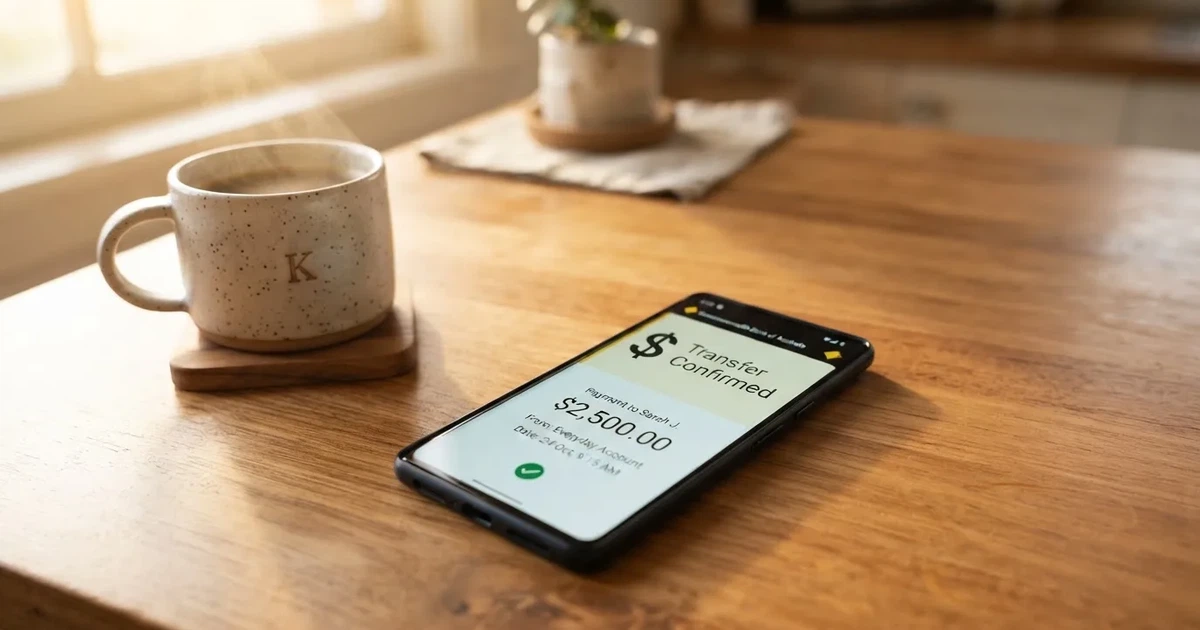
The three image anchors named in this article’s plan — settleme, fundamenta, prohibiti — mark the three lenses the rest of the page looks through. Settleme is the lens of how the money actually moves: a kitchen-table smartphone shot, not a casino-floor stock photo. Fundamenta is the lens of how the page explains itself to a reader: a person at a desk, reading, not playing. Prohibiti is the lens of the regulator’s own warning notice: a tablet screen, an official document, the moment a marketing claim meets the ACMA’s name on a piece of paper.

The fundamentals the ACMA action sets in plain language
The ACMA’s February 2025 formal warning to EOD Code SRL over Instant Casino reads as a regulatory letter, not a press release. It names the operator, names the brand, cites the IGA provision breached and sets a deadline. The same shape applies to the March 2026 warning to Pulsup Ltd over Rocketplay. The April 2026 warning to Ryker B.V. covers Jackbit and CasinOK together. The May 2022 warning to Dama N.V. covered six brands at once: Bambet, Dazard, Level Up, Rocketplay, Wild Tornado and Cobra Casinos. Dama N.V. picked up further warnings in March 2025 over Woo Casino and in May 2025 over Spirit Casino. Hollycorn N.V.’s September 2022 warning covers Sky Crown and Blue Leo.
The pattern is not random. Operators that already have one warning are still appearing on later warnings, often under new brands. The warning resets the clock on the ACMA’s enforcement options, but it does not remove the product from the Australian-facing internet; an Australian ISP block, when it follows, can lag the warning by months. A punter who finds a brand through a fresh affiliate link in that window has walked into a known warning the ACMA has already published.
Prohibition as a practical matter, not a technical one
The Interactive Gambling Amendment (Gambling Reform) Bill 2026 passed Parliament on 19 August 2026. Its advertising and inducement measures commence on 1 January 2027. On a page read in 2026, that is a law with a start date, not yet in force. The advertising crackdown it sets up will land in the new year; what is in force today is the prohibition itself, the ACMA’s existing powers and the bank-side blocks that have been running for several years.

Gambling winnings of a recreational player are not assessable income in Australia (section 6-5 ITAA 1997), and losses are not deductible, unless the person carries on a business of gambling. A punter who treats offshore casino play as a hobby has no tax reporting obligation and no tax deduction for the losses. A punter who treats it as a profession is in a different conversation with the Australian Taxation Office. Both states are silent on the cost the marketing never quotes: the bank fees, the Skrill fees, the blocked withdrawals, the bonus turnover and the regulator’s next blocking round.
How the blocking rate has compounded since 2019
The page’s calculation is the rate at which the ACMA has been removing sites from the Australian-facing internet since the first blocking request in November 2019. The inputs are the running total reported on 26 June 2026 — 1,751 blocked sites — and the date of that first blocking request.
The calculation shows the steady pace of enforcement. The period from November 2019 to June 2026 covers roughly six and a half years of enforcement. Across that span the ACMA moved from its first blocking request to a four-digit total, with the 12-name June 2026 round alone adding the names of fresh brands such as 7Signs, ChromaBet, Donbet, Duospin, Freshbet, Slots Gem, Jacks Club, Lucky Start, Pointsbetz, Spinrise, Vinyl Casino and Wildsino.
Stated as a band rather than a single figure: somewhere between roughly 250 and 300 sites a year have been added to Australia’s blocked list since November 2019, with the rate varying by enforcement round. Some years land heavier — 2023 and 2024 saw concentrated activity around named operators — and some land lighter as the ACMA shifted focus toward affiliate marketing sites rather than the casino brands themselves. The honest reading is that the rate has been steady enough that no punter should treat any single offshore brand as a permanent fixture. The ACMA’s blocking pattern is cumulative, not selective, and brands appear on the list on the ACMA’s timeline, not on the brand’s.
The reason this matters more than the per-year figure is that an offshore casino’s “we accept Skrill” pitch is not a statement about how long the site will be reachable from an Australian IP address in six months’ time. The ACMA’s enforcement record is the only published forecast. A punter who deposits through Skrill at a brand the regulator has not yet blocked is depositing at a brand the regulator may block with the punter’s balance still on it.
What the blocking rate does not measure
The blocking rate counts sites the ACMA has asked ISPs to block in Australia. It does not count the brands that withdrew from Australia without a formal blocking request — the “more than 230 unlicensed gambling services had left the Australian market since 2017” figure covers that side of the ledger. It also does not count the brands that kept operating outside Australia and simply stopped accepting Australian sign-ups, although this is a thin category: the offshore casino business model is built around jurisdictions it cannot serve from onshore, and withdrawing from the largest of those is a costly decision few have voluntarily made.
What the rate also does not measure is the time between a formal warning and a blocking request. That gap exists; it varies; and it is the window in which a brand named in a warning can still take deposits from an Australian IP address. A reader who treats the rate as “the ACMA will block it eventually” is reading the right conclusion from the wrong number. The right reading is that the rate is the trend, and the warning is the leading indicator.
What Skrill’s own page says about Australian use
Skrill’s Australian fee page is a payment-method document, not a gambling document. It sets out the deposit, withdrawal, FX and inactivity fees. It warns about credit-card cash-advance fees. It explains the VIP tiers. It does not name any offshore casino, and it does not warrant that any particular transaction will clear an Australian bank’s gambling block.
Skrill’s parent, Paysafe, is authorised by the UK Financial Conduct Authority as an Electronic Money Institution. Its consolidated FY2022 revenue across Skrill, Neteller and paysafecard was about US$1.496 billion. The Skrill product in Australia is sold by a UK-regulated EMI, not by an Australian-licensed deposit-taker. The protections that follow from Australian Financial Services Licence status do not attach to a Skrill account by default; they attach to the bank account or card that funds it.
The card side has its own story. The Reserve Bank of Australia’s July 2025 review of merchant card payment costs proposes removing surcharges only on eftpos, Mastercard and Visa transactions. American Express sits outside the proposed surcharge ban. Apple Pay, Google Pay and Samsung Pay transactions collectively accounted for around 45% of all card payments in Australia by number at the end of 2025. The RBA does not set Apple Pay’s terms; Apple does. Apple states that transaction limits and PIN requirements for Apple Pay purchases are set by the card issuer or merchant, not by Apple itself. Any surcharge a punter sees at a cashier comes from the merchant’s card-processing fees, not from Apple.
For a punter, the layering is the point. The card issuer decides whether to let the transaction through at all. The wallet decides whether to relay it. Skrill decides what fee to charge on receipt. The casino decides whether to honour the deposit. The ACMA decides whether to ask the ISP to block the site next month. None of these layers is the punter’s dispute resolution body. The punter is the only layer that gets to choose not to play.
The responsible-gaming shelf, restated where the wallet lives
The Australian responsible-gaming supports sit on a different network from the offshore casino. BetStop is the National Self-Exclusion Register and binds only Australian-licensed services. The National Gambling Helpline is 1800 858 858. Gambling Help Online operates free 24/7 chat and telephone counselling. State and territory problem-gambling services operate alongside the federal ones.
None of these services is integrated with Skrill, with any offshore casino brand, or with any of the payment intermediaries the offshore route runs through. The offshore product is paid for outside the Australian support network and is also unregulated by it. The Australian support network is free, confidential and immediate, and it does not wait for an ACMA blocking round.
A punter who has moved offshore because a BetStop exclusion has shut the licensed market is a punter who has moved away from the support, not toward it. A punter who self-excludes today and then opens a Skrill-funded account at an offshore casino tomorrow has not beaten BetStop; they have left its jurisdiction.
How the eleven brands compare on the page’s one axis
The page’s single comparison axis is the ACMA’s own enforcement record. The order of the eleven brands follows the order in which the ACMA has acted against them in recent years. The most recent warning sits at the top of the list; the earliest sits lower. That ordering is the page’s only ranking, and it is the ACMA’s, not the page’s.
Each brand sits on the same legal ground: the Interactive Gambling Act 2001 prohibits the product, the ACMA has formally warned the operator, and the brand’s Curacao or Anjouan licence is jurisdictionally irrelevant to Australia. Where the public record carries a Skrill mention — through Westpac’s merchant-category code list, through AUSTRAC’s payment-processor coverage, through cross-referenceable industry pages — the table records it as “listings-only” and attributes the source. Where the public record does not, the table records an em dash and the row is silent on the Skrill question.
That silence is honest. A reader who lands here from a “best Skrill casinos” affiliate page will find a column that mostly does not name Skrill. The reason is that the affiliate pages exist to sell the deposit; this page exists to describe the cost. The two are not the same product.
What the rest of the offshore pitch sounds like, and where it falls down
The offshore pitch is built from four claims: speed, anonymity, generous bonuses, and a Curacao licence. Each claim is accurate at the level it is made. Each claim also has a limit the marketing skips.
Speed is real for the Skrill leg, less real for the bank funding leg, and contestable for the withdrawal leg once the casino’s internal approval queue gets involved. Anonymity from the casino’s point of view is real; anonymity from the Australian bank’s point of view is not, because Westpac, ANZ, CBA and NAB all run gambling-block controls at card or wallet level, and Skrill’s own terms warn that credit-card funding may trigger a cash-advance fee. Bonuses are real in the sense that bonus money is credited; the wagering multiple, the game-weighting rule and the max-cashout cap that come with the bonus are the real numbers, and the affiliate pages rarely quote them. Curacao is a real licence; it is a real licence issued by a jurisdiction that has no Australian enforcement reach and that does not bind the operator to Australian consumer law.
The cost the marketing skips is the sum of those limits. The fees at the Skrill leg are listed above. The bank friction is the bank’s decision, not Skrill’s. The bonus terms are in the casino’s own small print. The licence is a fact about the operator’s home jurisdiction, not about the punter’s.
A punter who reads the marketing, then reads this page, then reads the operator’s own terms is doing the work the marketing was designed to skip. The work is the page’s purpose.
Choosing between the brands is not the right question
Eleven brands on one axis is not a buying guide. It is a record. The record tells an Australian reader which operators the ACMA has put on notice, in what order, and what the warning covered. The record does not say “this brand is safer than that brand”. The IGA does not grade illegality; either the operator provides a prohibited interactive gambling service to people in Australia, or it does not. Eleven warnings is eleven findings.
A punter who needs to compare options is a punter who has not yet decided whether to play at all. The Australian-licensed wagering market offers horse racing, harness racing, greyhound racing and sports betting, all settled through Australian payment rails and all covered by BetStop, the Australian bank block system and the Australian Financial Complaints Authority. The product this page covers — online casino games and online pokies, funded through Skrill at an offshore brand the ACMA has warned — sits outside that system by design.
The arithmetic of the cost the marketing skips
Skrill’s deposit fee is up to 5.00%. The withdrawal fee is 2.00% to 3.00% with a EUR 3.50 minimum. The currency-conversion fee is 4.49% on any non-EUR-to-AUD transfer. The bank funding the Skrill wallet may add a cash-advance fee on credit-card top-ups or refuse the transaction outright under a gambling block. The casino may add a fee of its own on the cashier, typically labelled a “processing fee” and usually deducted from the deposit. The bonus, if any, comes with a wagering multiple and game-weighting rules that decide how much of the deposited money has to be turned over before any winnings become withdrawable. None of these fees appear in the headline “fast and anonymous” pitch.
A A$200 deposit, on a worst-case stack of fees, can arrive at the casino worth roughly A$170 after Skrill’s deposit fee and a card-issuer surcharge, and any withdrawal of A$170 would be reduced by the Skrill withdrawal fee and the FX fee. The bonus the casino credits to encourage the deposit does not change that arithmetic; it adds a turnover requirement that has to be met before the balance can be moved at all. The marketing pitch and the cashier page are not describing the same transaction.
The cost that does not fit on a cashier page
The blocking rate above is the rate at which the ACMA removes sites from the Australian-facing internet. A punter with a balance on a freshly blocked site cannot move that balance to an Australian bank through Skrill, because the site is no longer reachable from Australia. Skrill can refund an incoming deposit that the merchant has not yet claimed; Skrill cannot refund a balance the casino holds. The casino holds it because the casino’s terms say it does, and the regulator that would override those terms is in Curacao or Anjouan, not in Canberra.
The cost the marketing skips is the one that arrives after the marketing has finished talking. It is the cost of an offshore cashier, a Skrill wallet and an ACMA blocking round meeting at the same Australian IP address on the same Tuesday morning.
Australian-licensed alternatives, and why they are not the same product
The Australian-licensed wagering market is real, regulated, and covers only the products the IGA permits. Pre-event betting on horse racing, harness racing, greyhound racing and sport is licensed; lotteries and keno are licensed. Online casino games and online pokies are not. A punter comparing a Skrill-funded offshore casino to a Bet365-funded Australian bookmaker is comparing two different products with two different consumer protections and two different payment rails.
The licensed product takes deposits via debit card, bank transfer, PayID, Osko or BPAY. It honours withdrawals through the same rails. It is bound by BetStop self-exclusion. It is covered by the Australian Financial Complaints Authority. It does not take credit cards. It does not take crypto. It does not offer a Skrill cashier, because Skrill is not on the list of approved payment methods for an Australian-licensed wagering service.
The choice is not “Skrill or no Skrill”. The choice is “offshore product with Skrill, no Australian protection, ACMA on the operator” or “Australian-licensed product with Australian payment rails, BetStop binding, AFCA cover, and a product set that excludes online casino games”. This page is about the first option. The second exists and it is the legal alternative.
A note on the language this page uses
Australian spelling throughout: licence as a noun, license as a verb, organisation not organization. “Pokies” is the Australian term for slot machines; “punter” is the Australian term for a betting customer. “PayID”, “Osko” and “BPAY” are the Australian payments infrastructure. “ACMA” is the Australian Communications and Media Authority. “IGA” is the Interactive Gambling Act 2001. “BetStop” is the National Self-Exclusion Register. The 1800 858 858 number is the National Gambling Helpline, free from any Australian phone, 24/7.
The dollar amounts on this page are Australian dollars unless a fee page specifies otherwise. Where research quotes a fee in euros (Skrill’s minimum withdrawal fee, for instance), the euro figure is kept because the punter’s invoice from Skrill is in euros or the local-currency equivalent, and a converted figure is the punter’s problem, not Skrill’s.
Frequently asked questions about Skrill at Australian casino sites
Is it legal for an offshore casino site to accept Skrill from an Australian visitor?
No. The Interactive Gambling Act 2001, as amended in 2017, makes it an offence to provide online casino games, online pokies or in-play betting to a person in Australia, irrespective of the payment method used. Skrill is a payment method, not a licence. The ACMA has formally warned and, in many cases, asked Australian ISPs to block the offshore operators listed above. The individual player is not prosecuted; the player has no Australian consumer protection either.
How quickly does a Skrill transaction typically settle?
The leg from a funded Skrill wallet to the casino’s merchant account usually settles in seconds. The leg from an Australian bank or card into Skrill depends on the bank: Osko transfers between participating Australian banks settle in under a minute 24/7, but a card funding attempt may be refused under the card issuer’s gambling block. Withdrawals back to a Skrill wallet are typically faster than withdrawals back to an Australian bank, and then depend on Skrill’s own withdrawal queue.
Does using Skrill offer any buyer protection if an offshore site refuses to pay out?
No. Skrill is an Electronic Money Institution authorised by the UK FCA; it can confirm that funds reached the merchant and when, but it cannot order a merchant to refund a disputed balance. The Australian Financial Complaints Authority does not cover disputes with unlicensed offshore operators, because those operators are outside its jurisdiction. Any complaint goes to the regulator named in the casino’s footer licence, which is almost never in Australia.
Can Skrill be used to fund a licensed, land-based venue in Australia the same way it’s used online?
Not through Skrill itself at a venue cashier. Australian-licensed wagering services — including land-based TAB outlets, licensed bookmakers and licensed online operators — accept deposits via debit card, bank transfer, PayID, Osko and BPAY. Credit cards and crypto are banned since 11 June 2024. Skrill is not on the list of approved payment methods for an Australian-licensed wagering service. A punter who wants to fund play at a licensed Australian venue does so through Australian payment rails, not through an offshore wallet.
What deposit limits are commonly attached to Skrill at offshore casino sites?
Limits vary by operator and by Skrill account tier. Skrill’s own VIP structure (Silver, Gold, Diamond) raises transaction limits but is paid for in volume. Australian bank blocks — Westpac’s merchant-category-code block, ANZ’s gambling transaction block, CBA’s and NAB’s equivalents — operate at the funding side, not at Skrill, and can refuse the underlying card or wallet transaction before Skrill ever sees it. The practical limit on an Australian punter’s deposit at an offshore casino is whichever is reached first: the casino’s cashier limit, the Skrill account limit, or the Australian bank’s refusal.
Why might a bank block a Skrill transaction flagged as gambling-related?
Australian banks operate gambling-block controls at card or wallet level. Westpac refuses authorisation of transactions registered under the merchant category code “Betting/Casino Gambling”. ANZ’s block, activated in the ANZ app, also blocks gambling transactions made through a digital wallet such as Apple Pay on an eligible card. Removing the ANZ block requires a 48-hour waiting period. Commonwealth Bank and NAB publish comparable controls. The block is at the funding layer, between the Australian bank and the Skrill wallet, and it does not depend on what the casino’s cashier labels the merchant.