
Best Video Slots Australia 2026: The Format, the Offshore Blocklist, and What the IGA Leaves You With
The phrase “video slots Australia” pulls up two parallel markets that share a format and a name but not a legal footing. Inside the country, modern multi-reel video slot machines operate in pubs, clubs and casinos under state and territory approval, with payouts and rules set by a state regulator. The same format appears online too — five reels, scatter pays, free-spin rounds, branded bonus mechanics — on sites licensed in Curaçao, Costa Rica or Anjouan, where the offer is one the Interactive Gambling Act 2001 does not recognise as a lawful Australian product. The consequence of that split does not arrive at signup. It arrives when the ACMA asks an ISP to add the brand to its block list, when a withdrawal stalls for a reason the operator’s terms page never quite explains, or when a player realises BetStop does not reach the site they have been playing on.
Current as of 28 October 2026. Verified against the ACMA’s published register of formal warnings and the most recent blocking round.
Bonus Rounds, Free Spins and What They Actually Cost
What a “bonus round” means on a modern video slot
A bonus round is the second layer of the game, the one that turns a base spin into a longer sequence with different mechanics. Land three scatter symbols — or the specific combination the paytable names — and the reels change. An extra row might drop in. Sticky wilds lock into place. A multiplier climbs with each cascade. A free-spin counter starts ticking down. The format varies from provider to provider, but the structure is consistent: the base game pays small wins for line hits, and the bonus round pays the larger amounts the paytable advertises in its top tier.
This is the layer the marketing points to. When a casino bonus page promises “free spins on Book of Dead” or “bonus rounds on Big Bass Bonanza”, it is naming this layer — the part of the game where the multi-line pays cluster and the symbol stack becomes the headline. The mechanics on offer are real. Book of Dead does have an expanding symbol in its free-spin round. Big Bass Bonanza does run a money-symbol collection in its bonus. What changes between a venue in Sydney and a site licensed offshore is not the format. It is the legal frame the offer sits inside, and the consumer protections that frame provides or withholds.
Free-spin offers and the conditions behind them
A free-spin offer is the inducement the marketing wraps around that bonus round. The format is familiar: deposit, claim a package, receive a number of spins on a named slot, watch the winnings land in a bonus balance. The catch sits in the same paragraph as the offer, often in a smaller font. Three conditions recur across this market, and each one shapes what the bonus is worth in practice.
The first is a wagering requirement. The operator names a multiple — thirty times, forty times, sometimes fifty times the bonus — and asks the player to turn the bonus balance over that many times before any withdrawal. The second is a maximum cashout cap, which limits what the bonus can pay out even after the wagering is met. The third is a game-weighting clause, which counts slots at one rate and table games at another, sometimes at zero. The roulette and blackjack player who clears the wagering on a side bet discovers, at withdrawal time, that the wagering did not move.
None of this is hidden. Every bonus terms page carries these clauses; the better ones display them in plain English. The issue is what they cost in practice. A wagering multiple of forty times the bonus on a slot running at a 96 per cent return to player is, on average, a four-per-cent take from the bonus turnover before any payout. That is before the max-cashout cap, which can sit at five or ten times the deposit. The marketing word “free” describes the spins. It does not describe what the spins pay.
Why the marketing outruns the arithmetic
The marketing word does the work. The arithmetic that follows does not. That gap is the page’s interest, not its complaint. Players who read the wagering requirement before they deposit are not misled; they have decided whether the offer is worth what it asks for. Players who do not read it discover the cost in the small print, often after a winning streak the terms page retroactively disqualifies. The consequence of the gap is not a hidden fee. It is a delay in finding out what was always there.
The offshore version of the gap is sharper because the regulator on the other end is not an Australian one. The Curaçao Gaming Control Board does not adjudicate player complaints the way the Northern Territory Racing and Wagering Commission does for licensed bookmakers. A wagering dispute on an offshore site is settled by the site’s own customer support, then by its own complaints team, with the operator’s terms page as the final document. The arithmetic does not change. The venue that enforces it does, and that is the gap a player who deposits without reading never closes.
The Video Slot on a Phone
What changes when the reels move to touch
A video slot on a phone is the same game engine as on a desktop, served through HTML5 rather than the Flash that the format used before 2020, with the same reels, the same paylines and the same random number generator. What changes is the interface. The five-by-three grid that fits a 1920-pixel monitor does not fit a 360-pixel screen without compression, so providers redesign for portrait orientation: the reels take the top two-thirds of the display, the spin button sits under the thumb, and the paytable slides in from the side rather than opening in a modal window. Touch replaces the mouse click, which is why bonus rounds that depend on a precise click — a pick-em screen, a hold-and-spin feature — are usually rebuilt for swipe gestures.
The result is a game that feels lighter but plays identically. Return-to-player percentages do not change between mobile and desktop. Bet sizes do not change either, except that minimum bets on mobile are often lower. A$0.10 per spin is the floor across most providers, where the desktop floor is A$0.20 or A$0.50. That lower floor is one of the genuine differences the format offers a phone player, and the reason mobile sessions tend to run longer in spins and shorter in dollar turnover.
App versus browser for the legal alternative
Inside Australia, the licensed electronic gaming machine sits in pubs, clubs and casinos — venues, not phones. The few licensed wagering apps that operate under Northern Territory Racing and Wagering Commission oversight are sports and race bookmakers, not casino games. Sportsbet, Bet365 and Ladbrokes are licensed in the Territory for tax reasons, but the licence covers wagering only; none of them offers online pokies. The IGA makes that offer unlawful, and the ACMA’s blocking list is the practical consequence of trying.
The legal alternative on a phone is therefore not a casino app. It is a browser pointed at a state-licensed venue’s responsible-gambling portal, or a browser pointed at a wagering app restricted to sports and race markets. There is no Australian-licensed mobile casino app for video slots. None. Anyone offering one is offshore, and the ACMA’s register of formal warnings, recorded in the section below, lists who is currently doing so.
Performance and the parts of mobile play that matter
Two parts of mobile play matter to a player in a way the marketing does not mention. The first is load time. A modern video slot’s HTML5 build weighs between five and fifteen megabytes, with bonus-round animations loading in stages as the reels settle. On a stable 4G connection, that takes two to three seconds per round. On a moving train, or at the edge of a shopping-centre signal, it can take ten seconds. The second is connection drops. A connection drop in the middle of a free-spin sequence is the moment when the result is committed by the server but not yet displayed on the phone. The site credits the win, but the player sees a frozen screen until the connection restores.
This is not a fault. It is how client-server games work. But it is the kind of detail an offshore site’s FAQ page answers briefly and a venue-floor machine never raises, because the venue machine has no connection to drop. For a phone player weighing offshore against a venue, the question of what happens on a weak signal is a real one, and the answer sits in the operator’s terms page, in the section about disconnections and unfinished rounds.
Inside the Paytable
Reels, symbols and the modern paytable
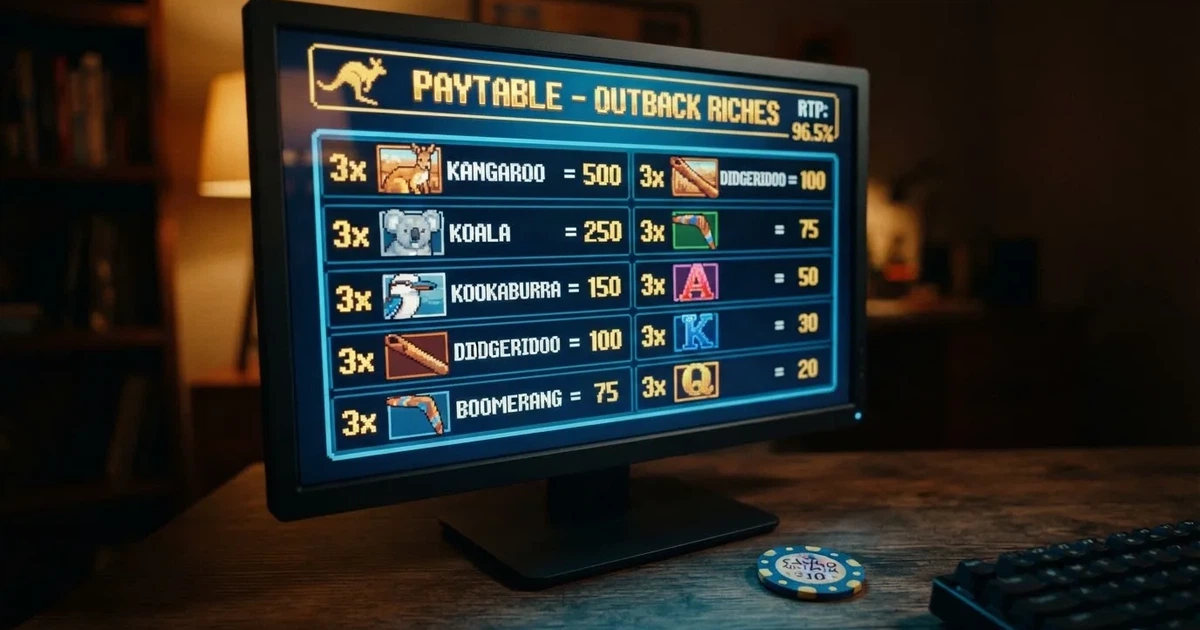
A modern video slot’s paytable is the document that does the work the marketing page does not. It names the symbols, the line combinations, the wild behaviour, the scatter pays, the bonus trigger and the maximum payout per spin. For a five-reel slot with fifty symbols per reel, the number of possible combinations at any given spin is fifty to the power of five — 312,500,000 — and that is before the bonus mechanics rearrange the math. Some modern games push that figure past 300 million to one against the top combination, against the roughly 1,000 possible combinations on a classic three-reel mechanical machine with ten symbols per reel.
The paytable also states the slot’s volatility and its return-to-player percentage. The first tells the player how the wins are distributed. High volatility means longer dry spells between bigger wins. Low volatility means smaller wins more frequently. The second is the long-run theoretical payout across millions of spins, usually expressed as a percentage between 94 and 97 per cent for online video slots, with 96 per cent the most common figure. Neither figure is a guarantee for any session. Both are statistical averages over the volume the regulator or the testing house audits.
A short history from Liberty Bell to five reels
The mechanical slot machine dates to the late nineteenth century. Charles Fey, working in San Francisco, developed the first automatic payout mechanism in the 1890s — a three-reel machine with five symbols (horseshoes, diamonds, spades, hearts and the Liberty Bell), where three bells in a row paid the top prize of ten nickels. Bally’s “Money Honey”, released in 1963, was the first electromechanical slot with a bottomless hopper and automatic payout of up to 500 coins without an attendant. The first true video slot arrived in 1976, developed by Fortune Coin Co. in Kearny Mesa, California, and used a modified 19-inch Sony television as its display.
The move from mechanical to electronic to video to HTML5 took roughly fifty years. The move from three reels to five, and from a handful of paylines to 243 or more, took the second half of that period. Modern video slots are software products running on certified random number generators, displayed on whatever screen the provider’s build supports. The five-reel layout, the scatter pay, the expanding wild and the free-spin counter are the formats the technology enabled, and they are the formats a player on a 1996 NSW pub-club machine and a player on a Curaçao-licensed site in 2026 share.
Volatility, RTP and what the spread means
Volatility and return-to-player sit at the centre of every paytable, and the spread between them is what makes two video slots from the same provider play very differently. A high-volatility game can return 96 per cent of turnover over a million spins and still leave a player with nothing after a hundred. A low-volatility game at the same 96 per cent pays smaller amounts more often and stretches a bankroll further per session. The paytable names both. The math between them is what a session feels like.
That math is also why two video slots from the same provider can feel like different products. A provider like Pragmatic Play or NetEnt publishes dozens of titles a year, and each is tuned to a different point on the volatility curve. Book of Dead sits at high volatility with a max win around 5,000x stake. Big Bass Bonanza sits at medium with smaller but more frequent bonus hits. The provider’s name on the front of the cabinet does not tell a player which game they are getting. The paytable does, and a player who reads it knows what the next hundred spins look like before the first one lands.
The Eleven Brands the ACMA Has Formally Warned
Why this is not a ranking of recommendations
The eleven brands below appear because the Australian Communications and Media Authority has issued a formal warning about each of them. They are not ranked. They are not recommended. They are listed in the order the ACMA’s register places them, and the section exists so a reader can recognise the names the marketing surfaces and the dates the warnings were published. None of these brands is licensed to offer online casino games to a person in Australia — the Interactive Gambling Act 2001 does not permit that licence to be issued, no matter what the footer of an offshore site claims.
The framing matters. This is the ACMA’s register, in plain English, with the operator named in each warning. It is not a buyer’s guide, and it is not a comparison of who pays fastest or who has the best welcome package. The only ground for inclusion is that the regulator has formally warned the operator. The only comparison that follows is the one a reader can make for themselves across the rows.
At a glance — the warning register
| Brand | Formal warning date | Operator named by the ACMA | Subject support per research |
|---|---|---|---|
| RocketPlay | March 2026 | Pulsup Ltd | — |
| Level Up Casino | May 2022 | Dama N.V. | Listings only — BGaming catalogue |
| Woo Casino | March 2025 | Dama N.V. | — |
| Spirit Casino | May 2025 | Dama N.V. | — |
| National Casino | July 2025 | Consolutetish S.R.L. | Listings only — Wikipedia entry |
| Bizzo Casino | July 2025 | Consolutetish S.R.L. | — |
| Ignition Casino | July 2025 | Bamboo Media | — |
| Instant Casino | February 2025 | EOD Code SRL | — |
| Jackbit | April 2026 | Ryker B.V. | — |
| Casino Intense | April 2025 | Sterplay Holding Ltd | — |
| Sky Crown | September 2022 | Hollycorn N.V. | — |
The Dama N.V. file: Paytable brands across four warnings
Dama N.V. is the operator that recurs most often across the ACMA’s register on this subject. The Commission’s first formal warning to the company, in May 2022, named six brands at once: Bambet, Dazard, Level Up, Rocketplay, Wild Tornado and Cobra Casinos. Two further warnings followed — one in March 2025 over Woo Casino, and another in May 2025 over Spirit Casino. A fourth Dama N.V. brand, RocketPlay, drew a separate formal warning in March 2026, this time to a different legal entity — Pulsup Ltd — operating the same .com.au-targeted brand.
Woo Casino and Spirit Casino are the two that fall under the most recent Dama N.V. file. Both ran the same inducement pattern: a multi-deposit welcome package with bonus cash and free spins on named slots, wagering requirements in the forty-times range, and a withdrawal pipeline that processed smaller amounts and stalled on larger ones. The marketing was loud. The bonus terms were typical of the offshore market — neither lighter nor heavier than the segment average. What was not typical was the operator on the other end of the bonus: a company the ACMA had already warned, then warned again, then warned a third time. The Paytable of Dama N.V.’s conduct over four years reads less like a sequence of mistakes than a sequence of rebrands under one parent company.
Level Up Casino, also under Dama N.V., was named in the May 2022 batch but not in the 2025 or 2026 follow-ups. Its current catalogue, on the listings research consulted, includes games from BGaming, a provider whose titles appear across a wide range of offshore brands. The BGaming presence does not make Level Up licensable in Australia. It makes Level Up a brand whose game library research can identify by name. The licence status, the regulator’s view, and the IGA’s reach all remain unchanged.
The repeated Dama N.V. warnings are the pattern the ACMA’s register most clearly exposes. Two of the operator’s brands have been warned at least twice; RocketPlay has been warned under two different corporate entities. The Commission’s published notices do not explain what changed between warnings. They simply record that the conduct it warned against continued. The consequence of that continuation, for a player, is that a brand name gives no protection the regulator’s record does not already remove.
Consolutetish S.R.L., Bamboo Media and Sterplay Holding Ltd — six more brands
The July 2025 batch was the ACMA’s most concentrated single round in this register. Three operators were warned in the same publication: Bamboo Media, over Ignition Casino; Consolutetish S.R.L., over National Casino and Bizzo Casino; and Sterplay Holding Ltd, over Casino Intense, named separately the same month.
Bizzo Casino is the brand in this batch with the longer file. It was named in a 2022 formal warning to TechSolutions Group N.V. and TechSolutions (CY) Group Limited, then named again in 2025 under Consolutetish S.R.L. The 2022 warning and the 2025 warning do not describe the same corporate entity on the other end of the brand, but the brand is the same one Australian players were invited to register at across three years. That is the operational pattern the ACMA’s register documents most clearly: a brand that gets re-licensed under a new operator after a warning and continues to advertise to Australian residents.
National Casino, the second Consolutetish S.R.L. brand named in the same July 2025 warning, is the only one in this batch the consulted research catalogues by name on a reference page. The Wikipedia listing for the brand is descriptive rather than promotional, and it does not change the IGA position. A player who finds the listing is not a player who finds a lawful product.
Sterplay Holding Ltd’s Casino Intense is the third operator named in the July 2025 round, with its own ACMA publication. The four source pages research consulted do not catalogue Casino Intense by name; what they do is contextualise the broader offshore market in which the brand operates. That is a research gap rather than a regulatory finding. The ACMA’s warning is published and stands regardless of how the operator is or is not listed elsewhere.
Bamboo Media’s Ignition Casino closed the July 2025 batch. The brand had been operating for several years under the same name and the same Curaçao licence structure; the ACMA’s formal warning recorded that the structure did not make it lawful in Australia. None of the brands named in the July 2025 batch has been removed from the ACMA’s register since the warning was issued.
The earlier end of the register — Hollycorn N.V. and EOD Code SRL’s Fundamentals
Two brands sit earlier in the ACMA’s published register and recurred during the research pass. Hollycorn N.V. was the subject of a formal warning over its Sky Crown and Blue Leo casino services, published in PDF form in September 2022. Sky Crown is the more marketed of the two brands; Blue Leo runs the same underlying platform under a different name. The Hollycorn file is one of the ACMA’s longer-running entries, with the operator appearing across several warning publications rather than a single one.

EOD Code SRL’s Instant Casino is the brand whose February 2025 warning captures the Fundamentals of how these operators surface in Australian search results. The brand name is short, the marketing aggressive, and the bonus terms page long. The ACMA’s formal warning names the operator and the conduct it warned against. The warning is the public record of an enforcement action that started before the marketing landed in Australian inboxes and continued after.
The Fundamentals of the offshore model’s persistence are visible in these two files. The brand surfaces. The regulator warns. The brand continues under the same or a related name. The cycle does not require a new entrant each time; it operates on the same operator and the same domain for years.
Jackbit and the Prohibition Trail Under Ryker B.V.
Ryker B.V., the operator of Jackbit and CasinOK, is the most recent name in the ACMA’s published register at the time of writing. The formal warning was issued in April 2026. Jackbit markets itself as a casino-and-sportsbook combination, with a game library in the multi-thousand range and a sportsbook that covers most major leagues. CasinOK runs the same platform under a separate brand name; the two brands share a corporate parent and a Curaçao licence.
The Prohibition path the ACMA’s register exposes is the same one the Hollycorn and Dama N.V. files trace, but more compressed. A brand launches, the marketing reaches Australian residents, the regulator investigates, the formal warning publishes. From there the trajectory depends on the operator. Some brands continue under the same name with the same licence; others rename; others rotate to a fresh corporate entity. The register records only the warning. The next step — a block request, a domain seizure, or an exit from the Australian market — is what the player encounters when they try to load the site from an Australian IP. For Jackbit specifically, the consequence of that warning is now visible at the network level rather than only at the bonus terms page.
What the register shows across seven years
The register shows a slow escalation. The early warnings — 2022, on Dama N.V. and Hollycorn N.V. — covered six brands in a single publication and a handful in a second. The 2025 round added Consolutetish S.R.L., Bamboo Media and Sterplay Holding Ltd. The 2026 round added Pulsup Ltd and Ryker B.V., with the ACMA’s blocking list running in parallel. The total count of blocked illegal gambling and affiliate marketing sites reached 1,751 as of June 2026, against twelve named in the most recent single round.
What the register does not show is the volume of marketing that reaches Australian players without a formal warning. The ACMA’s enforcement action covers the brands it has investigated and named; the broader offshore market is larger than the warning list, and most of its marketing runs without ever drawing one. The eleven brands in this section are the names the ACMA has put on the public record. They are not the full set, and a player who treats them as the only set misses the brands the regulator has not yet got to.
What the Format Actually Is in Australia
The licensed electronic gaming machine
The legal video slot in Australia is the electronic gaming machine — the EGM — that sits in pubs, clubs and casino floors under state and territory approval. New South Wales legalised slot machines in 1956; by 2010 the country operated an estimated 97,103 gaming machines outside casinos, a per-capita rate about five times that of the United States. The EGM in 2026 is the same product the format has described since Bally’s “Money Honey” in 1963: a digital display, a button or touchscreen, a random number generator certified by the state regulator, and a payout percentage set by the same regulator.
Pokies is the Australian term for the EGM. It is what a player in a Melbourne pub calls the machine by the bar; it is what a Crown Melbourne brochure names when it lists the floor’s offering. The phrase “video slots” describes the same product with a more international vocabulary. There is no separate category for a five-reel HTML5 video slot at the Australian venue level — the machine’s reels, paylines and bonus mechanics are the same; what changes is the regulatory frame that approves them and the payment methods that fund them.
The state-by-state count
The licensed EGM count outside casinos is published state by state. New South Wales, the largest market, ran 87,298 pokies-style machines as of June 2023. Victoria reported 26,380 in 2021–22. Queensland reported 21,122 in October 2023. South Australia reported 11,672 in September 2023. The Australian Capital Territory reported 3,587 in November 2023. These are the figures the state regulators publish; they update quarterly or annually, and the most recent snapshot is the one a player would see on the regulator’s website today.
New South Wales runs the largest EGM market by a wide margin, and it has since 1956. The state’s ClubsNSW data shows more than 80,000 machines in clubs and hotels alone. The ACT’s smaller count reflects both the territory’s population and its stricter harm-minimisation settings — mandatory $100 cash-load limits, mandatory shutdown periods between 4am and 9am, and a slower rate of new machine approvals. The contrast is not in the format; it is in the regulatory settings that wrap around it.
Why “video slots” and “pokies” are the same machine
The terminology converges on the product. A video slot is a five-reel slot machine with multiple paylines and at least one bonus mechanic. An EGM is the Australian regulatory category for a slot machine approved for use in a licensed venue. A pokie is the colloquial Australian name for the same machine. The marketing pages of offshore casinos use “video slot” because the term is internationally recognised; the venue floor signs in Sydney use “pokie” because it is what Australian players call the machine; the regulator’s database uses “EGM” because that is what the licensing class is called.
The mechanic is identical. A five-reel slot with an expanding scatter symbol and a free-spin counter plays the same way on a Crown Melbourne terminal as on an offshore HTML5 build. The return-to-player percentage is similar — Australian venues typically publish 87 to 92 per cent, against the 94 to 97 per cent the offshore market advertises — and the reason is the venue’s operating cost base, not a difference in game design. The house always has an edge. The edge sits at the percentage point the regulator or the operator publishes, and a player who reads the venue’s payout sign sees the same figure an offshore site’s paytable claims to honour.
The Law, the Blocklist, and the Reform
What the Interactive Gambling Act actually prohibits
The Interactive Gambling Act 2001 makes it an offence to provide certain interactive gambling services to a person in Australia. The 2017 amendment to the Act strengthened the prohibition and extended the ACMA’s enforcement powers. Online casino games, online pokies and in-play betting are the three product categories the Act names; none of them can be lawfully offered to a person physically present in Australia, regardless of where the operator is incorporated or what licence it holds offshore. The Act targets the provider, not the player. Prosecutions of individual Australian players are not the regime’s mechanism.
What is licensable is wagering on races and sport placed before the event, lotteries and keno. In practice, those licences sit with the Northern Territory Racing and Wagering Commission, which regulates 52 of Australia’s online bookmakers — including Sportsbet, Bet365 and Ladbrokes — under territory law. The NTRWC has no full-time staff and meets once a month in Darwin; its role is administrative rather than investigative, and the actual enforcement of the IGA against offshore operators is the ACMA’s.
The minimum age for any form of licensed gambling in Australia is 18. Offshore sites that take Australian customers without an age check — or with a self-declared age field that an honest thirteen-year-old could complete — are operating outside both Australian law and the licensing requirements of any reputable offshore regulator. The age check is one of the few concrete differences a player can verify at signup, and an offshore site that does not ask is signalling the standard it will hold to in everything else.
The credit-card and crypto payment ban
Since 11 June 2024, credit cards, credit-related products and digital currency have been banned as payment for licensed online wagering in Australia. The penalty for operators accepting them is up to A$247,500. Legal deposit routes for licensed wagering are debit card, bank transfer, PayID and Osko, and BPAY. The exclusion list is short for a reason: a credit card can fund a gambling session out of money the player has not yet earned, and digital currency operates outside the Australian banking settlement system. Both create harm pathways the regulator is no longer willing to leave open.
An offshore casino asking an Australian customer for a credit card or a crypto deposit is operating outside the Australian rules regardless of what its terms page says. The IGA is the legal frame; the payment ban is the operational one. Where the two intersect — at the deposit page of an offshore site — is the moment a player can see, without reading any legal document, whether the brand on the other end is licensed to take Australian money.
How fast the blocklist has grown
The ACMA’s first blocking request went out in November 2019. By June 2026 the running total of blocked illegal gambling and affiliate marketing sites reached 1,751. Spread across roughly eighty months — from that first request to the round reported in June 2026 — the average works out to between twenty and twenty-five websites added per month, with the long-run pace sitting closer to twenty-two. Over a full year, that is somewhere in the band of 250 to 265 websites added to the blocklist annually, with the band widening at either end depending on how the next round is counted.
The most recent single round, reported on 26 June 2026, named twelve more sites: 7Signs, ChromaBet, Donbet, Duospin, Freshbet, Slots Gem, Jacks Club, Lucky Start, Pointsbetz, Spinrise, Vinyl Casino and Wildsino. The pace of individual rounds varies — some weeks the ACMA publishes several; others pass without an addition — but the running total does not retreat. Sites that have been blocked once do not reappear on the public list. The same period saw more than 230 unlicensed gambling services leave the Australian market since enforcement was strengthened in 2017, according to the ACMA’s figures.
This is the arithmetic of an enforcement regime that scales with the volume of the market it polices. H2 Gambling Capital’s 2025 report estimated that Australians lose about A$3.9 billion a year to illegal gambling sites, and that the share of gambling going through legal channels fell from 74 per cent in 2021 to 64 per cent. The blocklist is the regulator’s response to a market that is, on the figures, growing. Twenty-two sites a month is the average; what that average masks is the larger problem the average is the regulator’s only lever against.
The 2026 reform bill — advertising and inducements
The Interactive Gambling Amendment (Gambling Reform) Bill 2026 passed Parliament on 19 August 2026. Its advertising and inducement measures commence on 1 January 2027. The bill is law with a start date, not law in force — a 2026 page reads the bill as enacted but not yet operational, with the first enforcement actions under the new measures landing in the new calendar year.
The bill’s operative change is to extend the ACMA’s reach over inducements — the bonus offers, the “free spins”, the deposit-match packages that offshore brands use to recruit Australian customers. Under the amended regime, an inducement offered to a person in Australia by an unlicensed operator becomes a regulatory matter in its own right, not only an element of an existing offence. The mechanism for enforcement is the ACMA’s existing powers: formal warnings, civil penalties, and the request to ISPs to block the offending site.
For the player, the change closes a small but real loophole: a bonus offer that previously sat in a grey area between marketing and a regulated product becomes, in 2027, a named offence. For the offshore operator, the change narrows the inducement category to licensed wagering on sports and races, where inducements have been regulated since 2017. The consequence, for a player who took the bonus under the old rules, will be visible in the next marketing email they receive: fewer of them.
Tax and winnings
Gambling winnings of a recreational player are not assessable income in Australia. The relevant provision is section 6-5 of the Income Tax Assessment Act 1997; it treats a recreational gambler’s winnings as a windfall rather than as earnings. Losses are correspondingly not deductible against other income. A player who wins A$10,000 on a poker machine does not declare it. A player who loses A$10,000 over a year does not claim it back.
The exception is a person who carries on a business of gambling — a professional poker player, a sports bettor whose activity rises to the level of a trade. The ATO publishes guidance on what makes a gambling activity a business, and the threshold is high. For most players, the tax position is straightforward: winnings are not income, losses are not deductions, and the ATO is not involved.
Where the Help Is
BetStop and what it does and does not reach
BetStop, the National Self-Exclusion Register, has been live since August 2023. It binds Australian-licensed online and phone wagering services — the sports and race bookmakers licensed by the NTRWC and the equivalent state bodies — to honour a player’s request to be excluded for a chosen period. The exclusion is national in scope, and a player who has registered with BetStop cannot open a new account with a participating licensed operator while the exclusion is in force.
What BetStop does not reach is the offshore casino. An offshore site is not connected to the register, has no obligation to honour an Australian self-exclusion request, and operates under its own responsible-gambling terms. A player who has self-excluded from a Sportsbet account and then opens an account with an offshore brand has not broken BetStop, but they have also not been protected by it. The exclusion stops at the licensed perimeter; the offshore market sits outside it.
The mechanism a player uses to enforce a personal exclusion on an offshore site is the site’s own self-exclusion tool — usually a request to customer support, with a confirmation email and a cooling-off period. The mechanism is real but operator-dependent. A brand that processes the exclusion within twenty-four hours and a brand that ignores it for a week are both operating within their own terms, and both are outside the Australian framework.
1800 858 858 and Gambling Help Online
The National Gambling Helpline is 1800 858 858. It is free, available 24/7, and routed through Gambling Help Online, which also offers web chat and email counselling. The service is funded by the Commonwealth and operated by state-based providers; it is confidential, and a player can use it without identifying themselves to their bank, their family or their employer.
For a player whose gambling has moved past what they can manage alone, the helpline is the first stop. It does not require a person to have stopped gambling. It does not require a person to want to stop. It is the channel through which the rest of the help system — financial counselling, psychologist referrals, peer support groups like Gamblers Anonymous — can be accessed in a structured way.
The helpline is also the route into BetStop for players who want a national exclusion. A caller can register over the phone, and the registration is processed within twenty-four hours. The combination of helpline plus register is the Australian system’s first response to a gambling problem. The offshore market offers neither, and the offer is not coming.
What offshore sites do not offer
The list is short. Offshore casino sites do not offer Australian consumer protection: there is no Australian complaints body a player can take an unresolved withdrawal dispute to. They do not offer Australian financial recourse: a bank can decline a chargeback on a gambling transaction, and the operator’s terms page usually names the jurisdiction whose courts apply, which is not Australia. They do not offer BetStop, the helpline, or any Australian-funded counselling pathway on the platform itself. They offer their own responsible-gambling tools, which are usually a deposit limit and a self-exclusion button, neither of which binds the operator in the way BetStop binds an Australian licensee.
For a player deciding between an offshore site and a legal onshore alternative, the asymmetry is the relevant fact. The game format is the same; the player-protection frame is not. The onshore punter walks into a club with a regulator behind the machine’s payout percentage and a helpline number on the wall. The offshore punter sits at a phone with no one behind either.
Frequently Asked Questions
How is a video slot different from the older three-reel pokies still in some Australian clubs?
A modern video slot has five or more reels, multiple paylines — often 25, 50 or 243 ways to win — and at least one bonus mechanic such as free spins or cascading reels. A classic three-reel pokie has one payline, three symbols per spin and no bonus round. The engine is the same; the depth is not.
Is the mobile version of a video slot the same game as on a desktop browser?
Yes. The mobile build is HTML5, served from the same game server as the desktop version, with the same random number generator and the same return-to-player percentage. The interface changes for portrait orientation and touch input; the maths do not.
Why does volatility differ between two video slots from the same provider?
Volatility is set per game, not per provider. Book of Dead is tuned to high volatility — long dry spells, max payout around 5,000x stake. Big Bass Bonanza sits at medium — smaller, more frequent bonus hits. The provider’s brand on the cabinet tells a player nothing about which game they are getting; the paytable does.
Which Australian state operates the most licensed gaming machines outside casinos?
New South Wales, by a wide margin. The state ran 87,298 pokies-style machines as of June 2023, against 26,380 in Victoria, 21,122 in Queensland, 11,672 in South Australia and 3,587 in the ACT. NSW legalised slot machines in 1956 and remains the largest EGM market in the country.
Do free-spin offers on offshore casino sites let an Australian player actually withdraw the winnings?
Sometimes, but only after the conditions are met. Most offers carry a wagering requirement of 30x to 50x, a max-cashout cap of 5x to 10x the deposit, and a game-weighting clause. A player who reads the terms can withdraw; a player who does not finds the conditions disqualifying the withdrawal after the fact.