
Inclave casinos in Australia: what the login system actually is, and what the law says about it
An Inclave casino is not a casino brand. It is an account: a single username, password and two-factor login that several different offshore sites accept in place of their own registration form. The interesting question for an Australian reader is not which sites are on the list, it is whether any of them may lawfully serve a person sitting in Australia at all. The short answer is no. The Interactive Gambling Act 2001 prohibits the supply of online casino games to anyone in Australia, and a shared login changes neither the prohibition nor the regulator’s view of it. What follows is the longer answer, written for a reader weighing an Inclave list against the law, the ACMA’s enforcement record and the practical payment and self-exclusion landscape they would actually be playing inside.
28 October 2026 — figures cross-checked against the ACMA’s published formal warnings list and the Interactive Gambling Act 2001 as amended.
Table of Contents
- The legal frame: why an Inclave site is illegal here before its login screen loads
- Prohibiti: the ACMA’s enforcement record against the brands on an Inclave list
- Fundamenta: payment routes an Australian player will run into on an offshore site, and what each one actually does
- Wellbei: what an Inclave login does to tracking your own spend
- The operators behind an Australian-facing Inclave list, and what the ACMA has published about each
- Choosing, on the choices an Australian player actually has
- Frequently asked questions
The legal frame: why an Inclave site is illegal here before its login screen loads
Online casino games, online pokies and in-play betting cannot lawfully be supplied to a person physically in Australia. The Interactive Gambling Act 2001 (the IGA), tightened by the Interactive Gambling Amendment Act 2017, makes the supply an offence. No state or territory licences it. The Interactive Gambling Amendment (Gambling Reform) Bill 2026 passed Parliament on 19 August 2026 and adds advertising and inducement measures, but those parts commence on 1 January 2027 — law on the books, not yet in force on a page read in 2026.
What is licensable is wagering on racing and sport placed before the event, lotteries and keno. In practice that means online bookmakers — Sportsbet, Bet365, Ladbrokes and 49 others — operating under a Northern Territory licence issued by the Northern Territory Racing and Wagering Commission. The commission regulates 52 of Australia’s online bookmakers. It has no full-time staff and meets once a month in Darwin, which is itself a useful fact to keep in the back of a reader’s mind when “Australian-licensed” is offered as a reassurance for any casino-style product: that licence does not exist for casino games here.
The regulator that handles illegal supply is the ACMA, the Australian Communications and Media Authority. It investigates complaints, issues formal warnings and, since November 2019, has asked Australian internet service providers to block illegal sites. The IGA targets the provider, not the player — an Australian punter is not at risk of prosecution for opening an account — but the offshore site gives no Australian consumer protection, no complaints body and no recourse if a withdrawal is refused. It can also be blocked while a balance is still sitting on it.
The minimum age for any licensed wagering product in Australia is 18. BetStop, the National Self-Exclusion Register, has been live since August 2023 and covers Australian-licensed online and phone wagering services. An offshore Inclave casino is not connected to it. The National Gambling Helpline — 1800 858 858 — is free, 24/7, with web chat at Gambling Help Online, and is the route that does work for someone whose spend has moved beyond what they intended.
Where this leaves an Inclave login
Inclave is a piece of software. It holds credentials and passes them to sites that have signed up to accept them. The legal status of a casino does not change because its registration form is hosted elsewhere. The IGA looks at where the service is provided to, not at how the account is created. If a casino offers online pokies or table games to a person in Australia, it is providing a prohibited interactive gambling service whether the player typed a password into its own form or into Inclave’s.
Prohibiti: the ACMA’s enforcement record against the brands on an Inclave list
Prohibiti
The ACMA has published formal warnings against the operators behind every Australian-facing brand that matters on a current Inclave list. A formal warning is a written notice that the ACMA has reasonable grounds to believe the recipient has breached or is breaching the IGA; it precedes civil penalty proceedings and usually precedes a request to ISPs to block the site. Reading these as a list is the fastest way to see what “offshore licensed” has actually cost Australian players.
In March 2026 the ACMA issued a formal warning to Pulsup Ltd over Rocketplay.com.au. Dama N.V., the operator behind RocketPlay and several other Inclave-friendly brands, has been on the receiving end of formal warnings twice: in May 2022 over six brands including Bambet, Dazard, Level Up, Rocketplay, Wild Tornado and Cobra Casinos, and again in March 2025 over Woo Casino and in May 2025 over Spirit Casino. The 2025 warning was the second time Woo Casino had come to the regulator’s attention in roughly three years. Two formal warnings against the same operator for the same kind of conduct is not, in the regulator’s vocabulary, a clean record.
In July 2025 the ACMA widened the net to Bamboo Media over Ignition Casino and to Consolutetish S.R.L. over National Casino and Bizzo Casino. Bizzo Casino had already been the subject of a 2022 formal warning to TechSolutions (CY) Group Limited and TechSolutions Group N.V., so the July 2025 action was the second formal warning tied to that brand in three years. In February 2025 EOD Code SRL was warned over Instant Casino; in April 2026 Ryker B.V. was warned over Jackbit and CasinOK in the same notice; in April 2025 Sterplay Holding Ltd was warned over Casino Intense; and Hollycorn N.V. was warned over Sky Crown and Blue Leo in September 2022. Each of these notices sits on the ACMA’s own register.
What that register shows, taken together, is a familiar pattern: an operator opens a brand, the ACMA warns it, the brand is wound down or quietly replaced, and a near-identical brand appears under a new corporate vehicle. The licence displayed on a casino’s footer is usually Curaçao or Anjouan, both of which sit well outside the Australian supervisory perimeter.
The blocking rate and what it means in practice
The arithmetic on the ACMA’s blocking activity is the part of the public record that most directly answers the question “does any of this actually stop the supply?” The regulator had Australian ISPs block 1,751 illegal gambling and affiliate marketing websites as of the round reported on 26 June 2026, with more than 230 unlicensed services having left the Australian market since enforcement was stepped up in 2017. The first blocking request went out in November 2019.
From the first blocking request to the most recent count reported here is roughly 79 months, across which the ACMA has accumulated 1,751 blocked domains. That works out to a little over 22 blocked domains a month on average — though the spread is uneven, with bursts when several operators fall together. More than 230 services have left the market altogether, an exit rate of roughly one every two to three weeks over the eight years since 2017. Read as a blocking rate, the regulator is not catching up with new supply, it is closing older fronts while new ones appear; read as an exit rate, it is the faster of the two mechanisms by a wide margin.
The same round reported on 26 June 2026 added 12 names to the block list: 7Signs, ChromaBet, Donbet, Duospin, Freshbet, Slots Gem, Jacks Club, Lucky Start, Pointsbetz.com, Spinrise, Vinyl Casino and Wildsino. Several of those are the kind of white-label brand that pops up on an Inclave list within weeks of going live. A reader who treats an offshore licence as protection should weigh the date of that round against the date on the casino’s footer.
Fundamenta: payment routes an Australian player will run into on an offshore site, and what each one actually does
Fundamenta

The way an Australian bank talks to an offshore casino is the part of the experience the marketing never shows. The IGA’s 2023 amendments, which took effect for Australian-licensed wagering services in June 2024, ban the acceptance of credit cards and credit-related products and ban the use of digital currency for licensed wagering. Those rules apply to Australian-licensed operators, not to offshore sites — but the banks apply their own filters at the card and wallet level, and that is what an Australian player feels.
A Westpac gambling block works at the card level: it refuses authorisation of transactions registered under the merchant category code for “Betting/Casino Gambling” on eligible personal credit and debit cards. ANZ’s gambling block, activated in the ANZ app, works in the same place, and explicitly catches transactions made through a digital wallet such as Apple Pay on an eligible card, not just on the physical card. Once the block is on, removing it requires a 48-hour waiting period, and the bank warns that not all gambling transactions will be blocked and some non-gambling transactions might be blocked in error. Commonwealth Bank lets customers apply a gambling lock to eligible cards via the CommBank app, with the same kind of “most, not all” disclaimer.
Digital wallets complicate the picture. Apple does not charge consumers fees for using Apple Pay in stores, online or in apps; any surcharge comes from the merchant’s own processing fees, not from Apple. Transaction limits and PIN requirements for Apple Pay purchases are set by the card issuer or the merchant, not by Apple. By the end of 2025, Apple Pay, Google Pay and Samsung Pay transactions collectively accounted for around 45% of all card payments in Australia by number — a quarter of all transactions go through a wallet before they reach a card network. A card-level gambling block has to work through the wallet to catch them, and ANZ’s is the one that explicitly states it does.
The Reserve Bank of Australia’s July 2025 review proposed removing surcharges only on eftpos, Mastercard and Visa card transactions, explicitly leaving American Express outside the scope of the proposed surcharge ban. American Express was established in 1850 as a freight-forwarding company, launched its first charge card on 1 October 1958 and runs as a three-party scheme where it both issues cards and processes transactions itself, unlike the four-party Visa or Mastercard network. None of that changes whether a charge card will be declined at an offshore casino’s cashier — what determines that is the merchant category code on the transaction, not the network it sits on.
For a player who does manage to get a deposit to land, the receiving side is where the Australian payments infrastructure becomes useful and where it becomes a warning sign. With Osko, a bank transfer between participating Australian banks arrives in under a minute, 24/7, addressed either to a BSB and account number or to a PayID. Paying to a PayID shows the name of the account holder before the transfer is sent; Australian Payments Plus warns that being asked to transfer money to a PayID on an illegal gambling site almost certainly means a scam site. PayID-based instant transfers are available at over 100 Australian financial institutions, more than 25 million PayID identifiers had been registered on the New Payments Platform as of April 2025, and the platform’s monthly outages must not exceed two minutes under its service-level rules.
BPAY is a bill-payment service in online banking: the payer enters the Biller Code and the Customer Reference Number printed on the bill. It has operated in Australia since 1997, is available in the online banking of over 140 banks and financial institutions and is offered by over 95,000 businesses. It is owned equally, via parent company Cardlink Services Limited, by Australia’s four major banks: ANZ, Commonwealth Bank, National Australia Bank and Westpac. In September 2021 the ACCC authorised the merger of BPAY Group, eftpos and NPP Australia into a single holding company, Australian Payments Plus (AP+).
AUSTRAC’s threshold-transaction-report rule, which requires reporting of transfers of A$10,000 or more, applies only to physical cash. Ordinary electronic bank transfers are not subject to that per-transaction reporting requirement, regardless of the amount sent — a fact worth keeping in mind when a cashier screen implies otherwise. The legal deposit routes for Australian-licensed wagering are debit card, bank transfer, PayID/Osko and BPAY; a site asking an Australian for a credit card or a crypto deposit is operating outside the Australian rules, and an offshore site asking for one is not pretending to operate inside them.
Wellbei: what an Inclave login does to tracking your own spend
Wellbei
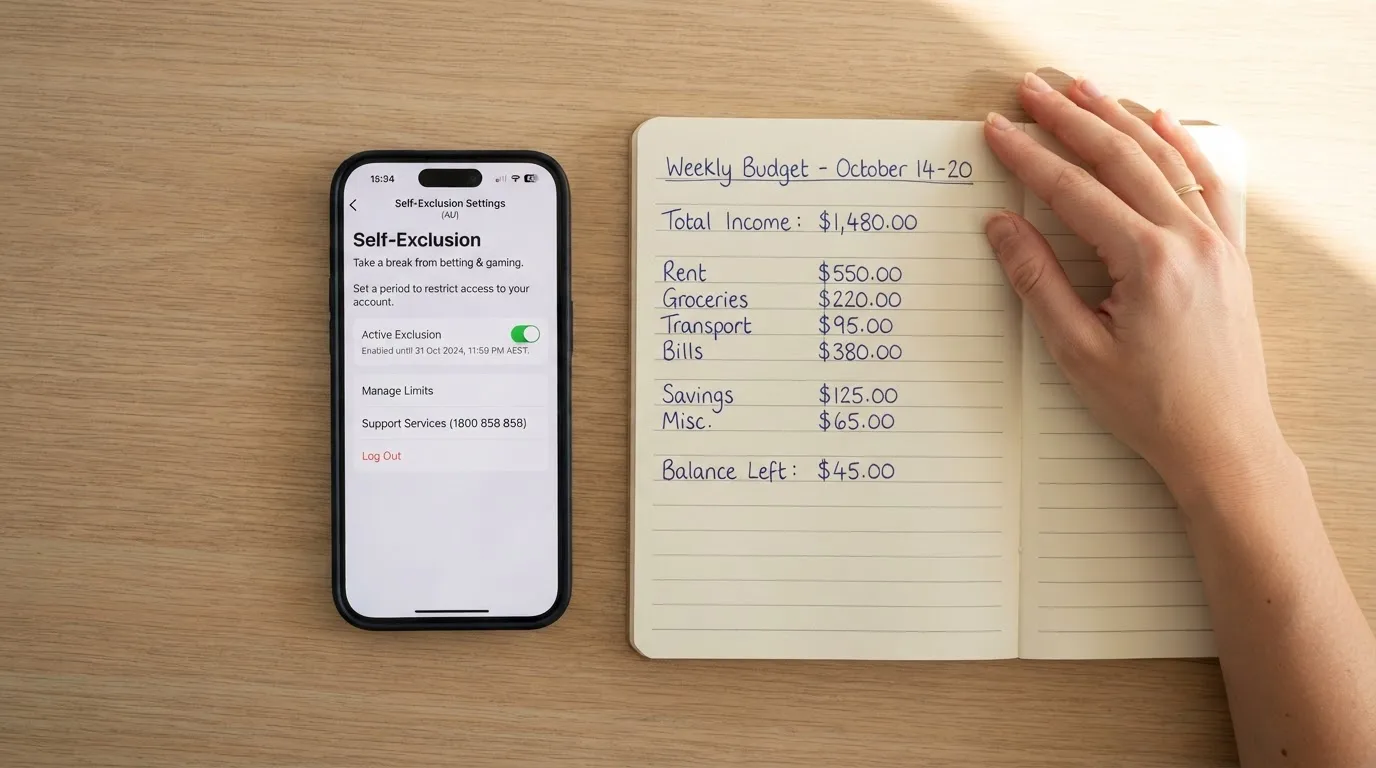
A single login that works across several sites solves a real problem for the operator — keeping the player’s session alive as they move from one white-label brand to the next — and it solves a real problem for the player: not typing the same details into a new form. The cost is the same single point of view across every site the network touches. There is no consolidated balance view, no consolidated deposit-history view, and the network’s two-factor authentication does not aggregate anything about the player that the player did not already type in.
What that means in practice is that a player with five Inclave-linked accounts has to maintain five separate records of what they deposited, what they wagered and what they withdrew, because each operator’s cashier sees only its own slice. The H2 Gambling Capital 2025 report estimates Australians lose about A$3.9 billion a year to illegal gambling sites, and that the share of gambling going through legal channels fell from 74% in 2021 to 64%. That shift of roughly ten percentage points in four years is the size of the population the consolidated view has to be done by hand.
The Australian-licensed side, by contrast, sits inside BetStop. A player who has self-excluded through BetStop cannot open a new account with any Australian-licensed wagering provider for the exclusion period they nominated, and the provider cannot accept their action. An offshore Inclave casino has no obligation to honour a BetStop registration, and the registration is not transmitted to it. Australian bank gambling blocks, applied at the card level, catch the offshore site where it tries to debit the card — which is part of the reason crypto deposits feature so heavily in offshore cashier screens.
The practical toolkit for a player who decides to play at one site only, on a debit card, with a hard weekly limit written down, is what a responsible-gaming approach looks like on this side of the law. It does not need Inclave to work and it does not need an offshore licence to clear it. What it needs is a notepad and a banker who will let the card block be on long enough to make removing it a deliberate choice rather than a tired one.
The operators behind an Australian-facing Inclave list, and what the ACMA has published about each
Every operator in this section is listed because the ACMA itself published a formal warning about it for offering prohibited services to Australians. The entries are not a recommendation to play, and the list is not a ranking. The order is the order in which the ACMA’s published formal-warning notices put them on the public record.
| Brand | ACMA action and date | Operator named by the ACMA | Inclave support |
|---|---|---|---|
| RocketPlay | Formal warning, March 2026; earlier Dama N.V. warning May 2022 | Pulsup Ltd (Rocketplay.com.au); Dama N.V. | Listings mention the network |
| Level Up Casino | Formal warning, May 2022 | Dama N.V. | Listings mention the network |
| Woo Casino | Formal warning, March 2025 | Dama N.V. | No data |
| Spirit Casino | Formal warning, May 2025 | Dama N.V. | No data |
| National Casino | Formal warning, July 2025 | Consolutetish S.R.L. | Listings mention the network |
| Bizzo Casino | Formal warning, July 2025; earlier TechSolutions warning 2022 | Consolutetish S.R.L.; TechSolutions (CY) Group and TechSolutions Group N.V. | Listings mention the network |
| Ignition Casino | Formal warning, July 2025 | Bamboo Media | No data |
| Instant Casino | Formal warning, February 2025 | EOD Code SRL | Listings mention the network |
| Jackbit | Formal warning, April 2026 | Ryker B.V. | No data |
| Casino Intense | Formal warning, April 2025 | Sterplay Holding Ltd | Listings mention the network |
| Sky Crown | Formal warning, September 2022 | Hollycorn N.V. | No data |
The table is the regulator’s record, not the operator’s marketing. Two of the eleven entries — Woo Casino and Bizzo Casino — were the subject of a second formal warning tied to the same brand within roughly three years of the first, and a third — RocketPlay — was warned under one operator in 2022 and a different one in 2026. The list of operator names reads like a sequence of corporate vehicles rather than a sequence of separate businesses.
RocketPlay
RocketPlay was the subject of a formal warning in May 2022 against Dama N.V. as one of six brands, and again in March 2026 against Pulsup Ltd, this time over the Australian-facing Rocketplay.com.au domain. The 2026 action post-dates the 2022 action by nearly four years, which means the brand has been on the regulator’s radar across most of its Australian-facing life. Industry listings continue to flag the site on Inclave-compatible directories, but the public record on it is two formal warnings from two different operators.
RocketPlay has now been flagged by the regulator twice for the same prohibited service, confirming its status as a site operating outside of Australian law.
Level Up Casino
Level Up Casino was named in the May 2022 Dama N.V. warning, one of six brands covered by the same notice. There is no published second formal warning under a separate corporate vehicle, but Level Up has the same operator history as several of the other brands on this list and the same Anjouan/Curaçao footer. Listings flag it on Inclave-compatible directories.
Four years after its initial warning, the brand continues to accept Australian players despite the regulator’s continued focus on this operator group.
Woo Casino
Woo Casino was the subject of a March 2025 formal warning against Dama N.V., the second time that operator had come to the regulator’s attention after the 2022 notice. This brand does not appear in the industry directories analyzed for this list.
The regulator’s repeated focus on this operator group clearly indicates a lack of compliance, irrespective of the site’s own assessment.
Spirit Casino
Spirit Casino was the subject of a May 2025 formal warning against Dama N.V., the third Dama N.V. brand to come to the regulator’s attention after the 2022 batch. Like Woo Casino, this site is omitted from the analyzed Inclave-compatible directories.
As with other brands from the same operator, this site remains on the ACMA’s radar.
National Casino
National Casino was the subject of a July 2025 formal warning against Consolutetish S.R.L., paired with Bizzo Casino in the same notice. Industry listings flag it on Inclave-compatible directories and reference Australian-specific routes such as BetStop and AUSTRAC’s reporting thresholds in the brand’s marketing.
It is contradictory for a brand to market Australian-specific safety features while simultaneously ignoring the formal warnings issued by the regulator overseeing those very features.
Bizzo Casino
Bizzo Casino was the subject of a 2022 formal warning to TechSolutions (CY) Group Limited and TechSolutions Group N.V., and then a second formal warning in July 2025 to Consolutetish S.R.L. The same brand has been warned twice in three years, under two different corporate vehicles, and the second warning has not been withdrawn. Industry listings flag it on Inclave-compatible directories.
With two formal warnings in three years, the brand’s continued presence is a direct challenge to the regulator’s authority.
Ignition Casino
Ignition Casino was the subject of a July 2025 formal warning against Bamboo Media. Industry listings do not flag it on Inclave-compatible directories in the research base. Ignition has historically been marketed at Australian players, and its Australian-facing presence is the reason the ACMA published the warning.
Being subject to a formal warning for targeting Australians is the primary reason this brand is on the regulator’s record.
Instant Casino
Instant Casino was the subject of a February 2025 formal warning against EOD Code SRL. Industry listings flag it on Inclave-compatible directories and mention payment routes such as ecoPayz and PayID, the latter being a payment rail an Australian player might already have set up, and one whose account-name display feature is itself a warning about scam sites.
A brand which lists PayID as a deposit route is either operating outside the Australian rules and using the rail to receive money, or is operating inside them, in which case a formal warning would be unlikely. The 2025 formal warning clarifies that this is the former case.
Jackbit
Jackbit was the subject of an April 2026 formal warning against Ryker B.V., paired in the same notice with CasinOK. Industry listings do not flag it on Inclave-compatible directories in the research base.
Given that this formal warning is only a few months old, there is no evidence to suggest that the site has altered its policy towards Australian players.
Casino Intense
Casino Intense was the subject of an April 2025 formal warning against Sterplay Holding Ltd. Industry listings flag it on Inclave-compatible directories and reference Australian-specific infrastructure such as BetStop and AUSTRAC, in the same posture National Casino takes.
Like National Casino, this site attempts to project an air of legitimacy by citing local regulatory bodies, which contrasts sharply with the formal warnings it has received from the ACMA.
Sky Crown
Sky Crown was the subject of a September 2022 formal warning against Hollycorn N.V., paired in the same notice with Blue Leo. Industry listings do not flag it on Inclave-compatible directories in the research base. Sky Crown is the oldest formal warning on this list, which is itself a useful fact — a brand that has been on the regulator’s record for over three years without a published second warning is, in this set, the closest thing to a quiet history.
For an Australian reader, the practical reading is that a 2022 warning does not expire, and an Australian-facing site that was on the regulator’s record in 2022 has not been taken off it. Quiet is not the same as cleared.
Choosing, on the choices an Australian player actually has
What an Australian player is choosing between is not which of these eleven brands to open an account at. The IGA closes that choice off. What the player is choosing between is the small set of legal alternatives and the larger set of offshore options the ACMA has been told to block, plus the set of practical guardrails the legal and banking infrastructure already offers.
The licensed wagering side has Sportsbet, Bet365, Ladbrokes and 49 other online bookmakers, all Northern Territory-licensed for sports and racing before the event. None of them can offer online casino games, online pokies or in-play betting to a person in Australia. Credit cards and crypto are not accepted; debit card, bank transfer, PayID/Osko and BPAY are. BetStop is the self-exclusion register that works for that side. The National Gambling Helpline at 1800 858 858 is free, 24/7.
The offshore side is what this page is about, and the practical guardrails that work there are the bank-level gambling blocks, the bank transfer rails that show the recipient’s name before the money moves, and the ACMA’s published register of formal warnings. None of those guardrails is unique to Inclave, none of them is stronger because the login is shared, and the licensed alternative does not need an Inclave account to use.
The right read of the eleven brands above is not which one is the best Inclave casino. It is that none of them is a legal place for an Australian player to play, the regulator has published that view in writing for each, and the practical question for a reader is whether the licensed alternative covers the kind of betting they actually want to do.
Frequently asked questions
Is a casino using the Inclave login system legal for an Australian player to use?
No. The IGA prohibits the supply of online casino games to anyone in Australia, and the supply is illegal regardless of whether the registration form lives on the casino’s own site or on a shared login service. The ACMA has issued formal warnings against Australian-facing Inclave-compatible brands.
What does the Inclave system actually connect between different casino sites?
A username, a password and a two-factor step. It does not consolidate balances, deposit histories, wagering records or self-exclusion status across sites, and an Australian player using it is responsible for tracking spend on each operator separately.
Do new Inclave casinos share the same account balance as older ones on the network?
No. Inclave authenticates the player at each operator; it does not pool funds. A balance at one operator is not transferable to another operator under the same login, and a withdrawal request has to be made to each operator separately.
Is signing up once through Inclave different from creating a separate account at each site?
It is the same legal and financial outcome for the player. KYC checks, deposit limits, withdrawal rules and the operator’s identity are set per site, not per login, so the convenience is on the login step only.
How can someone track total spend across several sites linked by one Inclave login?
The network does not do this for the player. The realistic options are a manual ledger kept by the player, a per-card banking block that fails at the deposit step, and BetStop — which only binds Australian-licensed operators, so it does not cover an offshore Inclave casino directly but does remove the licensed half of the spend.