
Google Pay at Australian online casinos: the cost a reader pays before the first spin
The cheapest way to put money into an offshore casino from Australia is Google Pay. That sentence is the entire reason this page exists, and it is also the reason a reader who only read this far would walk away with the wrong impression. The price tag is not on the cashier page. It sits one layer up: the Interactive Gambling Act 2001, the Australian Communications and Media Authority’s enforcement record, and the fact that an Australian-licensed online casino does not exist. What follows is a working breakdown of what Google Pay actually does at these sites, what it does not do, and what it costs a player who uses it anyway.
Current as of 28 October 2026. Operator status and licence claims verified against the ACMA’s formal warning register.
Table of Contents
- Responsible gambling comes first — because the offer isn’t the cost
- What Google Pay actually does at an offshore casino cashier
- The eleven brands the ACMA has warned
- How Google Pay fits into a market the law has already settled
- The legal frame a reader should hold in their head
- The cost, restated
- Frequently asked questions
Responsible gambling comes first — because the offer isn’t the cost
A reader who typed “casinos that accept Google Pay Australia” into a search box has already crossed a threshold most guides don’t name. None of the brands that surface for that query hold an Australian licence. The ones on this page — RocketPlay, Level Up, Woo, Spirit, National, Bizzo, Ignition, Instant Casino, Jackbit, Casino Intense, Sky Crown — have each received a formal warning from the ACMA for offering prohibited interactive gambling services to Australians. That is the starting line, and ignoring it is how the real cost arrives.
The blunt instrument the law gives a player who wants to back away is BetStop, the National Self-Exclusion Register. It went live in August 2023 and binds every Australian-licensed online and phone wagering service. An offshore casino is not connected to it. Registering with BetStop will not stop a deposit to Woo Casino landing, and the register cannot freeze a balance already on an offshore account. It works on the legal half of the market and stops there.

The tool that does bite offshore sites sits in a banking app. NAB, ANZ and Westpac all let customers apply a gambling block to eligible personal credit and debit cards without phoning or visiting a branch. ANZ’s block, activated through the ANZ app, also blocks gambling transactions made through a digital wallet on an eligible card — Apple Pay, Google Pay, Samsung Pay, all of them. Once on, ANZ imposes a 48-hour cooling-off before the block can be removed, and the bank warns in plain language that the block is not perfect: some gambling transactions will slip through, and some non-gambling transactions will be declined in error. Westpac’s version works at card level — it refuses authorisation on any transaction carrying the merchant category code for betting and casino gambling.
For someone who has already deposited, the National Gambling Helpline is 1800 858 858, free and answered around the clock, with webchat through Gambling Help Online. Both are run by registered Australian counsellors and neither asks a caller to identify themselves. They are the one part of the cost a reader can recover.
What Google Pay actually does at an offshore casino cashier
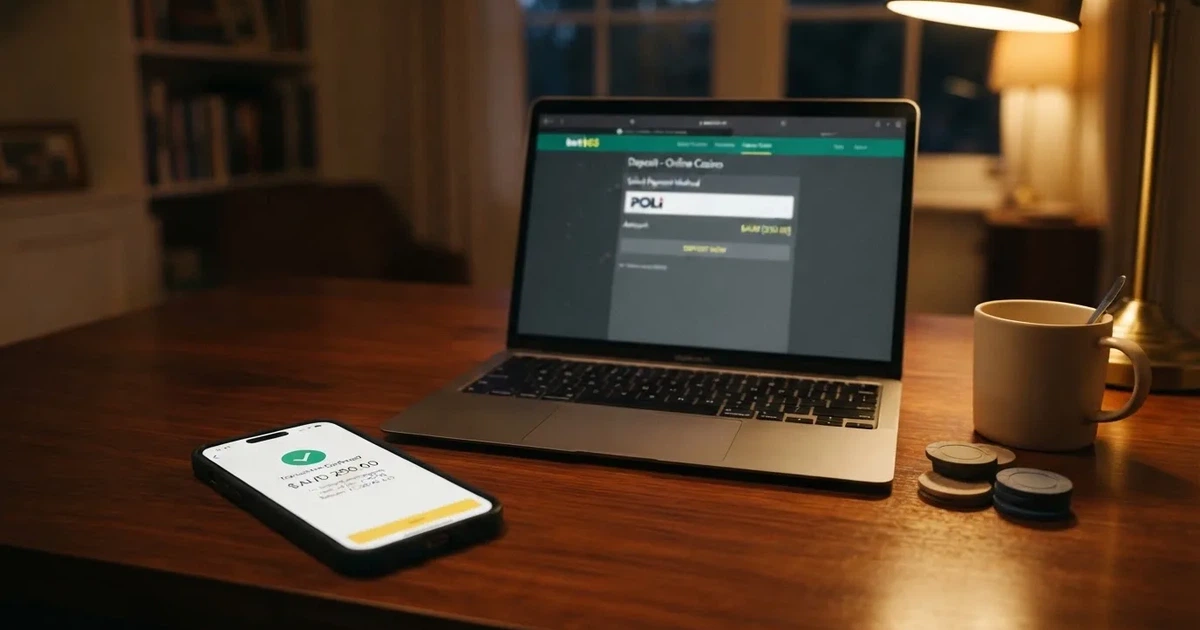
The mechanics of Google Pay at an offshore casino are unremarkable. A player adds a Visa, Mastercard or Amex to Google Wallet, opens the cashier, picks Google Pay, confirms with face or fingerprint, and the deposit arrives in seconds. The casino never sees the real card number. What it sees is a token — a Device Account Number generated by the card-issuing bank for that one device — and a payment processor’s authorisation. That tokenisation is the genuine security story Google Pay sells, and it is real: even if the casino’s payment processor is breached, the card data stored on file is not the player’s actual PAN.
The system underneath is older than most players realise. Google launched Android Pay, the precursor to Google Pay, in Australia in 2016. The wallet needs an NFC-enabled Android phone running Android 5.0 or later. By the end of 2025, Google Pay, Apple Pay and Samsung Pay together accounted for roughly 45 per cent of all card payments in Australia by number — a market share built on in-store contactless rather than online gambling, but the rails are the same.
A few wrinkles matter specifically for an Australian player:
- The deposit card still has to clear the merchant category code check at the issuing bank. Westpac’s gambling block refuses authorisation on the MCC for betting and casino gambling, regardless of the wallet wrapped around it. The block applies to the card, not to the device.
- ANZ’s block, similarly, covers digital wallet transactions on the blocked card. The wallet is a pass-through, not a workaround.
- Credit cards cannot be used at any Australian-licensed online wagering service, a ban that took effect on 11 June 2024 and includes credit-linked digital wallets. The ban applies to licensed Australian wagering; it does not change the IGA position on offshore casinos, which is that the operator is the offender, not the player.
The minimum deposit at most of these sites is set low for a reason. A$10 is the figure that recurs across the listings, with A$20 the next step up. A low floor pulls a player in for a small first session, the casino holds the card token, and a follow-up deposit rarely requires the same deliberation as the first one.
The withdrawal side is where Google Pay stops being a clean substitute for the card. Most offshore casinos will deposit through a wallet but require the withdrawal to go back to a bank account, a card, or sometimes a crypto address. Where a Google Pay withdrawal is offered at all, it still needs the casino’s own internal checks — source-of-funds, identity verification, anti-money-laundering review — before the settlement lands. Those checks are manual and not standardised. A withdrawal request that posts on a Friday night can sit over a weekend and still take a working day or two on top.
Fees and surcharges
Apple Pay, which sets the template the others follow, charges the consumer nothing — Apple states on its Australian site that no fee applies to a buyer using Apple Pay in a store, online or in an app. Any surcharge at the merchant comes from the merchant’s own card-processing costs, not from the wallet. Google Pay and Samsung Pay follow the same model. The Reserve Bank of Australia’s July 2025 review proposes removing surcharges on eftpos, Mastercard and Visa transactions only; American Express sits explicitly outside the proposed ban, which is why an Amex-funded Google Pay deposit is the one route that can still carry a surcharge.
At an offshore casino, the fee question tends to disappear behind a different one: the operator’s house edge on the games themselves. That cost does not show up on the cashier page. It is built into every spin.
The eleven brands the ACMA has warned
The following operators each received a formal warning from the ACMA for offering prohibited interactive gambling services to Australians. They are not a ranking. They are the public record of what the regulator has named, in roughly the order it named them in the warnings themselves. A reader who recognises a brand on this list is reading the page that explains why it is here.
| Brand | ACMA action and date | Operator named by the ACMA | Google Pay support |
|---|---|---|---|
| RocketPlay | Formal warning, March 2026; earlier Dama N.V. action, May 2022 | Pulsup Ltd (RocketPlay) | — |
| Level Up Casino | Formal warning, May 2022 | Dama N.V. | Westpac lists Level Up among sites its gambling block declines at the merchant level |
| Woo Casino | Formal warning, March 2025 | Dama N.V. | — |
| Spirit Casino | Formal warning, May 2025 | Dama N.V. | — |
| National Casino | Formal warning, July 2025 | Consolutetish S.R.L. | AUSTRAC and public records list National among payment-routed brands |
| Bizzo Casino | Formal warning, July 2025; earlier 2022 warning | Consolutetish S.R.L. (2025); TechSolutions (2022) | — |
| Ignition Casino | Formal warning, July 2025 | Bamboo Media | — |
| Instant Casino | Formal warning, February 2025 | EOD Code SRL | ecoPayz and PayID appear on the operator’s payment listings |
| Jackbit | Formal warning, April 2026 | Ryker B.V. | — |
| Casino Intense | Formal warning, April 2025 | Sterplay Holding Ltd | AUSTRAC, ITnews and NAB all carry Casino Intense on payment-routed records |
| Sky Crown | Formal warning, September 2022 | Hollycorn N.V. | — |
Two things the table does not show. First, none of the eleven can lawfully serve an Australian resident under the IGA; the licence a brand displays at the bottom of its homepage, whether Curaçao, Kahnawake or Anjouan, is not an Australian licence and confers no Australian consumer protection. Second, the “Google Pay support” column is mostly empty because most of the operators have no public confirmation of wallet support that survives a regulator’s review — what an affiliate marketing page writes about Apple Pay or Google Pay at these sites is not the same as a confirmed cashier route, and an absent cell on the table is the honest answer.
RocketPlay
RocketPlay is the most recent ACMA action on this list — a formal warning to Pulsup Ltd in March 2026 over RocketPlay — and the same brand was caught up in Dama N.V.’s earlier 2022 warning. The intervening years have not changed the IGA position: online casino games cannot be licensed anywhere in Australia, and a brand that has been warned twice is not a brand that has quietly come into compliance. The cost here is the same as for any other offshore casino, plus the regulator’s own recorded view that the operator continued offering prohibited services after the first warning.
Level Up Casino
Level Up sits on Dama N.V.’s May 2022 warning, the earliest formal action on this page. Westpac’s gambling-block documentation specifically names Level Up among the operators whose transactions the block declines at merchant level — which is a different kind of confirmation than an operator’s own payment page, because it comes from an Australian bank’s compliance list rather than from a marketing claim. The block is a card-level refusal; the wallet around the card does not change the outcome.
Woo Casino
Woo Casino received a fresh ACMA warning in March 2025, three years after its parent Dama N.V. first appeared on the regulator’s list. Two warnings to the same operator family over the same prohibited conduct is the pattern the IGA was amended to address — the 2017 amendments strengthened enforcement and gave the ACMA a longer reach. The arithmetic on a brand warned twice is straightforward: the first warning did not produce a withdrawal from the Australian market.
Spirit Casino
Spirit Casino was named in Dama N.V.’s second warning round, dated May 2025. Spirit sits alongside Woo in what is now the regulator’s most-warned operator family on this page. Reading the two warnings together is the only honest way to read either one: an operator warned twice inside three years has demonstrated that the cost of a formal warning, in its own calculation, is lower than the cost of leaving the Australian market.
National Casino
National Casino was the subject of a formal warning in July 2025, with Consolutetish S.R.L. named as the operator. AUSTRAC and public-records listings carry National among payment-routed brands, which is the limit of what a non-affiliate source will confirm about the site’s cashier. The IGA position is unaffected by how the deposit clears.
Bizzo Casino
Bizzo Casino is the only brand on this page that has been the subject of two separate ACMA warnings — one to TechSolutions in 2022 and a second to Consolutetish S.R.L. in July 2025. The 2025 warning also covered National Casino, which means the operator changed the corporate wrapper around the brand and the warning followed it. For a player, that is the cleanest possible demonstration that a change of corporate entity does not change the legal position.
Ignition Casino
Ignition Casino is named in the same July 2025 warning as Bamboo Media. Ignition has a longer offshore history than most brands on this list, and a longer history of serving Australian customers without an Australian licence. The cost here is identical to the rest, and the regulator has now added its name to the public record.
Instant Casino
Instant Casino was warned in February 2025 over EOD Code SRL. The operator’s own payment listings reference ecoPayz and PayID among the deposit routes — a PayID deposit to a brand under formal warning is the case AusPayPlus warns about directly, because a PayID transfer shows the account holder’s name before the money is sent and a request to send to an illegal gambling site’s PayID almost certainly means a scam site. A reader who tries Instant Casino and is asked for a PayID deposit is at the seam between a regulator’s warning and a payments-industry warning, and both are pointing the same way.
Jackbit
Jackbit received a formal warning in April 2026, naming Ryker B.V. as the operator. Jackbit is a crypto-first casino by most accounts of its cashier, and crypto is the payment route most consistently outside the Australian rules — digital currency is banned as a deposit method for Australian-licensed online wagering, and an offshore crypto casino sits well outside that licence frame. Google Pay support at a crypto-first site is therefore a niche question that the research record does not confirm.
Casino Intense
Casino Intense was warned in April 2025 over Sterplay Holding Ltd. AUSTRAC, ITnews and NAB all carry Casino Intense on payment-routed records — three Australian-sourced listings rather than the usual single affiliate page, which is the closest thing the public record offers to confirmed cashier information. None of those listings confirms Google Pay specifically.
Sky Crown
Sky Crown sits on Hollycorn N.V.’s September 2022 warning, alongside Blue Leo. Hollycorn is one of the larger Curaçao-licensed groups named in the ACMA’s register and has appeared on multiple warning rounds. The 2022 date means the warning is the oldest still-current action on this page, which is itself information: a brand under warning for nearly four years has had every chance to withdraw from the Australian market and has not.
How Google Pay fits into a market the law has already settled
The Google Pay casino question in Australia is not really a payments question. It is a market-structure question dressed up as one. Australian households run roughly A$3.9 billion a year through illegal offshore gambling sites, according to H2 Gambling Capital’s 2025 estimate, and the share of gambling flowing through legal Australian channels has fallen from 74 per cent in 2021 to 64 per cent. What the numbers describe is a market the legal framework cannot reach, and a payment method that the legal framework can reach only through the issuing bank.
The legal half of the Australian market looks different. The Northern Territory Racing and Wagering Commission regulates 52 of Australia’s online bookmakers — Sportsbet, Bet365 and Ladbrokes among them — licensed in the Territory for historical tax reasons. The commission has no full-time staff and meets once a month in Darwin. That is the regulator covering the wagering side of the legal market; there is no equivalent regulator for online casino games, because no state or territory licences them. The Northern Territory bookmakers take bets on races and sporting events placed before the event. They do not run pokies, blackjack or roulette online.
A Google Pay deposit at one of those licensed NT bookmakers would, in principle, work: the same wallet, the same tokenisation, the same Visa or Mastercard underneath. What stops it is the IGA itself, which since 2017 has banned credit cards and credit-related products at Australian-licensed online wagering services, and since 11 June 2024 has applied that ban to credit-linked digital wallets. Debit card, bank transfer, PayID via Osko and BPAY are the legal deposit routes. A licensed Australian wagering service that accepts Google Pay is, by definition, accepting credit — because almost every credit card tokenised inside Google Pay remains a credit card underneath.
The path a deposit takes at an offshore casino is the same wallet, the same token, but on the wrong side of the IGA. The casino holds the player funds in a Curaçao or Maltese bank account, settles through an international processor, and answers to none of the Australian consumer protections a player might assume are in place. The tokenisation story still holds — the player’s real card number is still safe — but the money is sitting in a jurisdiction the ACMA can block but cannot otherwise reach.
The blocking rate, in plain numbers
The ACMA’s enforcement record is the one measurable proxy for how fast the regulator can move against an offshore casino. As of June 2026, the ACMA had asked Australian ISPs to block 1,751 illegal gambling and affiliate marketing websites, starting from the first blocking request in November 2019. That works out to roughly a blocking request every one to two weeks over the six-and-a-half-year window, with a marked acceleration after the 2017 amendments. In the most recent reported round alone — 26 June 2026 — the ACMA added 12 more sites: 7Signs, ChromaBet, Donbet, Duospin, Freshbet, Slots Gem, Jacks Club, Lucky Start, Pointsbetz, Spinrise, Vinyl Casino and Wildsino. More than 230 unlicensed gambling services have left the Australian market since 2017, either by blocking or by voluntary withdrawal after a warning.
The arithmetic that matters for a reader is not the rate itself. It is what the rate implies about how long an offshore casino remains reachable from Australia. A brand that is named in a formal warning today typically sees its site blocked at the ISP level within weeks; a brand that is named in a blocking round is reachable only through VPNs and mirror domains from that point on. None of the eleven operators on this page has been formally blocked at the time of writing — they sit one step earlier in the ACMA’s pipeline, on the warning list rather than the block list. That is a temporary state, not a permanent one.
The legal frame a reader should hold in their head
The Interactive Gambling Act 2001 is the centre of gravity, and everything else sits around it. The IGA, as amended in 2017, makes it an offence to provide online casino games, online pokies or in-play betting to a person in Australia. The 2017 amendments gave the ACMA its current enforcement reach: formal warnings, civil penalty orders, and the ability to direct Australian ISPs to block offending sites. The 2023 amendments extended the credit-card ban to credit-related products including credit-linked digital wallets; the new Interactive Gambling Amendment (Gambling Reform) Bill 2026, which passed Parliament on 19 August 2026, will tighten advertising and inducement rules from 1 January 2027 — law with a future start date, not yet in force.
The IGA targets the provider, not the player. An individual Australian who deposits at an offshore casino is not prosecuted. What the player loses is the Australian consumer protection: no Australian complaints body, no recourse if a withdrawal is refused, no guarantee that a balance sitting in an offshore account is recoverable if the site is blocked. The ACMA can block the site; it cannot move the player’s money.
Age is 18 across the board. Recreational gambling winnings are not assessable income and losses are not deductible; a player who is running a gambling business is in different territory and should check with the ATO. None of this changes the IGA position, which is the same regardless of the player’s tax status.
What a deposit actually costs
Cost on the cashier page: the deposit fee is usually zero, because Google Pay charges the consumer nothing and the casino’s own fee schedule rarely lists a wallet deposit line item. The merchant surcharge that the Reserve Bank is moving to remove on eftpos, Mastercard and Visa transactions does not apply to Google Pay directly, but it does apply to the underlying card if that card is American Express, which the RBA’s July 2025 review left explicitly outside the proposed surcharge ban.
Cost underneath the cashier page: the house edge. Every spin at an offshore pokie returns, on average, somewhere between 90 and 96 per cent of what is wagered, depending on the game and the operator’s published RTP. The gap is the casino’s margin. It does not appear as a fee. It is built into every spin.
Cost outside the cashier page: the legal and recovery costs already laid out — no Australian consumer protection, the ACMA’s enforcement record, the offshore jurisdiction holding the player’s funds, the national ban on credit-funded wagering that applies to Australian-licensed operators and is irrelevant to offshore ones.
What a withdrawal actually takes
A Google Pay withdrawal, where the casino offers one, goes back through the same tokenisation system. The wallet token is reused; the casino pushes a refund against the original transaction. In practice, the bottleneck is not the wallet. It is the casino’s own internal checks: identity verification on the first withdrawal, source-of-funds on larger amounts, anti-money-laundering review that can take 24 to 72 hours even on a fast-paying operator. Weekends and public holidays stretch that further. A player who deposits at 8pm Friday and asks for a withdrawal before midnight has a realistic chance of seeing the funds on Tuesday, and that is on a site that processes withdrawals promptly. A site that does not will simply hold the request until its own internal review window closes.
For a player who has set a card-level gambling block at ANZ or Westpac, the picture changes again. The deposit leg has already been declined; the withdrawal leg is a credit back to a card that may now refuse to process a gambling-related credit. In that case the casino will fall back to a bank transfer, usually international, with its own fees and its own settlement time.
The cost, restated
Google Pay is the cheapest way to get money into an offshore casino from Australia because it is the cheapest wallet-to-merchant route the Australian card system offers, and because the casino itself has no incentive to charge for a deposit that is about to lose the player 4 to 10 per cent of its value at the tables. The cost a reader pays is not the deposit fee. It is the absence of Australian consumer protection over the funds once they clear, the regulator’s enforcement record against the operator carrying the brand, and the statistical certainty that the house edge will compound across every session a player runs through that cashier. A reader who treats Google Pay as the price of convenience is treating the wrong number as the price. The convenience is real. The cost is downstream of it.
Frequently asked questions
Is it legal for an online casino to accept Google Pay from a player in Australia?
No online casino may lawfully serve an Australian resident under the Interactive Gambling Act 2001, regardless of whether the casino accepts Google Pay as a deposit method. The law targets the provider, not the player, so the individual is not prosecuted — but the site has no Australian consumer protection and no Australian complaints body behind it. Credit-funded deposits, including credit cards tokenised inside Google Pay, are also banned at Australian-licensed wagering services from 11 June 2024.
What is the smallest deposit a Google Pay casino site usually asks for?
A$10 is the floor that recurs across most offshore casino listings, with A$20 the next step. The minimum is set deliberately low because the first deposit is the most expensive one for the player to walk away from; a casino that takes A$10 has bought itself a chance to take the next deposit on easier terms. The minimum is also the maximum a player can lose without consciously deciding to reload.
Does a Google Pay withdrawal clear any faster than a card withdrawal at these sites?
Where the casino offers Google Pay as a withdrawal route at all, the wallet does not change the underlying settlement. The casino’s own internal checks — identity verification, source-of-funds review, anti-money-laundering checks — still have to complete before any funds move. On a fast-paying operator that means 24 to 72 hours; on a slow one, longer, with weekends adding days on top.
Can Google Pay be used at every offshore pokies-style site, or only some of them?
Google Pay is widely listed as a deposit method across offshore casino sites, but the listings on affiliate marketing pages and the cashier routes the casino actually supports are not always the same thing. Some sites list Google Pay at the top of the cashier and decline it at the authorisation step; some accept it for deposits but route withdrawals back to a bank account; some accept only specific card types inside the wallet. The honest answer is that Google Pay support varies operator by operator and cannot be inferred from the brand name.
Does depositing with Google Pay add an extra fee at these casino sites?
No. Google Pay does not charge the consumer a fee, and most offshore casinos do not add a deposit-side surcharge for wallet funding. The fee that does sometimes appear is a card surcharge at the merchant level, which sits on the underlying card transaction rather than on the wallet, and which the Reserve Bank’s July 2025 review proposes to remove for eftpos, Mastercard and Visa — leaving American Express, which is the one card type that can still carry a Google Pay surcharge, outside the proposed ban.