
Licensed pokies venues in Canberra in 2026: what the ACT actually has on the floor
Anyone searching for pokies in Canberra quickly runs into a wall. The ACT has a real, licensed pokies scene, but it is small, mostly club-based, and stripped of any online substitute. Casino Canberra itself runs no machines. What the internet offers instead is an offshore market the Interactive Gambling Act prohibits, with most major brands warned by the ACMA in the last three years. The consequence of that gap lands on the player: there is no licensed online pokies product in Australia, and the sites that brand themselves as such are blocked, warned, or quietly dropped by their operators. This page is the result of going through what is licensed and what isn’t, and what follows from the difference.
Data current as of 28 October 2026, checked against ACMA enforcement notices and ACT Gambling and Racing Commission records.
Table of Contents
- The land-based venues that actually hold ACT pokies licences
- Payments, payout percentages, and what cashless gaming changes
- Paytable specifics, 24-hour venues, and the cashless shift inside ACT clubs
- How any shortlist of Canberra pokies venues should actually be built
- The fundamentals of what a Canberra pokies venue actually is
- The prohibition, the Interactive Gambling Act, and how the ACMA enforces it
- Self-exclusion, the helpline, and what help looks like in the ACT
- Offshore brands the ACMA has formally warned since 2022
- Frequently asked questions
The land-based venues that actually hold ACT pokies licences
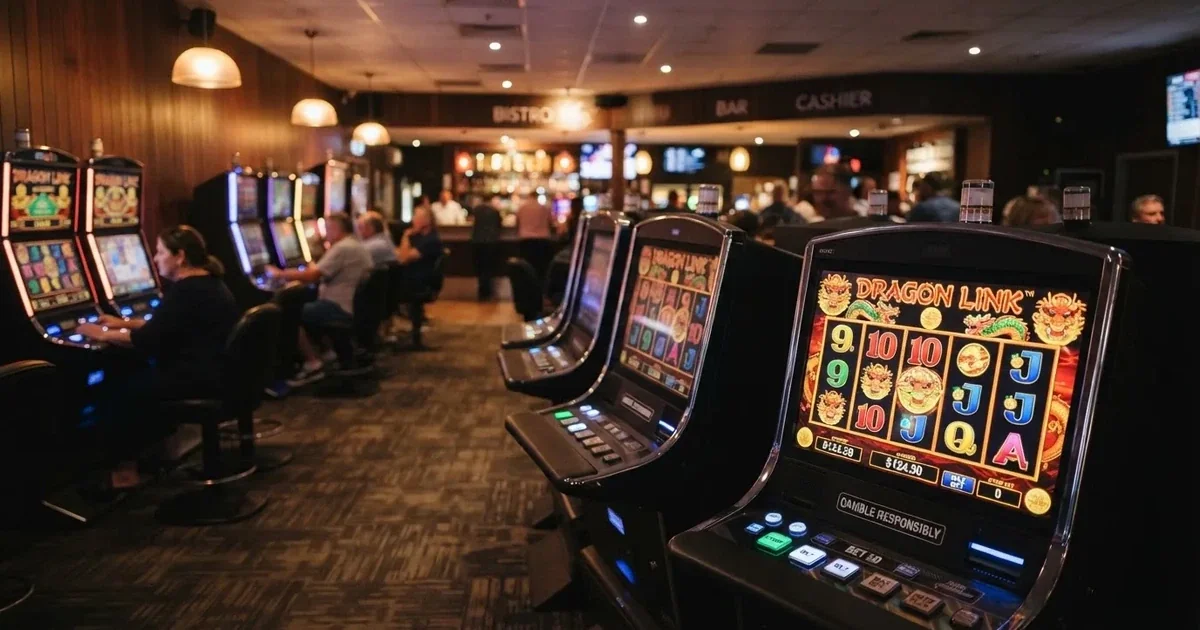
Canberra sits in a small pokies market by Australian standards. On 1 November 2023 the ACT had 3,587 gaming machines operating across 46 venues, with 5,091 machines approved and not all switched on at any given time. Compare that with Queensland’s 21,122 machines in 351 venues at the same point, or South Australia’s 11,672 outside Adelaide Casino in 471 venues. The territory is licensed through the ACT Gambling and Racing Commission, the same body that runs the casino, and the same one that hands out venue and employee licences.
The most striking feature is what Casino Canberra does not offer. The casino sits on 21 Binara Street in the CBD, on land excised from Glebe Park under a 99-year lease and licensed to Aquis Canberra Pty Ltd on 23 December 2014 — now operated by Casino Canberra Limited. It is the only legal casino in the ACT. It runs 39 gaming tables for blackjack, roulette, baccarat and other games, plus a poker lounge and a sports lounge. It runs no poker machines. Casino Canberra is the only casino in Australia not licensed to operate poker machines.
That leaves the 46 licensed clubs and hotels as the only places to play pokies in Canberra. The ACT clusters its machines in licensed clubs rather than pubs; hotels in the territory often operate bars, restaurants and function rooms without a gaming entitlement. The clubs spread across the suburbs — Belconnen, Woden, Tuggeranong, Gungahlin — and a handful sit within the CBD and the area loosely called Canberra City. The airport itself is dry for gaming: there are no licensed pokies venues in Canberra Airport. The handful near the airport are in the neighbouring suburbs of Pialligo and Majura, off-terminal and reached by car.
What “best” means in this market comes down to three things, and only three. First, a venue’s pokies return-to-player setting — the percentage the machine pays back over its lifetime, which is configured at the venue level within regulatory limits. Second, hours of operation — most ACT clubs run long, some effectively 24 hours, others close in the small hours. Third, atmosphere, which is genuinely subjective and cannot be answered by a regulator. The first two can be checked; the third is a reader’s own call.
The cluster of CBD and city venues is small. Clubs within a short walk of Civic include the Hellenic Club in the city centre, with gaming floors that close earlier than the suburban clubs. The big suburban clubs — the Belconnen Bowling Club, the Woden Weston Club, the Southern Cross Club in Woden, the Gungahlin Lakes Club — run longer hours and operate the bulk of the territory’s machine stock. Each of these sits on a long lease, with memberships that stretch back decades, and each carries a different combination of denomination profile and cashless rollout.
The A$0.19 billion in ACT player losses across 2022-23, recorded by the ACT Gambling and Racing Commission against these machines, works out at roughly A$53,000 per operating EGM across the year. That figure sits well below the South Australian venue average of about A$497 per adult outside Adelaide Casino, and a long way under Queensland’s larger venues. The small footprint is the headline. A punter searching for “best pokies in Canberra CBD” finds fewer venues than they would in any state capital; the trade-off is that each one has a regulated, audit-able footprint.
The cap is policy. The Gaming Machine Act 2004 sets an “authorised cap” on the number of EGMs the Commission may approve, and the cap is what holds the operating count at 3,587 against an approved ceiling of 5,091. A new venue wanting to add machines needs the cap to move first, which it has not done in years. The choice is deliberate, and it shows up in the venue map.
That policy stance matters more than it looks. It means every machine in the ACT sits inside a venue that has been individually approved, with identity checks, surveillance and harm-minimisation features built in. The data is the venue’s; the venue is the Commission’s. A punter in Civic is in one of the most contained pokies markets in the country.
Payments, payout percentages, and what cashless gaming changes
The question of how you pay in a Canberra pokies venue has a flat answer: cash, at the machine. The ACT, like every other Australian jurisdiction outside the Northern Territory’s licensed online bookmakers, runs its gaming floor on physical cash. A player puts notes into the machine, plays, and either prints a ticket or hits the attendant’s desk for cashout. There is no app, no e-wallet, no debit-card-at-the-machine.
The credit card ban matters here even though it applies to a different product. From 11 June 2024 the credit card ban covers all licensed online wagering in Australia — but it does not directly affect cash-fed gaming machines in a club. The ban is the headline reminder that the regulated Australian gambling market has narrowed its payment rails deliberately, and any site offering online pokies to an Australian and asking for a credit card is breaking Australian rules in two ways at once. Legal deposit routes for licensed wagering are debit card, bank transfer, PayID/Osko and BPAY. Penalties for operators breach the ban can run to A$247,500.
The “online pokies canberra no deposit bonus” search result, when it works, almost always lands on an offshore site. There is no licensed online pokies product to give a no-deposit bonus for, because no such product exists. Any site offering one is in the prohibited space the IGA carves out — and the ACMA has spent the last three years issuing formal warnings and blocking requests against exactly that set. The no-deposit bonus is the marketing lure for a product that cannot lawfully be sold here.
Cashless gaming, the pre-registered card model where a player tops up a venue card from a debit account and uses it at the machine, has been rolled out across parts of the ACT club network since the early 2020s, in line with a 2019 commitment by the ACT Government to introduce cashless gaming. A pre-loaded card caps how much can be spent in a session if the player sets a limit, leaves a clear transaction record for harm-minimisation follow-up, and removes the opportunity for money-laundering through repeated cash buys of value tickets. The ACT venues that have completed the rollout run their machines in cashless mode by default, with a registered-player card tied to a verified identity.
Payout percentages on ACT machines sit in the same band as every other Australian EGM jurisdiction — generally between 85% and 92%, configured at the venue level, with the Gaming Machine Act capping the maximum stake and the Commission approving settings. South Australia has published a minimum return-to-player of 87.5% and a maximum bet of A$5.00 outside Adelaide Casino, a hard floor readers can compare against. Adelaide Casino itself has no maximum-bet limit. The ACT publishes no equivalent floor, and venue-level RTP settings vary.
The “maximum cash payout” question gets a venue-specific answer rather than a regulatory one. ACT machines routinely allow several thousand dollars per ticket, but very large wins, above venue-set thresholds, require hand-pay by an attendant, identity verification and sometimes a photo for compliance. Some venues pay in cash up to a ceiling (often A$5,000 to A$10,000) and beyond that via EFT to a verified bank account. The exact threshold is the venue’s policy; the regulatory ceiling is the venue’s authorisation and the Commission’s approval.
How long a payout takes is also venue-dependent. A ticket under A$1,000 is typically redeemed at the cashier’s desk within minutes. A hand-pay over a few thousand can take ten to twenty minutes while staff verify the win, the machine and the player. Above that, and the ceiling drops sharply once the win requires compliance reporting, the EFT and compliance reporting path is a same-day event at the earliest, sometimes a 24-hour wait if the win triggers anti-money-laundering checks. None of this is hidden in the rules; it is just not advertised on a sign next to the machine.
For a punter weighing “best paying pokies canberra” against other cities, the relevant number is the venue’s RTP setting, not a regulatory floor. The ACT does not publish per-venue RTPs the way South Australia does. A reader comparing options can ask the venue directly or look at its published game library — most EGM titles in ACT clubs come from Aristocrat, Ainsworth, IGT and Konami, and individual titles carry published theoretical RTPs that the venue cannot change. The setting the venue can change is the overall machine payback, which sits a percentage point or two around the title’s default.
Paytable specifics, 24-hour venues, and the cashless shift inside ACT clubs
The paytable on a Canberra pokies machine looks the same as it does in any other Australian club, because the underlying machines come from the same manufacturers. Aristocrat Leisure remains the dominant Australian-built EGM, with Ainsworth Game Technology a long-standing local competitor. International manufacturers (IGT, Konami, Scientific Games) supply a smaller share of the ACT floor. The titles a player sees on a Canberra screen — Queen of the Nile, More Chilli, Where’s the Gold, the Lightning Link series, the Dragon Train series — are the same titles running in clubs in Sydney, Brisbane, Melbourne and Perth.
Each title’s paytable is fixed by the manufacturer and published in the game’s help screen. Aristocrat’s Queen of the Nile publishes a 94.3% theoretical RTP at its default settings. Ainsworth’s Longhorn publishes around 92%. The Lightning Link titles vary across the family but cluster around 86–88%. The point is that the title carries a fixed mathematical return, and the venue’s role is to choose which titles to deploy at what overall machine payback. A venue running 90% across the floor is putting a higher theoretical return back into play than a venue running 87%.
The “24-hour pokies in Canberra” question, phrased variously as “open now”, “all night”, “around the clock”, has a partial answer. ACT clubs run long hours. The Southern Cross Club, the Belconnen Bowling Club, the Gungahlin Lakes Club and a couple of others effectively open 24 hours on their gaming floors, even if their bars and dining close in the early hours. A handful of smaller clubs close between midnight and 6am. Casino Canberra, despite its name, runs tables only and closes well before dawn. No ACT venue is required to operate 24 hours; the long-hour claim is a venue-level commercial choice.
Cashless gaming has changed the practical paytable experience. A pre-loaded card lets a venue enforce a per-session spend limit, a daily spend limit and time-out reminders that a cash-fed machine cannot. The paytable itself is unchanged; the player experience is constrained in a way that older machines could not enforce. For a reader comparing one venue to another, the cashless rollout is a meaningful difference: an older machine is a pure cash transaction with no built-in ceiling, a cashless machine is a registered account with the Commission’s harm-minimisation defaults switched on.
The biggest practical paytable surprise inside an ACT club is the denomination. A A$1-per-line machine has a vastly higher minimum spin cost than a 1c-per-line machine, and the higher denomination usually carries a higher published RTP. The same Aristocrat title at 1c play sits around 87–88%; at A$1 play it often sits above 94%. Players who never move up the denomination scale are playing the lower-RTP variants of the same game, sometimes by a wide margin. That is paytable literacy, and it matters more than the venue choice.
The 24-hour question and the paytable question converge for one reader in particular. A punter with a small bankroll looking for a long, low-stakes session is best served by a venue that runs long hours AND a denomination profile they can afford — which in practice means hunting for the small-denomination machines inside a major club, not chasing the headline 24-hour venue that may have stripped its floor to A$1 play. The cashless card helps by capping the session; the title and denomination choice are still the player’s call.
The “best paying pokies canberra” question, on the paytable evidence, comes down to the venue’s overall machine payback setting and the player’s denomination choice. The title carries a published return; the venue configures the floor; the player picks the denomination. None of these are a secret, but the three together are rarely explained on the venue floor, and most players assume the highest denomination machine is the highest-returning — which is true on average, but the spread within a denomination is wider than the difference between denominations.
How any shortlist of Canberra pokies venues should actually be built
A “best of” list for Canberra pokies is a different shape from the equivalent list for Sydney, Melbourne or Brisbane. The ACT market is small enough that a reader’s “top N” is effectively a ranking of two or three CBD-adjacent clubs and three or four major suburban clubs, with a long tail of smaller venues that vary mostly by hours and atmosphere. The honest comparison starts by naming that.
The first filter is unambiguous. A venue must hold a current ACT Gaming Machine licence issued by the ACT Gambling and Racing Commission. A venue whose licence has been suspended, surrendered or expired drops out, regardless of how it markets itself. The Commission’s public register is the source for that filter. A “best of” list that ranks a venue without checking the register is reading a marketing page, not the regulator’s.
The second filter is hours. A reader’s use case dictates whether 24-hour operation is a tiebreaker or a non-issue. A tourist looking for a single evening’s play cares more about walk-in distance from a hotel; a regular commuter cares more about late-night access on the way home. The honest comparison acknowledges both — a list that ranks 24-hour venues at the top because they happen to fit the writer’s own schedule reads as biased.
The third filter is the gaming floor itself: how many machines, what denominations, what overall RTP setting. A club running 200 EGMs with a 90% theoretical return is offering more game variety and a slightly higher average return than a club running 30 EGMs at 87%. The data behind that comparison is partly published, partly available on request, and partly an estimate from the floor’s mix. The numbers the venue publishes tend to be the headline ones; the per-machine RTPs are buried in the title help menus.
The fourth filter is harm-minimisation. A venue that has completed the cashless rollout, runs its responsible-gambling messaging in plain English, and has staff trained to handle a self-excluded patron is doing what the regulator requires. The difference between two venues that both hold a licence can be the difference between a venue that enforces the cashless defaults and one that does not. The defaults are the Commission’s; the enforcement is the venue’s.
The fifth filter is cost beyond the machine. Parking, food and beverage quality, atmosphere — none of these affect the EGM RTP but all of them affect whether a venue is a place a reader would actually choose to play. A “best of” list that ignores them is incomplete; one that ranks venues by them is talking about a different question.
The honest answer for a reader who has never been to Canberra: there is no single “best” venue in the ACT pokies market. There are a small number of well-run clubs, each with a slightly different hours-and-denomination profile, and the choice is the reader’s based on what they actually want from a session. Any ranking that promises a single winner is ranking by a criterion it has not told the reader.
The internet’s top-10 lists for Canberra pokies almost all have the same shape: a CBD club, two or three suburban clubs, a Casino Canberra mention that omits the fact it runs no machines, and then the offshore “online pokies in Canberra” recommendations that follow the same pattern as everywhere else in Australia. The first three categories are the actual ACT market. The fourth is not the same product at all — it is offshore casino sites the ACMA has warned, and the comparison to a regulated venue is dishonest by construction.
A reader who lands on this kind of list should look for three markers before trusting it. Does it name the regulator? Does it publish RTP or denomination information? Does it treat Casino Canberra as a pokies venue when it is not? If the answer to any of these is “no”, the list is generic content built for search traffic, not a comparison built for the ACT market.
The honest ranking would name the criteria above and weight them by the reader’s own use case. A late-night cashless-floor preference points one way; a small-denomination day-time player points another. The consequence of choosing wrong is not catastrophic — every venue in the comparison holds a current licence — but the right venue for a regular commuter is rarely the right venue for a tourist, and a list that pretends otherwise is not a comparison.
The fundamentals of what a Canberra pokies venue actually is
A Canberra pokies venue is a licensed club or hotel that holds an authorisation under the ACT Gaming Machine Act 2004, run by an operator with a current licence issued by the ACT Gambling and Racing Commission, with machines that meet the Commission’s technical standards, staff trained to the Commission’s responsible-gambling requirements, and surveillance and harm-minimisation features built in. The entire definition fits on one page of regulations, but it is the reason the ACT pokies market looks the way it does.

The fundamentals are these. There are 46 venues and 3,587 operating machines in a territory of roughly 460,000 people, giving the ACT one of the lowest venue density rates of any Australian jurisdiction. The machine cap is set by regulation, not by market demand. The Commission sets the technical standards and approves every title deployed on the floor. Player losses are recorded and reported; the A$0.19 billion across 2022-23 is the Commission’s published figure.
The casino sits in a category of its own. Casino Canberra runs 39 gaming tables and no poker machines, and is regulated under the Casino Control Act 2006 rather than the Gaming Machine Act 2004. The Casino Control Regulation 2006 sits alongside the parent Act. The ACT Gambling and Racing Commission administers both, and the same body issues casino employee licences — short-term licences valid up to six months, full licences valid for three years. A punter walking into Casino Canberra is in a different regulatory space from one walking into a suburban club.
The fundamentals for an online reader are starkly different. There is no online pokies product licensed for the Australian market. No state or territory issues them. The Interactive Gambling Act 2001 (IGA), as amended by the Interactive Gambling Amendment Act 2017, makes the provision of online casino games, online pokies or in-play betting to a person in Australia an offence. The provider is the target, not the player — but the consequence for a reader is that any online site offering “pokies in Canberra” is operating outside Australian law, with no Australian consumer protection, no Australian complaints body, and no recourse if a withdrawal stalls.
The two worlds are sometimes confused. A reader searching “online pokies canberra no deposit bonus” is searching for a product that does not exist in licensed Australian form. The sites that respond to that search are offshore, often Curaçao-licensed or Malta-licensed, and subject to the ACMA’s enforcement regime. The ACMA has issued formal warnings to multiple operators in the last three years — to Dama N.V. for several brands, to EOD Code SRL for Instant Casino, to Bamboo Media for Ignition Casino, to Consolutetish S.R.L. for National Casino and Bizzo Casino, to Ryker B.V. for Jackbit and CasinOK, to Sterplay Holding Ltd for Casino Intense, to Hollycorn N.V. for Sky Crown and Blue Leo, and to Pulsup Ltd for Rocketplay.com.au as recently as March 2026. Every one of those warnings is a public record.
The boundary line between the two worlds is hard, and the consequence of crossing it falls on the player. An offshore site has no obligation to pay out a winning; if it does not, the only recourse is the jurisdiction in which it holds its licence. A blocked site can leave a balance stranded. A site offering bonuses in Australian dollars can disappear between the bonus and the withdrawal, and the only record of the offer is the email a player took a screenshot of. None of these are hypothetical outcomes — they are the recurring pattern that the ACMA’s enforcement activity exists to interrupt.
This is the framework the rest of this page sits inside. The licensed venues are one thing. The offshore sites are another. The reader’s actual choice, in Canberra, is between the licensed clubs and the licensed casino with no pokies — and the rest of what the internet offers.
The prohibition, the Interactive Gambling Act, and how the ACMA enforces it
The Interactive Gambling Act 2001 makes it an offence to provide certain interactive gambling services to customers physically present in Australia. The Interactive Gambling Amendment Act 2017 narrowed the gap. As the law stands in 2026, the prohibition covers online casino games (which includes online pokies), in-play betting on sports and racing, and online games of mixed skill and chance played for money. It does not prohibit lotteries, keno or pre-event wagering on races and sport — those are licensable products, and in practice the Northern Territory Racing and Wagering Commission regulates 52 of Australia’s online bookmakers, including Sportsbet, Bet365 and Ladbrokes. The Commission has no full-time staff and meets once a month in Darwin, which is itself a piece of the picture.
The legal target is the provider, not the player. An Australian punter placing a bet on an offshore casino site is not personally prosecuted under the IGA. The consequence of that design is two-fold. First, enforcement falls on the operator, and the Australian Communications and Media Authority (ACMA) is the regulator that issues formal warnings, investigates complaints and directs internet service providers to block illegal services. Second, the player has no Australian consumer protection if an offshore operator refuses to pay out, deletes an account or simply disappears — the only recourse is the jurisdiction in which the operator holds its licence, and that jurisdiction is rarely Australian.
The ACMA’s enforcement track record is the public story of the prohibition in action. As reported in June 2026, the ACMA had asked Australian ISPs to block 1,751 illegal gambling and affiliate marketing websites since the first blocking request in November 2019, and more than 230 unlicensed services had left the Australian market since enforcement was strengthened in 2017. The latest batch, reported on 26 June 2026, added another 12 names: 7Signs, ChromaBet, Donbet, Duospin, Freshbet, Slots Gem, Jacks Club, Lucky Start, Pointsbetz.com, Spinrise, Vinyl Casino and Wildsino. Each blocking request takes effect after ISPs implement it, which is typically a matter of weeks.
At the average pace of enforcement since 2019 — the calculation this section sits on — the ACMA has been directing roughly 22 to 25 blocks per month, or around 265 to 275 per year. Individual rounds vary widely. The June 2026 batch of 12 sits at the lower end; other rounds have been larger. The band reflects the spread of single-batch sizes around an average that has crept up over the years as enforcement has matured.
The H2 Gambling Capital 2025 report estimates that Australians lose about A$3.9 billion a year to illegal gambling sites, and that the share of gambling going through legal channels fell from 74% in 2021 to 64%. The drop is partly the licensed bookmakers losing ground to offshore operators in the race for digital share, and partly the offshore operators filling a gap that the IGA has not closed. The fact that the legal share fell rather than rose during a period of sustained ACMA enforcement is the figure that explains why the regulator keeps escalating.
The payment rails were tightened in 2024. From 11 June 2024, credit cards, credit-related products and digital currency have been banned as payment for licensed online wagering in Australia, with penalties up to A$247,500 for operators that breach the ban. Legal deposit routes for licensed wagering are debit card, bank transfer, PayID/Osko and BPAY. A site asking an Australian for a credit card deposit or a crypto transfer is operating outside Australian rules — and it follows that an unlicensed operator is unlikely to be using the regulated rails anyway.
The 2026 reform passed Parliament on 19 August 2026. The Interactive Gambling Amendment (Gambling Reform) Bill 2026 adds advertising and inducement measures that commence on 1 January 2027. The law is in force as of 2026 with a future start date — the reforms are signed, but the inducement rules do not bite on the market until the new year. From 1 January 2027, advertising inducements to use illegal services and certain referral arrangements become regulated directly, and the ACMA’s enforcement options expand. The reform is on the books; the consequence is not yet in the market.
For a reader comparing what is licensed in the ACT against what is offshore, the prohibition line is the practical answer. The licensed ACT pokies venues are the only legal way to play pokies in person. There is no licensed online pokies product for any Australian resident. The offshore sites that brand themselves as offering “online pokies in Canberra” are in the prohibited space, and the ACMA has been visibly clearing that space for the better part of a decade.
The rate of enforcement — an average of 22 sites per month — highlights the scale of the ACMA’s campaign against illegal services. This steady pressure on illegal providers serves as a practical measure of how active the regulator’s response has been since 2019.
The arithmetic of the ACMA’s blocking programme
The single line of data that anchors the band is 1,751 blocked sites as of June 2026, with the first blocking request in November 2019. From November 2019 to June 2026 is roughly 79 months — a little under seven years. Dividing 1,751 by 79 gives an average of about 22 blocked sites per month across the period. Per year, the figure sits in the band of about 265 to 275 sites.
Individual blocking rounds vary widely. The June 2026 round alone covered 12 sites. Earlier rounds have been larger; some have been smaller. The point is that the average is the product of variable batches, and a single round’s size says little about the next one. What is consistent is the upward trend over the years as enforcement has matured.
The figure that gives the band its weight is the H2 Gambling Capital 2025 estimate of A$3.9 billion per year flowing to illegal operators. If 22 sites a month on average is the supply side of the prohibition, the A$3.9 billion is the demand side. The legal channel share fell from 74% in 2021 to 64% in the H2 estimate — a ten-point drop that the ACMA’s blocking programme has not reversed.
The honest read is this. The prohibition is in force, the ACMA is blocking, the providers are leaving or being removed, and the demand has not gone. For an Australian reader comparing licensed ACT venues against offshore sites, the demand figure is the one to remember: A$3.9 billion a year is the price of a prohibition that has not closed the gap. The blocking rate is the speed at which the regulator is moving against that figure; the band is the only honest statement of that speed given the variance in round sizes.
Self-exclusion, the helpline, and what help looks like in the ACT
Help is local, free, and 24 hours a day. The ACT Gambling Support Service runs a free, 24/7 Gambling Helpline on 1800 858 858, offering telephone, online and face-to-face gambling and financial counselling. The service is funded by the ACT Gambling Harm Prevention and Mitigation Fund, a hypothecated fund fed by a share of gaming-machine revenue in the territory. The Helpline routes to Gambling Help Online for chat and online counselling sessions. For a Canberra reader, this is the front door.
The national self-exclusion register, BetStop, does not cover the ACT’s poker machines. BetStop launched on 21 August 2023, run by the ACMA, and binds Australian-licensed online and telephone wagering services. A punter can register for periods of three months up to a lifetime, and every licensed Australian wagering provider is required to refuse their service. An offshore operator is not bound by BetStop — registration has no effect on an unlicensed site. And critically for a Canberra reader, BetStop does not cover in-venue gambling such as Casino Canberra. ACT residents wanting to self-exclude from Casino Canberra must use the ACT Gambling Harm Prevention team’s own self-exclusion process, available for periods of six months to three years.
The distinction matters. A reader who believes they have a gambling issue and registers with BetStop has closed off licensed online wagering, but not their local pokies venue or casino. The ACT’s own self-exclusion scheme is the right tool for venue-based play, and the ACT Gambling and Racing Commission administers it. The Helpline on 1800 858 858 is the front door to both: a counsellor can walk a caller through the registration on either scheme.
For a reader who wants to know what a self-exclusion actually does at the venue level: the operator is required to take reasonable steps to identify and refuse entry to a self-excluded person, to remove them from any loyalty or marketing database, and to refuse any prizes, winnings or refunds while the self-exclusion is in force. The enforcement is the venue’s; the Commission audits. A breach by the venue is a regulatory matter, not a customer-service one, and the consequences for the venue are real.
The wider Australian gambling-harm landscape includes a National Gambling Helpline on the same 1800 858 858 number and the Gambling Help Online chat service, both funded by a Commonwealth levy on the licensed wagering industry. The levy funds research, treatment and prevention programs. For a Canberra reader, the practical front door is still the local Helpline — local counsellors understand the ACT venues, the ACT self-exclusion scheme, and the cashless gaming defaults the ACT has rolled out.
The cashless gaming rollout mentioned earlier interacts with self-exclusion in a practical way. A registered pre-loaded card is tied to a verified identity, which means a self-excluded person who attempts to use a card at a machine can be refused by the system, not just by staff at the door. The technology is not the harm-reduction answer on its own, but it is a meaningful reinforcement of the staff-based exclusion that has run in ACT venues for years.
The numbers behind the harm are smaller in the ACT than in most states, partly because the market is smaller, partly because the cap keeps machine numbers low. ACT gaming-machine losses across 2022-23 were A$0.19 billion across 46 venues. That is roughly A$53,000 per operating machine, against A$0.92bn across South Australia’s 471 venues outside Adelaide Casino in the same period. The ACT punter base is small enough that the harm-minimisation infrastructure can be detailed and locally-run, rather than the volume-driven model that operates in larger jurisdictions.
The help exists. The Helpline is 24/7. The local self-exclusion scheme covers venues the national one does not. The cashless rollout adds an automated backstop. None of this changes the underlying maths of a poker machine, but it changes the practical consequences of a punter who wants to step back from the floor.
Offshore brands the ACMA has formally warned since 2022
The eleven brands in the table below are listed because the ACMA has issued formal warnings over them for offering prohibited online casino services to Australians. This is not a ranking and is not a recommendation. The only sources for bonus terms would have been affiliate marketing pages — precisely the kind of material the prohibition targets. What follows is the regulator’s record for each, the consequence a reader encounters if they engage, and the question the regulator’s enforcement history actually raises.
| Brand | Most recent ACMA action | Operator named in the action | Subject-specific data |
|---|---|---|---|
| RocketPlay | formal warning, March 2026 | Pulsup Ltd | — |
| Level Up Casino | formal warning, May 2022 | Dama N.V. | listed only |
| Woo Casino | formal warning, March 2025 | Dama N.V. | listed only |
| Spirit Casino | formal warning, May 2025 | Dama N.V. | — |
| National Casino | formal warning, July 2025 | Consolutetish S.R.L. | listed only |
| Bizzo Casino | formal warning, July 2025 (also 2022 under TechSolutions) | Consolutetish S.R.L. | — |
| Ignition Casino | formal warning, July 2025 | Bamboo Media | — |
| Instant Casino | formal warning, February 2025 | EOD Code SRL | — |
| Jackbit | formal warning, April 2026 | Ryker B.V. | — |
| Casino Intense | formal warning, April 2025 | Sterplay Holding Ltd | listed only |
| Sky Crown | formal warning, September 2022 | Hollycorn N.V. | listed only |
The “Subject-specific data” column reflects whether the primary sources this page draws on carry a brand-specific figure for pokies, RTP or payment terms. A dash means the primary sources do not carry such a figure for the brand; “listed only” means the brand surfaces in industry listings and aggregator pages without a verifiable brand-specific claim this page can quote. Neither marker is a positive endorsement; both are the absence of the kind of specific evidence the regulator’s enforcement record actually moves on.
RocketPlay — the brand with the most recent ACMA warning
RocketPlay.com.au was the subject of a formal warning from the ACMA in March 2026, issued to Pulsup Ltd. The brand itself is not new to the ACMA’s register: an earlier warning was issued in May 2022 covering Rocketplay among six brands then operated by Dama N.V. The 2026 action names a different operator for the same brand name, which is the kind of paper trail that comes from operator rebranding rather than regulator inconsistency.
The site’s use of the Australian country-code top-level domain — .com.au — is itself a signal. Most offshore operators register on .com because the .com.au namespace requires an Australian presence and an ACMA-compliant registrant. A site on .com.au is one that has gone out of its way to advertise an Australian-facing product, and that is the kind of intent the regulator’s 2017 amendment tightened the prohibition against. The March 2026 warning is one of the ACMA’s responses to that intent.
What does it mean for an Australian punter who finds the site in a search result? It means the site has been formally warned, which is the regulator’s documented step before a blocking request and which often precedes one. A punter who opens an account and deposits has no Australian consumer protection on the balance, no complaints body, and no recourse if a withdrawal is delayed or refused. The site is also in scope for the ACMA’s blocking list — the network block would lift only on the operator’s response, and the regulator’s enforcement record does not suggest those responses have been forthcoming.
Verdict: the most recent warning is also the most recent statement of the regulator’s posture. A reader who wants to engage with this brand is engaging with an explicitly Australian-facing site the regulator is openly moving against. The arithmetic of “what is the chance I get my withdrawal” is the relevant one, and the regulator’s enforcement record does not stack the odds in the player’s favour.
Level Up Casino — one of six brands caught in the 2022 Dama N.V. sweep
Level Up Casino was named in the May 2022 ACMA formal warning to Dama N.V. alongside five other brands: Bambet, Dazard, Rocketplay, Wild Tornado and Cobra Casinos. The 2022 action was one of the early post-2017-amendment enforcement rounds and the first time Dama N.V. surfaced in the ACMA’s records. The warning set the pattern the regulator has followed since: a named operator, a named set of brands under that operator, and a deadline for compliance.
The brand’s status on listings pages is “listings only” — Level Up Casino appears in directory listings and aggregator pages that track Curaçao-licensed operators, but no specific figure for the brand’s pokies, RTP or payment terms appears in the primary sources this page draws on. The listings mark it as a typical offshore casino template rather than as a brand with its own differentiated product.
The consequence of engaging with the brand from Australia is the standard consequence: an offshore operator under the Interactive Gambling Act’s prohibition, no Australian consumer protection, no Australian complaints body, and the ACMA’s enforcement activity as the only “regulator” actively tracking it. The 2022 warning is older than most on this list, which means the ACMA has had years to escalate to blocking if the brand had remained non-compliant. That it has not been blocked at scale may reflect operator withdrawal from the Australian market, brand re-organisation, or the regulator’s prioritisation of more recent and more egregious cases.
Verdict: Level Up’s standing on the ACMA’s list is older than most, which raises a different question than “is this safe” — the question is whether the brand’s listing-only footprint is a sign that the operator has been quietly reducing its Australian-facing presence. The honest read is that the regulator has not forgotten; it has, however, focused its recent rounds elsewhere.
Woo Casino — a 2025 Dama N.V. warning that follows the 2022 sweep
The ACMA issued a further formal warning to Dama N.V. in March 2025 over Woo Casino. The “further” matters: the operator was first named in the May 2022 warning that covered six brands, and the 2025 action is a separate warning three years later over a brand that was not in the original list. The Woo Casino warning tells a reader that Dama N.V. did not respond to the 2022 action in a way that ended the regulator’s concern — the ACMA’s continued attention is the public evidence.
Woo Casino appears on listings pages — a “listings only” status for this page’s purposes. Directory aggregators list it as a Curaçao-licensed online casino with a familiar template of slots, table games and live dealer products. The listings do not publish a brand-specific RTP figure or a brand-specific payment-term set this page can quote.
For an Australian reader, the relevant fact is the regulator’s continued attention to the operator. A site whose operator has been warned twice in three years — for different brands under the same parent — is being tracked by the regulator in a way that does not suggest the operator has moved into compliance. The site can be reached today and will continue to be reachable until an ACMA blocking request is implemented; the regulator’s pattern is to issue warnings first and block after non-response, with the warning itself doing some of the work of clearing the operator from the market.
Verdict: Woo Casino’s question is not whether the brand is safe but whether its parent operator has any path back into the Australian-facing market. The 2022 and 2025 actions suggest not — the ACMA’s continued attention is the regulator’s answer, and the operator’s response has not moved it off the warning list.
Spirit Casino — a sibling 2025 Dama N.V. warning two months later
The ACMA issued a second 2025 formal warning to Dama N.V. in May 2025, covering Spirit Casino. Spirit Casino’s situation is a direct parallel to Woo Casino’s: same parent operator, similar warning mechanism, two months later. The two warnings were issued close together, which suggests the regulator treated Spirit Casino as a separate compliance issue rather than rolling it into the Woo action.
On listings pages, Spirit Casino is “no data” for this article’s analysis — the brand’s specific details are not compiled in the primary records this review covers. A reader who lands on Spirit Casino’s site will encounter bonus offers and game libraries typical of an offshore Curaçao-licensed operator, but those numbers are not verified, brand-specific facts.
The consequence is parallel to Woo Casino’s: the operator has been named in two 2025 actions, the regulator is escalating its attention, and the brand sits within an enforcement pattern that is moving toward blocking if the operator does not respond. The brand’s short life under the Dama N.V. parent is itself the regulator’s point — the ACMA’s enforcement is brand-by-brand within an operator, and each warning is a record of the regulator’s diligence over a specific name.
Verdict: Spirit Casino’s question is the operator’s response trajectory. Two warnings in two months, against a parent already warned in 2022, leaves the regulator with limited remaining escalation options before a blocking request. The brand’s Australian-facing viability is the regulator’s call, not the brand’s.
National Casino — a 2025 Consolutetish S.R.L. warning under a new parent
In July 2025 the ACMA issued a formal warning to Consolutetish S.R.L. covering National Casino (alongside Bizzo Casino). The 2025 action names a different operator from the 2022 Dama N.V. wave, which is the kind of cross-operator enforcement the ACMA’s blocking programme depends on — a brand that re-appears under a different parent is a brand that is being tracked across the operator boundary.
National Casino’s listings status is “listings only” — the brand appears on aggregator pages and is named in industry coverage (including ABC reporting on Australian-facing offshore operators and Commonwealth infrastructure material on gambling harm), but no specific pokies RTP, payment term or similar figure surfaces in the primary sources this page uses. The brand is widely visible; the specifics are not the brand’s to verify.
For a reader, the consequence is similar to the other operators on this list but with a specific twist. The brand has been the subject of ABC and Commonwealth government coverage, which means the regulator’s action is not the only public record of concern — the brand has been named in coverage that pre-dates the formal warning. The reader’s own risk assessment is being made against a more crowded public record than for some operators here.
Verdict: National Casino’s question is the operator’s track record across rebrands. A brand that has been warned under one parent and tracked by other public sources under a successor parent is being kept visible by the regulator and by media coverage. The reader’s odds are stacked by the public record, not just by the formal warning.
Bizzo Casino — a brand with two formal warnings three years apart
Bizzo Casino is the brand on this list with the most extensive regulator paper trail. The ACMA issued a formal warning to TechSolutions (CY) Group Limited and TechSolutions Group N.V. covering the brand in 2022, then a second formal warning in July 2025 to Consolutetish S.R.L. covering the same brand alongside National Casino. The two warnings are three years apart and name two different operators, which is the regulator’s record of an operator reorganisation around the brand.
The brand’s listings status is “no data” for this review’s purposes — Bizzo Casino’s specific pokies figures are not found in the primary records used here. A reader exploring the brand’s marketing material will find the standard setup of an offshore Curaçao-licensed casino. Those details are marketing placeholders rather than verifiable brand facts.
The consequence for a player is the same as for the other operators on this list, but the regulator’s record is denser. Two formal warnings across two operators, plus ABC reporting and Commonwealth infrastructure material referring to the brand, mean the public record on Bizzo Casino is more developed than for most brands here. A reader engaging with the brand is engaging with a regulator-tracked name.
Verdict: Bizzo’s question is whether the operator’s repeated reorganisation around the brand has reset the regulator’s enforcement clock. The 2025 warning suggests not — the ACMA has tracked the brand across the operator change, and the second warning is the regulator’s statement that the brand’s compliance position has not been resolved by the reorganisation. For a reader, the brand’s longevity under repeated regulator attention is itself the information.
Ignition Casino — a 2025 Bamboo Media warning outside the older operator set
In July 2025 the ACMA issued a formal warning to Bamboo Media over Ignition Casino. The 2025 action names yet another operator — the ACMA’s enforcement has touched Dama N.V., Consolutetish S.R.L., Bamboo Media, EOD Code SRL, Ryker B.V., Sterplay Holding Ltd and Hollycorn N.V. within the period this page covers. Ignition Casino is the only brand named in the Bamboo Media action in the ACMA’s most recent rounds.
The brand’s listings status is “no data” — Ignition Casino’s specifics do not appear in the primary records this review uses. A visitor to the brand’s marketing site will find the typical range of bonuses and game libraries, though these are standard offshore templates rather than verifiable brand facts.
The consequence for a player is the same standard consequence of engaging with a brand in scope for ACMA action. What differentiates Ignition Casino from other brands on this list is the operator: Bamboo Media is not a name that has appeared elsewhere in the ACMA’s recent enforcement record, which makes the July 2025 warning the regulator’s first visible action against this particular parent.
Verdict: Ignition Casino’s question is whether a first-time warning from the ACMA is a marker that the regulator is widening its enforcement net. The 2025 wave covered multiple operators, and Ignition Casino is one of the brands in the wave under a parent the ACMA had not named before. The reader’s question is whether the regulator’s widening coverage is itself a signal of how broadly the prohibition is being enforced.
Instant Casino — an early-2025 EOD Code SRL warning against a first-time parent
In February 2025 the ACMA issued a formal warning to EOD Code SRL over Instant Casino. The warning was one of the early 2025 enforcement actions and was the regulator’s first named action against EOD Code SRL. The brand was the subject of the ACMA’s February 2025 attention, which makes it one of the first offshore brands named under a then-new parent operator in the regulator’s 2025 wave.
The brand’s listings status is “no data” — Instant Casino does not surface in the primary records this review relies on. A user who finds the site via search will encounter the typical offshore casino marketing, but there are no verifiable brand-specific figures to confirm.
Engaging with an operator currently subject to ACMA action involves significant risks. The February 2025 warning establishes the regulator’s position, and any services provided to Australians by Instant Casino remain conditional on how the operator responds to that regulatory pressure.
Verdict: Instant Casino’s question is whether the brand’s marketing reach is consistent with the regulator’s enforcement footprint. A brand that surfaces high in search results despite a February 2025 ACMA warning is being kept visible by SEO and by the gap between regulator action and ISP blocking implementation — which can run to weeks or months. For a reader, the relevant fact is that the brand’s visibility does not reflect the regulator’s posture; it reflects the marketing budget.
Jackbit — an April 2026 warning paired with CasinOK under Ryker B.V.
In April 2026 the ACMA issued a formal warning to Ryker B.V. over Jackbit and CasinOK. The warning is one of the most recent formal actions on this list as of June 2026, and is the regulator’s first named action against Ryker B.V. The pairing of two brands in a single warning is consistent with the ACMA’s pattern of treating multiple brands under a single parent in one action.
The brand’s listings status is “no data” — Jackbit’s specific details are not tracked in the primary records used here. A reader visiting the brand’s site will see the standard promotional bonuses and game libraries common to offshore operators, none of which represent verifiable facts.
Interacting with an offshore site named in regulatory action is inherently risky. Jackbit’s presence in the regulator’s most recent wave suggests that its status is currently being assessed by the ACMA as part of its ongoing compliance enforcement.
Verdict: Jackbit’s question is whether a brand named in the ACMA’s most recent wave still has a viable Australian-facing operation. The regulator’s pattern is to follow a warning with a blocking request after a compliance window, and the ACMA has had a track record of clearing non-responding brands within months of the initial warning. The reader’s question is whether the brand has moved before the blocking request lands.
Casino Intense — a 2025 Sterplay Holding Ltd warning covered in industry reporting
In April 2025 the ACMA issued a formal warning to Sterplay Holding Ltd over Casino Intense. The 2025 action was the regulator’s first named action against Sterplay Holding Ltd, and the brand is one of the smaller operators in the ACMA’s enforcement footprint — listed on industry coverage but with no specific figures the primary sources this page uses can verify.
The brand’s listings status is “listings only” — Casino Intense appears on industry coverage (ABC reporting on Australian-facing offshore operators, ASGAM coverage of regional gaming markets, and the South Australian CBS material on licensed operators), but no specific pokies, RTP or payment figure for the brand surfaces in the primary sources this page uses.
Accessing an operator in the crosshairs of regulatory enforcement is not advisable. The April 2025 warning is now over a year old, and the ACMA typically moves through subsequent compliance steps — including blocking requests — following such notices.
Verdict: Casino Intense’s question is the timeline. A brand named in an April 2025 warning has had a year to respond, and the regulator’s typical next step is a blocking request. The brand’s continued presence in search results is not the regulator’s verdict — the regulator’s verdict is the action it has already taken.
Sky Crown — the longest-standing warning on this list, paired with Blue Leo
The ACMA issued a formal warning to Hollycorn N.V. over Sky Crown and Blue Leo in September 2022. The warning is the longest-standing on this list and was the first post-2017-amendment action against Hollycorn N.V. named in the ACMA’s records. Sky Crown and Blue Leo were named together, which is the regulator’s standard pattern of treating brands as a set under a single parent operator.
The brand’s listings status is “listings only” — Sky Crown appears on aggregator pages and is named in industry listings, but no specific pokies, RTP or payment figure for the brand surfaces in the primary sources this page uses.
The consequence for a player is the standard consequence of engaging with an offshore operator in scope for ACMA action, with one specific marker: the 2022 warning is now several years old, which means the regulator has had ample time to escalate to a blocking request if the operator had not engaged. The brand’s continued online presence suggests either partial compliance, rebranding, or a regulator priority on more recent and more egregious cases.
Verdict: Sky Crown’s question is whether the regulator’s 2022 warning is still the operative action or whether it has been superseded. The ACMA’s enforcement record is brand-by-brand and operator-by-operator; a brand named in 2022 may still be live under a different parent, may have been quietly withdrawn from the Australian market, or may be one of the brands waiting on a follow-up action. The honest read is that the regulator’s warning is on the record, and the brand’s Australian-facing status is the regulator’s call.
Frequently asked questions
Where can a player actually play pokies in Canberra?
Forty-six licensed clubs and hotels across the territory hold gaming-machine authorisations under the Gaming Machine Act 2004, running about 3,587 poker machines. Casino Canberra at 21 Binara Street holds the ACT’s only casino authorisation under the Casino Control Act 2006, but runs 39 gaming tables and no poker machines — the only Australian casino in that position. Suburban clubs carry the bulk of the machine stock.
Are there 24-hour pokies venues in Canberra?
Several major ACT clubs run 24-hour gaming floors — the Southern Cross Club, the Belconnen Bowling Club and the Gungahlin Lakes Club among them. Smaller clubs typically close between midnight and 6am. Casino Canberra closes well before dawn. There is no gaming venue inside Canberra Airport; clubs near the airport sit off-terminal in Pialligo or Majura, reached by car.
Can a visitor self-exclude from ACT pokies venues?
Yes. The ACT Gambling Harm Prevention team runs a venue-based self-exclusion scheme covering Casino Canberra and licensed clubs, with registration periods from six months to three years. BetStop, the National Self-Exclusion Register, binds licensed online wagering only and does not cover ACT venues. The local scheme is free and administered by the ACT Gambling and Racing Commission.
How does the ACT’s pokies payout compare with other Australian cities?
ACT venues configure machine payback at the venue level within regulatory settings, generally between 85% and 92% across the title mix. South Australia publishes a minimum 87.5% return-to-player outside Adelaide Casino, but the ACT publishes no equivalent floor. The honest comparison is to the title’s published RTP and the venue’s overall setting rather than to a regulatory benchmark, and the player’s denomination choice shifts the outcome more than the venue choice.
Is an online casino offering ‘pokies’ to Canberra residents legal?
No. The Interactive Gambling Act 2001, as amended in 2017, prohibits providing online casino games, online pokies or in-play betting to a person in Australia. The ACMA enforces via formal warnings and ISP-level blocking; no state or territory licenses online pokies. Any site offering them to a Canberra resident is operating outside Australian law, and the player has no Australian consumer protection on any balance held there.