
CashtoCode deposits at Australian-facing casino sites: what the player pays
The promise is a clean, anonymous deposit. The reality, for an Australian player in 2026, is a regulated market that has made every one of these sites illegal to operate here, and a payment rail that handles the deposit well but does nothing about the risk sitting on the other side of it.
Currency and licensing data current as of 28 October 2026, cross-checked against the Australian Communications and Media Authority’s published register of formal warnings.
Table of Contents
- Responsible play comes first: the protections that DO NOT reach an offshore CashtoCode casino
- How CashtoCode deposits and withdrawals actually work at these sites
- Offshore operators subject to ACMA warnings: every brand on this page is one the ACMA warned
- Overview: what the CashtoCode “casino landscape” actually is
- Legality and regulation: what the IGA actually does to a CashtoCode deposit
- How fast an offshore CashtoCode withdrawal actually clears — the calculation
- How the ACMA’s enforcement is reshaping the field
- What the bank does and does not catch on the way through
- The payment rail, in practice, for an Australian player in 2026
- What changes in 2026 and after
- Frequently asked questions
Responsible play comes first: the protections that DO NOT reach an offshore CashtoCode casino
A CashtoCode eVoucher is sold without any personal details. That is the feature most players notice first, and it is the feature that does the least work for the person holding it. The voucher shields a name; the offshore operator it pays does not.
Australia runs two consumer-protection rails for online gambling, and neither of them connects to an offshore casino regardless of the deposit method.
| Protection | Reach |
|---|---|
| BetStop | Australian-licensed online/phone wagering services |
| Gambling transaction blocks | Major Australian banks (NAB, CommBank, Westpac, St George, ANZ) |
| National Gambling Helpline | Free, 24/7 access (1800 858 858) |
BetStop is the National Self-Exclusion Register, live since August 2023. A punter who registers is opted out of every Australian-licensed online and phone wagering service, and the exclusion is enforced by the wagering provider itself. It is binding on the 52 online bookmakers the Northern Territory Racing and Wagering Commission regulates — Sportsbet, Bet365, Ladbrokes, and the rest of the field. An offshore casino is not bound by BetStop, is not connected to its database, and accepts deposits from self-excluded Australian accounts without a flag. Self-exclusion on the regulated side does not travel with the voucher.
The major banks’ gambling transaction blocks are the second rail. NAB, Commonwealth Bank, Westpac and St George let cardholders self-activate a gambling block through their banking app. Once requested, a block is usually applied immediately; lifting it can take up to two business days. Westpac’s block refuses authorisation on transactions registered under the merchant category code “Betting/Casino Gambling” on eligible personal credit and debit cards. ANZ’s block, activated in the ANZ app, blocks gambling transactions made through a digital wallet on an eligible card as well, not just the physical card — and once turned on, ANZ requires a 48-hour waiting period before removal. The block lives on the card network, so it stops a card-funded deposit cleanly. A CashtoCode voucher, paid in cash at a convenience store or reseller, sits outside the card rails entirely and the block does not see it.
That is the trade-off the marketing copy never mentions. Anonymity at the point of purchase, no protection at the point of play.
For anyone who feels the wagering is sliding, the National Gambling Helpline on 1800 858 858 is free and answered around the clock, with chat at Gambling Help Online. Neither BetStop nor the helpline is an answer on its own — but on a market where the offshore route is the only route CashtoCode takes, they are the answers that actually reach an Australian player.
How CashtoCode deposits and withdrawals actually work at these sites
The mechanism is straightforward, which is part of why it has spread.

The voucher itself
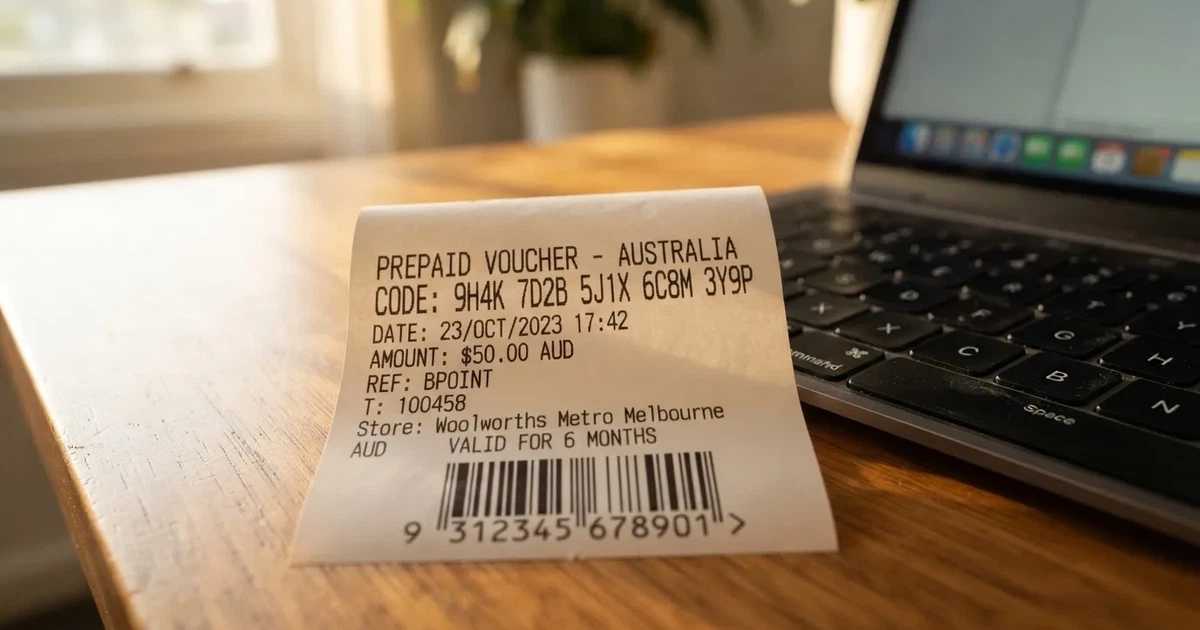
A CashtoCode eVoucher is a 20-digit code that needs no personal details to use. It supports more than 25 currencies and is sold by resellers ranging from convenience stores to online platforms. The brand’s own site lists gambling game providers — Pragmatic Play, Evolution, NetEnt and Playtech — in its catalogue filters, which is the candid version of the marketing point: CashtoCode sells itself to gambling sites. The eVoucher brand’s copyright is held by Eightball Marketing Services LLC, and the company states it has been on the market since 2013.
The deposit flow
At the cashier of an accepting site, the player selects CashtoCode, chooses a value, and is handed the reseller where the 20-digit code can be bought. Payment is in cash at a physical outlet, or through the reseller’s own online flow. The code is entered on the casino’s deposit page and the credit appears. CashtoCode states the voucher is free of charge to the customer with no usage fees, and that any unused balance keeps its full value. The fee, when there is one, sits in the spread between the code’s face value and the local-currency amount that lands on the casino account.
The withdrawal problem
CashtoCode eVouchers are deposit-only. The official site offers no withdrawal option. A player who deposited with a 20-digit code has to be paid back through whatever other rail the casino supports — typically a bank transfer, sometimes a card refund or an e-wallet. Each of those carries its own settlement clock, and each of them goes through the casino’s own manual checks before the funds move. A CashtoCode withdrawal is not a thing; a CashtoCode deposit followed by a casino withdrawal is.
That settlement window is where the offshore calculus shows. A bank transfer via PayID and Osko is fast at the Australian end — under a minute between participating banks, 24/7, addressed to a BSB and account number or to a PayID. Paying to a PayID shows the name of the account holder before the transfer is sent. The bottleneck is the offshore operator’s own compliance review, not the rail. A player who deposits at 8 pm in Sydney and asks for a withdrawal at 8 am the next morning is asking an offshore operation in whatever jurisdiction it sits to clear the transaction, and the cleared amount will then move through an Australian bank on a fast rail the operator may or may not be set up to use. Some operators route withdrawals back to a card, which forces an inter-bank refund cycle measured in business days.
Fees the operator does not always print
CashtoCode states the voucher is free to the customer. What the customer pays at the reseller is whatever the reseller charges; what the casino credits to the account is whatever the casino credits; and the gap between those is the player’s effective deposit fee, even when both ends of the chain call themselves free. On a $20 voucher that lands as $18 of credit, the player has paid a 10% premium for anonymity.
Why the deposit is anonymous and the player is not
The 20-digit code does not carry a name, a bank account or a card number. That is the privacy claim. Once the deposit lands, the casino has the player’s account details, the IP address the account is logged in from, the device fingerprint, and a transaction history under that account name. A voucher that protected the name at the till has not protected the player at the table.
Offshore operators subject to ACMA warnings: every brand on this page is one the ACMA warned
The set below is not a recommendation and not a ranking in the usual sense. Each of these operators has been the subject of a formal warning from the Australian Communications and Media Authority for offering prohibited interactive gambling services to Australians. The order is the order of the most recent ACMA action, newest first, then the earlier 2022 warnings.
| Brand | ACMA action and date | Operator named by the ACMA | CashtoCode as a deposit rail |
|---|---|---|---|
| RocketPlay | Formal warning, March 2026; earlier Dama N.V. action in May 2022 | Pulsup Ltd (Rocketplay.com.au); Dama N.V. | — |
| Jackbit | Formal warning, April 2026 | Ryker B.V. | — |
| Spirit Casino | Formal warning, May 2025 | Dama N.V. | — |
| Ignition Casino | Formal warning, July 2025 | Bamboo Media | — |
| National Casino | Formal warning, July 2025 | Consolutetish S.R.L. | — |
| Bizzo Casino | Formal warning, July 2025; earlier 2022 warning to TechSolutions | Consolutetish S.R.L.; TechSolutions (CY) Group Limited and TechSolutions Group N.V. | — |
| Woo Casino | Formal warning, March 2025 | Dama N.V. | — |
| Instant Casino | Formal warning, February 2025 | EOD Code SRL | listings reported by payment aggregators |
| Casino Intense | Formal warning, April 2025 | Sterplay Holding Ltd | listings reported by payment aggregators |
| Sky Crown | Formal warning (ACMA publication) | Hollycorn N.V. | — |
| Level Up Casino | Formal warning, May 2022 | Dama N.V. | listings reported by Westpac’s merchant categorisation |
The rightmost column is honest about what the research actually carries. A handful of these brands show up in payment-method listings scraped or indexed by aggregator pages and a couple of bank reference documents. None of them has had its CashtoCode support independently verified for this page. The marketing copy on each of these sites claims broad payment coverage; the ACMA has decided, in the same year most of them were launched, that the offering itself is unlawful.
The pattern in the operator column matters more than any individual brand. Dama N.V. shows up four times in this set — Level Up, Woo Casino, Spirit Casino, and RocketPlay in its earlier incarnation — under three different warnings in three different years. Consolutetish S.R.L. takes two of the eleven spots, for National Casino and Bizzo Casino. The same operator names resurfacing across separate brands is the structural finding: the offshore market rotates the front of house while the back of the house keeps a familiar set of incorporations.
Overview: what the CashtoCode “casino landscape” actually is
The marketing framing calls it a landscape. In 2026 it is something narrower and less friendly.
CashtoCode markets itself as a deposit rail for casino sites, with gambling game providers named in its catalogue. The brands that integrate the rail are overwhelmingly the offshore operators the ACMA has acted against. The “landscape” is a roster of sites that take real money from Australian players under arrangements that the Australian regulator has formally warned are unlawful.
None of the eleven brands above holds an Australian licence to take casino deposits. None could. The Interactive Gambling Act 2001 prohibits the provision of online casino games, online pokies and in-play betting to a person in Australia; no state or territory issues such a licence. What is licensable in Australia is wagering on races and sport placed before the event, lotteries and keno — products that do not integrate CashtoCode as a deposit rail.
The offshore brand often displays a Curaçao or Anjouan licence at the foot of its homepage. Those licences permit the operator to run an international casino; they do not permit the operator to take Australian players. An IGA prohibition is enforced against the provider, and the provider’s response to a formal warning has historically been one of three: comply with the Australian request by ceasing service, ignore the warning, or rebrand.
Dama N.V. has chosen each of these in turn. Its May 2022 warning covered six brands — Bambet, Dazard, Level Up, Rocketplay, Wild Tornado and Cobra Casinos. By March 2025 the ACMA was warning the same operator over Woo Casino; by May 2025 it was warning it again over Spirit Casino. The rebranding is the product. The legal status is unchanged.
The CashtoCode deposit at the cashier is not the unsafe part. The unsafe part is the rest of the transaction: the company holding the balance, the licence it claims to operate under, and the absence of any Australian consumer-protection framework the moment the deposit is accepted.
Legality and regulation: what the IGA actually does to a CashtoCode deposit
The Interactive Gambling Act 2001, as tightened by the Interactive Gambling Amendment Act 2017, makes it an offence to provide online casino games, online pokies or in-play betting to a person physically in Australia. The offence targets the provider, not the player. The deposit is lawful for the player; the offering is unlawful for the operator. That is the legal shape of every site on this page.
What the ACMA does
The ACMA investigates, issues formal warnings, and directs Australian internet service providers to block illegal sites. According to the ACMA as reported in June 2026, a total of 1,751 illegal gambling and affiliate marketing websites had been blocked since the first blocking request in November 2019, and more than 230 unlicensed gambling services had left the Australian market since enforcement was strengthened in 2017. In a single round reported on 26 June 2026, the ACMA asked Australian ISPs to block 12 more sites — 7Signs, ChromaBet, Donbet, Duospin, Freshbet, Slots Gem, Jacks Club, Lucky Start, Pointsbetz, Spinrise, Vinyl Casino and Wildsino. A blocking request does not require a court order; the ACMA directs, the ISP applies the block, and the site is unreachable on Australian residential connections.
A block is not a refund. A player whose balance is still on the blocked site is left holding a receivable against an offshore operator that has, by definition, just been told by an Australian authority that it is breaking Australian law. The operator’s compliance team is not in a hurry to settle.
The estimated cost to Australians
H2 Gambling Capital’s 2025 report estimates that Australians lose about A$3.9 billion a year to illegal gambling sites, and that the share of gambling going through legal channels fell from 74% in 2021 to 64%. The dollar figure is the headline; the channel-shift figure is the harder fact. A regulated market is shrinking while the illegal one grows, and the deposit rails the illegal one uses — CashtoCode, plus the card and crypto channels the legal side has banned — are exactly the ones the player cannot reach a complaints body about.
The credit-card and crypto carve-out
From 11 June 2024, Australian-licensed online wagering service providers have been banned by law from accepting credit cards, credit-linked digital wallets or digital currencies as payment. The rule is enforced by the ACMA, with penalties of up to A$247,500 for non-compliance. The same rule is the reason a CashtoCode deposit — cash, anonymous, no credit-card rails involved — exists as a marketing proposition to Australian players in the first place: it is one of the few ways the offshore operator can take a deposit that the licensed Australian side is no longer allowed to take. That is not an endorsement of the offshore route; it is an explanation of why the offshore route has to exist in this shape.
The legal deposit routes for a licensed Australian wagering service are debit card, bank transfer, PayID via Osko, and BPAY. Apple Pay and Google Pay, used at the card-network level, are caught by the credit-card ban on the licensed side when the underlying funding card is credit; on the offshore side, the same wallets move money to operators that have no relationship with the Australian regulator at all.
The Northern Territory anomaly
The Northern Territory Racing and Wagering Commission regulates 52 of Australia’s online bookmakers — including Sportsbet, Bet365 and Ladbrokes — which are licensed in the Territory for tax reasons. The commission has no full-time staff and meets once a month in Darwin. The figure is striking and worth sitting with: the regulator of more than fifty wagering brands has fewer staff than a mid-sized suburban accounting practice. The “regulator” in this market is, in part, a postal address and a monthly meeting.
What the player loses
The IGA targets the provider, not the player, so an Australian who plays at one of these offshore sites does not face prosecution. What the player loses is the framework that licensed wagering carries: the Australian Consumer Law remedies, the AFCA complaints path, the BetStop exclusion binding on the operator, the bank’s gambling block catching a deposit before it leaves the account, and the licensed-operator’s own internal responsible-gaming controls.
Recreational gambling winnings in Australia are not assessable income and losses are not deductible, unless the activity amounts to carrying on a business of gambling. That tax treatment is the same whether the wagering was placed with a licensed Australian bookmaker or with an offshore casino. The tax point does not differentiate the two routes; the consumer-protection framework does.
How fast an offshore CashtoCode withdrawal actually clears — the calculation
The calculation of offshore blocking rates reveals a consistent pattern: the marketing copy on every one of these sites claims fast payouts without naming what the player is waiting on.
The blocking-rate question the page works through is this: at the rate the ACMA has been adding sites to the Australian block list since November 2019, what does the cumulative total of 1,751 blocked sites imply about the pace of the offshore market’s growth into Australia, and what does that pace mean for a single player sitting on a balance at one of these brands?
The conditions: 1,751 sites blocked since November 2019 — that is 80 months between the first blocking request in November 2019 and the June 2026 figure. The running total is the number of distinct offshore gambling and affiliate marketing sites the ACMA has directed Australian ISPs to block, including repeat offenders re-emerging under new domains. The arithmetic is:
- 1,751 blocked sites ÷ 80 months from November 2019 to June 2026 = approximately 21.9 blocked sites per month on average, or roughly one new blocked site every 33 hours across the period.
- That figure flatters the offshore operators: it averages over the entire enforcement window, and the ACMA’s monthly pace has not been uniform. The June 2026 round alone added 12 sites. Earlier rounds, particularly in the 18 months after the IGA was tightened in 2017, added none.
- The rate is a floor, not a ceiling. Every offshore operator that quietly complies with an ACMA warning exits the count; every new brand launched into the Australian market enters it.
What the rate means for the player: a balance held at an offshore brand is exposed to a blocking request at any time. The brand does not need to be a repeat offender; one warning is enough to put it on the next blocking round. The cumulative rate of roughly 22 sites per month is the rate at which the Australian market is being told, one site at a time, that the offerings on it are unlawful. A player using CashtoCode to deposit is not protected by that rate. The deposit still goes in; the site holding it can be blocked at the next round; the withdrawal, when the player asks for one, sits inside an offshore operation whose compliance team is reading the same ACMA notice.
The deposit that took a minute at the reseller will not be matched by a withdrawal at the same speed. A bank transfer from the casino back to an Australian account, when the casino processes it at all, lands through the New Payments Platform on a sub-minute rail — but the casino initiates the transfer only after its own checks, and the checks happen on the casino’s clock, not the player’s. A PayID transfer at the Australian end shows the account name before the funds move, which protects the player against sending to a wrong account, not against the offshore operator never sending at all.
How the ACMA’s enforcement is reshaping the field
The action is not symmetric. The ACMA publishes a formal warning and the operator either complies or does not. Compliance means stopping Australian service; non-compliance means an ISP block at the next round. The cycle has produced the cumulative figure cited above, and it has produced a parallel pattern in the operator names.
Dama N.V. has been warned three times across four of the eleven brands in this set: May 2022 over Level Up and four others, March 2025 over Woo Casino, May 2025 over Spirit Casino. Consolutetish S.R.L. has been warned once, in July 2025, but the warning covers two brands — National Casino and Bizzo Casino — and Bizzo Casino had already been the subject of a 2022 warning to TechSolutions (CY) Group Limited and TechSolutions Group N.V. The Bizzo file is a two-operator, three-year case study in rebranding.
Other operators in this set have been warned once and not yet been tested by a second warning. Hollycorn N.V., the operator behind Sky Crown and Blue Leo, was the subject of a formal warning the ACMA published as a PDF in September 2022. EOD Code SRL was warned over Instant Casino in February 2025. Sterplay Holding Ltd over Casino Intense in April 2025. Bamboo Media over Ignition Casino in July 2025. Ryker B.V. over Jackbit and CasinOK in April 2026.
A player at any of these sites in 2026 is playing at a brand the regulator has already named. That is not a moral claim about the operator’s conduct; it is a factual statement about what the Australian regulator has published. The regulator’s view, repeated eleven times in this set, is that offering online casino games to Australians is unlawful under the Interactive Gambling Act 2001.
What the bank does and does not catch on the way through
Casino Intense’s payment-aggregator listings include names a player might recognise — and one payment rail the player almost certainly has on the card in their wallet.
The major Australian banks’ gambling blocks operate at the card-network level. Westpac’s block refuses authorisation on transactions registered under the merchant category code “Betting/Casino Gambling”. The block catches a card-funded deposit; it does not catch a CashtoCode voucher paid for in cash. ANZ’s block extends the same logic to a digital wallet on an eligible card, so Apple Pay funded from a credit card is blocked at the wallet step. The block is not a moral judgement on the player’s intentions; it is a switch the player or the bank can throw, and on the licensed wagering side it does exactly what it is meant to do.
The licensed wagering side is also where the credit-card ban applies. Since 11 June 2024, no Australian-licensed online or phone wagering service may accept a credit card, a credit-linked digital wallet, or digital currency. The rule is enforced by the ACMA, with penalties up to A$247,500 for the operator. Apple Pay, Google Pay and Samsung Pay collectively accounted for around 45% of all card payments in Australia by number at the end of 2025, so the rule touches a meaningful share of the way Australians pay for things — but it touches only the licensed side. An offshore CashtoCode casino is not subject to it.
The New Payments Platform makes the Australian end of a withdrawal fast when the operator uses it. Osko transfers between participating banks settle in under a minute, 24/7 including weekends, whether addressed to a BSB and account number or to a PayID. Over 100 Australian financial institutions participate in PayID-based instant transfers. By April 2025 more than 25 million PayID identifiers had been registered on the platform. Paying to a PayID shows the name of the account holder before the transfer is sent — a useful check against misdirected transfers, and, according to Australian Payments Plus, almost certainly an indicator of a scam site if the PayID is on an illegal gambling platform. The fast rail is in place; the operator at the other end of it may or may not be set up to use it.
AUSTRAC’s threshold-transaction-report rule requires reporting of cash transfers of A$10,000 or more; it applies to physical cash, not to ordinary electronic bank transfers. A $9,999 bank transfer to an offshore casino is not, on the AUSTRAC reporting rule alone, a flagged transaction. The reporting perimeter and the casino perimeter are different shapes.
The payment rail, in practice, for an Australian player in 2026
A CashtoCode deposit and a credit-card deposit at the same offshore casino carry the same legal status under the IGA — both are deposits at an unlawful offering — but they reach the casino through different rails and the player pays for each rail in a different currency.
A CashtoCode voucher is paid for in cash at a reseller. The voucher carries a 20-digit code, no personal details, and no card data. The casino’s deposit page takes the code and credits the account in the casino’s house currency. The reseller’s fee is whatever the reseller charges; the casino’s conversion rate is whatever the casino applies. The player has bought a 20-digit code and given it to an offshore operator.
A card deposit at the same casino carries card-network data and runs against the major banks’ gambling blocks. If the block is on, the transaction declines at the merchant category code step; if it is off, the transaction clears and the deposit lands. The player has given the casino the card number and the bank knows where the money went.
The two rails are not substitutes; they reach different points of friction. The card rail lets the bank see and, if the player has asked, stop the transaction; the voucher rail lets the player pay for the transaction in cash and leaves the bank out of the loop entirely. Neither rail changes what the casino is allowed to do under Australian law.
What changes in 2026 and after
The Interactive Gambling Amendment (Gambling Reform) Bill 2026 passed Parliament on 19 August 2026. Its advertising and inducement measures commence 1 January 2027 — law with a start date, not yet in force on a 2026 page. The Bill tightens the IGA further on the marketing side; it does not legalise online casino games. The legal position of every brand in this set is unchanged.
The ACMA’s monthly blocking rounds continue. The cumulative figure of 1,751 blocked sites will be higher in six months than it is now. The offshore brands will continue to launch, rebrand, and integrate CashtoCode as a deposit rail aimed at the Australian market — because the cash, anonymous nature of the voucher is one of the few deposit shapes the Australian regulator cannot see through a bank.
A reader who has read this far knows what an offshore CashtoCode casino is in Australia in 2026: an unlawful offering, taken at a marketing convenience the licensed side cannot match, settled through a rail that does nothing about the unlawful part.
Frequently asked questions
Is it legal for an online casino to accept CashtoCode from a player in Australia?
No. The Interactive Gambling Act 2001 makes it an offence for an operator to provide online casino games, online pokies or in-play betting to a person physically in Australia. The operator can accept the deposit; the offering itself is unlawful, and the ACMA may direct Australian ISPs to block the site. The individual player is not prosecuted under the Act.
What is the smallest deposit a CashtoCode casino site usually asks for?
CashtoCode eVouchers are sold in fixed denominations by resellers, and the casino’s minimum deposit is whatever the casino sets at its cashier. A $10 minimum is the figure that recurs in the market for the small-denomination end, though the voucher denominations and the casino’s own floor are two separate settings and either can be the binding one on a given transaction.
Does a CashtoCode withdrawal clear any faster than a card withdrawal at these sites?
CashtoCode eVouchers are deposit-only; the official site offers no withdrawal option. The withdrawal is whatever other rail the casino supports, and the bottleneck is the offshore operator’s own compliance review rather than the Australian end of the transfer. PayID and Osko move money between Australian banks in under a minute once the operator initiates the transfer.
Can CashtoCode be used at every offshore pokies-style site, or only some of them?
CashtoCode markets itself to gambling operators and lists gambling game providers in its catalogue filters, so the rail is integrated across a meaningful share of the offshore market. The Australian question is different: every offshore casino offering online pokies to an Australian player is operating against the IGA, regardless of which deposit methods it accepts.
Does depositing with CashtoCode add an extra fee at these casino sites?
CashtoCode states the voucher itself is free to the customer with no usage fees. The player pays the reseller for the code and the casino credits whatever the casino credits; the gap between those is the effective deposit fee. On a $20 voucher that lands as $18 of credit, the player has paid a 10% premium for the anonymity.
What should a player do if a CashtoCode deposit does not appear in a casino account?
The deposit is the player’s evidence: the 20-digit code, the reseller’s receipt, the timestamp, and the casino account the code was entered against. The first step is the casino’s own support channel, because the casino’s cashier is the only party that can confirm whether the code was accepted. If the casino does not respond or refuses to credit the account, the player has no Australian complaints body to approach — an offshore operator sits outside the ACMA, AFCA and BetStop frameworks. The National Gambling Helpline on 1800 858 858 is free and answered 24/7 for anyone whose wagering is heading in a direction they did not intend.