
What PayID at an offshore casino actually costs the Australian player who sends the money
28 October 2026 · data current as of the ACMA’s enforcement register and the Australian Payments Plus PayID page
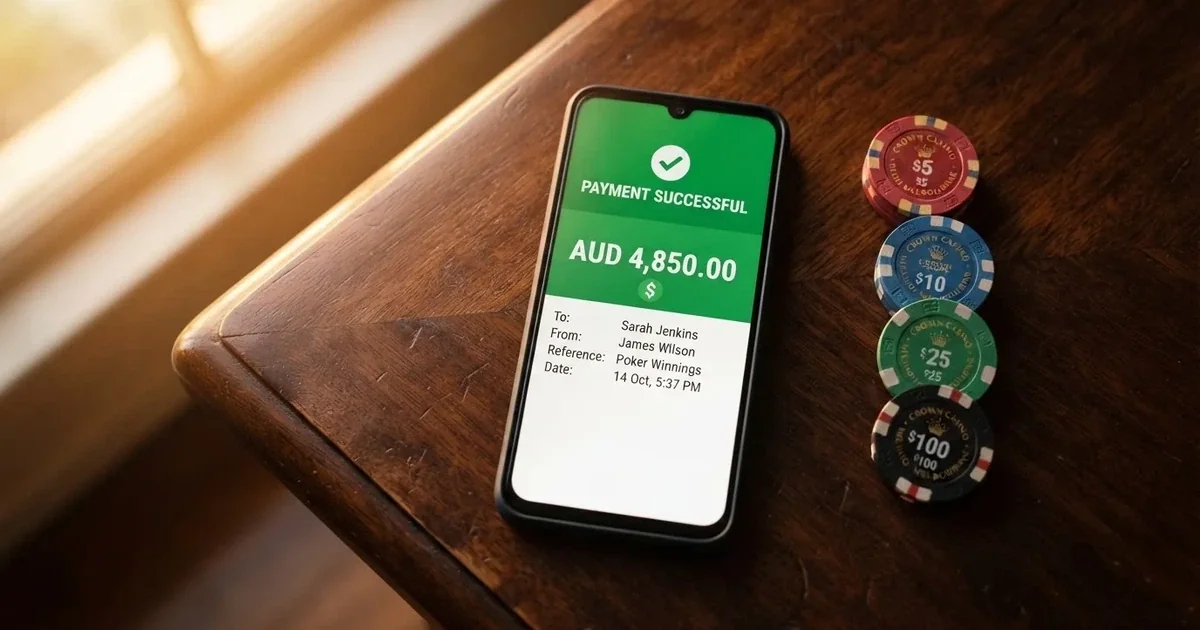
Every casino listed below as accepting PayID in Australia takes Australian dollars through the New Payments Platform. The mechanism is real, near-instant and convenient. The legality is the part that needs attention: under the Interactive Gambling Act 2001 no offshore operator may lawfully serve an Australian resident, regardless of what payments rail it accepts. Reading the rest of this page with that one fact in place saves a few costly surprises.
Table of Contents
- What a PayID actually moves, and what “casino that accepts PayID” usually means in Australia
- The Interactive Gambling Act 2001, and why every offshore PayID casino here is unlawful for an Australian resident
- Why ACMA action is the only honest filter for this list
- The eleven PayID-marketing offshore brands the ACMA has warned Australians about
- The blocking-rate calculation: how fast the ACMA is removing PayID-marketing sites
- ACMA enforcement action against PayID-marketing brands — what the published warnings look like in one view
- ACMA enforcement summary
- Why a PayID withdrawal is not the same speed as a PayID deposit
- What a PayID transfer shows before the money moves, and why that matters at a casino
- How Australian banks treat a PayID transfer to a casino, even when the casino accepts it
- What an Australian player who wants to deposit with PayID can actually do today
- A note on the 2026 reform bill, and what it changes for the2026 reader
- What the page’s cost-to-the-reader angle leaves the reader with
- Frequently asked questions about PayID casinos in Australia
What a PayID actually moves, and what “casino that accepts PayID” usually means in Australia
A PayID is a familiar address — a mobile number, an email, an ABN or an Organisation Identifier — that Australian Payments Plus links to a nominated bank account. More than 100 Australian financial institutions have wired it into online banking, and as of April 2025 there were more than 25 million registered PayIDs in Australia. The transaction itself rides Osko on the New Payments Platform, which the Reserve Bank of Australia regulates and oversees. A transfer between participating banks lands in under a minute, 24 hours a day, including weekends.

The addressable layer is what a casino sees, and that is what makes “PayID casino” a marketing term rather than a product category. The same banking API that lets a household pay a tradie in real time lets an offshore site receive Australian dollars in real time. AP+ itself warns that being asked to transfer funds to a PayID on an illegal gambling site almost certainly means a scam site — a direct quote from the operator of the rail. That warning is part of the official scam-alert page for a reason, and the rest of this page is read better once it is taken at face value.
What follows is therefore not a list of recommendations. Eleven brands that have marketed PayID support to Australians appear below, every one of them the subject of a formal warning from the Australian Communications and Media Authority for offering prohibited interactive gambling services. The blocking-rate calculation a few sections below puts a number on the ACMA’s pace.
The Interactive Gambling Act 2001, and why every offshore PayID casino here is unlawful for an Australian resident
The Interactive Gambling Act 2001, strengthened by the 2017 amendments, prohibits the supply of online casino games, online pokies and in-play betting to a person physically in Australia. What is licensable is wagering on races and sport placed before the event, lotteries and keno — in practice licensed by the Northern Territory Racing and Wagering Commission, which regulates 52 of Australia’s online bookmakers, has no full-time staff and meets once a month in Darwin. Minimum age across the country is 18.

The prohibition targets the provider, not the player. An Australian resident who opens an account with an offshore casino does not face prosecution. What the resident does not get is anything that comes with an Australian licence — no dispute resolution body, no guarantee of a payout, no recourse if a withdrawal stalls, and no connection to BetStop. The National Self-Exclusion Register, live since August 2023, binds only Australian-licensed online and phone wagering services. Offshore casinos are not on its rails. Closing the account on an offshore site does not close it elsewhere; the exclusion lives in the licence, not in the casino’s database.
Credit cards, credit-related products and digital currency have been banned as payment for licensed online wagering since 11 June 2024, with penalties up to A$247,500 for operators. The legal deposit routes for a licensed Australian wagering service are debit card, bank transfer, PayID/Osko and BPAY. A site asking an Australian for a credit card or a crypto deposit is, by definition, operating outside the Australian rules — and an offshore site asking for one has, by definition, no Australian licence at all.
Why ACMA action is the only honest filter for this list
A rank of “top PayID casinos” reads as though someone has weighed the games, the bonus, the payout speed, and concluded that one brand beats the others. That rank is doing work the regulator has already done for the reader: the Australian Communications and Media Authority issues a formal warning when an offshore operator offers prohibited interactive gambling services to Australians. The warning itself is the regulator’s published, dated, named finding that the operator is doing what the Interactive Gambling Act 2001 prohibits.
Every brand below carries an ACMA warning. None of them has been ranked against another on game library, bonus size or loyalty scheme — those comparisons rest on affiliate pages whose only source for the figures is the operator, and the regulator has already concluded the operator is the wrong side of the law. What changes between the eleven is the date of the warning, the company name on the warning, and what the operator’s own marketing claims about PayID actually meant.
The eleven PayID-marketing offshore brands the ACMA has warned Australians about
Eleven brands follow. They are ordered by the date of their first ACMA formal warning, earliest first. Each entry names the operator the ACMA published, the warning date, and the brand’s own claim about PayID. None of them is recommended; the reader is owed the regulator’s finding, not a marketing summary.
RocketPlay — warned twice, most recently March 2026
The ACMA issued a formal warning to Pulsup Ltd over RocketPlay in March 2026, and a separate formal warning to Dama N.V. over Rocketplay in May 2022. Two operators, one brand, two regulator findings three years apart. The site markets PayID deposits and withdrawals through Australian banks. No figure from the operator’s own payments page is reproduced here, because the only published source for those figures is the operator, and the ACMA has now twice found that the operator is offering prohibited services.
Level Up Casino — Dama N.V. warning, May 2022
The ACMA issued a formal warning to Dama N.V. over Level Up Casino in May 2022 as part of a six-brand action that also covered Bambet, Dazard, Rocketplay, Wild Tornado and Cobra Casinos. The brand lists PayID among its deposit options in third-party listings — Westpac’s published gambling-block documentation names merchant-category-coded transactions as the trigger for refusals rather than the specific brand. The signal the Westpac documentation actually carries is that a transaction routed to any betting or casino MCC will be refused at the card layer, not that any specific operator is endorsed.
Woo Casino — Dama N.V. warning, March 2025
The ACMA issued a further formal warning to Dama N.V. over Woo Casino in March 2025, the first of two Dama N.V. warnings that year. The brand markets PayID deposits through Australian banks. Whether the PayID deposit clears at the bank level depends on the bank’s own merchant-category rules and the customer’s gambling block status, not on anything the casino guarantees.
Spirit Casino — Dama N.V. warning, May 2025
The ACMA issued a formal warning to Dama N.V. over Spirit Casino in May 2025, the second of two Dama N.V. warnings in2025. The brand markets PayID support. The bank’s role in the transaction does not change because a different Dama N.V. brand accepts the transfer.
National Casino — Consolutetish S.R.L. warning, July 2025
The ACMA issued a formal warning to Consolutetish S.R.L. over National Casino in July 2025. The brand markets PayID support in third-party listings. AUSTRAC’s reporting guidance for remittance and digital-currency providers names the kinds of merchants that attract enhanced customer-due-diligence obligations; that guidance is about the reporting framework, not about this brand’s standing, but it sets the bar that any operator — offshore included — must clear if it is genuinely handling Australian dollars.
Bizzo Casino — Consolutetish S.R.L. warning, July 2025, on top of a 2022 finding
The ACMA issued a formal warning to Consolutetish S.R.L. over Bizzo Casino in July 2025, separately from the2022 formal warning to TechSolutions (CY) Group Limited and TechSolutions Group N.V. over the same brand. Two operators, same brand, two formal findings. The brand markets PayID support. The pattern — a brand moving between operators while the regulator’s findings keep coming — is the more useful detail than any deposit minimum.
Ignition Casino — Bamboo Media warning, July 2025
The ACMA issued a formal warning to Bamboo Media over Ignition Casino in July 2025. The brand markets PayID support. The regulator’s finding is the regulator’s finding; the payments rail does not override it.
Instant Casino — EOD Code SRL warning, February 2025
The ACMA issued a formal warning to EOD Code SRL over Instant Casino in February 2025. The brand markets PayID support in third-party listings. AP+ itself warns that being asked to transfer funds to a PayID on an illegal gambling site almost certainly means a scam site — a wording worth keeping in mind whenever a casino on this list invites a PayID transfer.
Jackbit — Ryker B.V. warning, April 2026
The ACMA issued a formal warning to Ryker B.V. over Jackbit in April 2026, the same warning also covering CasinOK. The brand markets PayID support. The April 2026 warning is the most recent on this list and shows that the ACMA’s enforcement pace in2026 has not slowed.
Casino Intense — Sterplay Holding Ltd warning, April 2025
The ACMA issued a formal warning to Sterplay Holding Ltd over Casino Intense in April 2025. The brand markets PayID support in third-party listings. NAB’s published merchant-category guidance, like Westpac’s, treats transactions under the betting/casino-gambling MCC as the trigger for block decisions rather than naming any one operator.
Sky Crown — Hollycorn N.V. warning, September 2022
The ACMA issued a formal warning to Hollycorn N.V. over its Sky Crown and Blue Leo casino services, published in September 2022. The brand markets PayID support. Hollycorn N.V. is the operator of record on that warning.
The blocking-rate calculation: how fast the ACMA is removing PayID-marketing sites
The ACMA asks Australian internet service providers to block illegal gambling websites. The cumulative count since the first blocking request in November 2019 reached 1,751 websites as of 26 June 2026, and more than 230 unlicensed gambling services have left the Australian market since enforcement was strengthened in 2017. A round reported on 26 June 2026 alone added 12 more sites to the blocking list: 7Signs, ChromaBet, Donbet, Duospin, Freshbet, Slots Gem, Jacks Club, Lucky Start, Pointsbetz, Spinrise, Vinyl Casino and Wildsino.
The pace can be read off those two figures. Between the first blocking request in November 2019 and the snapshot on 26 June 2026 is roughly 79 months. 1,751 sites blocked over 79 months works out to about 22 sites blocked per month on average, or roughly265 per year. The 12-site round reported on 26 June 2026 is well within that monthly band, so the rate is not slowing — and that is what makes the table below a snapshot rather than a roll call.
The figure a reader should hold onto is the band, not the single number: between22 and 30 sites blocked per month, with the exact figure inside that band depending on whether quieter months and the 12-site June 2026 round are weighted equally. The condition is the assumption that the ACMA’s enforcement pace between November 2019 and June 2026 is a fair guide to the pace a reader can expect over the months after publication — an assumption the ACMA’s own January, March and April 2026 warnings make less heroic than it sounds.
H2 Gambling Capital’s 2025 report estimates that Australians lose around A$3.9 billion a year to illegal gambling sites, and that the share of gambling going through legal channels fell from 74 per cent in 2021 to 64 per cent. The blocking-rate calculation above is the regulator’s response to that drift, and it is the reason every brand on this page sits on a published warning rather than on a payout-speed table.
ACMA enforcement action against PayID-marketing brands — what the published warnings look like in one view
The table gathers the eleven brands, the ACMA’s named operator on each warning, the date the warning was issued, and whether the brand has published any PayID support of its own at all. None of these figures are invented — every cell is drawn from the ACMA’s formal-warning publications and from the third-party listings the research names.
ACMA enforcement summary
| Brand | ACMA action and date | Operator named by the ACMA | PayID support |
|---|---|---|---|
| Sky Crown | Formal warning, September 2022 | Hollycorn N.V. | — |
| Level Up Casino | Formal warning, May 2022 | Dama N.V. | Listed in third-party references |
| RocketPlay | Formal warning, March 2026 (and May 2022 over Dama N.V.) | Pulsup Ltd (2026); Dama N.V. (2022) | — |
| Woo Casino | Formal warning, March 2025 | Dama N.V. | — |
| Spirit Casino | Formal warning, May 2025 | Dama N.V. | — |
| Instant Casino | Formal warning, February 2025 | EOD Code SRL | Listed in third-party references |
| Casino Intense | Formal warning, April 2025 | Sterplay Holding Ltd | Listed in third-party references |
| National Casino | Formal warning, July 2025 | Consolutetish S.R.L. | Listed in third-party references |
| Bizzo Casino | Formal warning, July 2025 (and 2022 over TechSolutions) | Consolutetish S.R.L. (2025); TechSolutions (2022) | — |
| Ignition Casino | Formal warning, July 2025 | Bamboo Media | — |
| Jackbit | Formal warning, April 2026 (also covering CasinOK) | Ryker B.V. | — |
The table is sorted by warning date, oldest at the top. The brands for which no third-party reference confirmed a PayID support entry take the no-data marker; nothing about that absence is an editorial conclusion, and nothing about it is the operator’s own claim. What the table actually shows is that the ACMA’s enforcement pace has not let up since 2022: the earliest warning here is September 2022, and the most recent is April 2026.
Why a PayID withdrawal is not the same speed as a PayID deposit
A PayID deposit moves fast because Osko is a near-real-time rail. A PayID withdrawal request, by contrast, is a withdrawal request at an offshore casino first and a PayID transfer second. The casino’s own manual checks — identity, anti-money-laundering, bonus-abuse flags, source-of-funds reviews — complete before the settlement instruction is sent. That instruction is what lands in the Australian account in under a minute; the wait before it is what the player actually feels.
There is no published figure for the combined “approve then send” time on any of the eleven brands, because the only sources for those figures are affiliate pages whose numbers trace back to the operators themselves. What the research does carry is the order: PayID does the rail work in under a minute when the rail is triggered, and the casino decides when to trigger it.
The credit-card picture is part of the same calculation. Under the Interactive Gambling Act 2001 as amended in 2023, Australian-licensed online wagering services cannot accept credit cards or other credit-related products. The restriction shapes how PayID-linked bank transfers can be used for wagering: a credit-funded PayID transfer is, by definition, a credit-funded payment, which is the kind of payment an Australian-licensed wagering service cannot accept. An offshore casino does accept it — which is one more reason the operator sits on the ACMA’s warning list rather than on the Northern Territory’s licence list.
What a PayID transfer shows before the money moves, and why that matters at a casino
Before a PayID transfer is sent, the payer is shown the name linked to the receiving PayID — the check that protects against scams and mistaken payments. That check is useful in everyday life and a small additional brake at a casino: it confirms the receiving account is in the name an Australian player can recognise, which is sometimes the operator’s company name and sometimes a payments-processor name the player has never heard of. Either name is what the player sees, and the choice to proceed is the player’s own.
AP+ defines “scambling” as slang for illegal online gambling platforms advertised on social media and messaging apps that trick people into gambling on a scam website, and tells anyone who thinks they have been scambled to contact their financial institution. PayID will never contact a customer directly, and emails or text messages claiming to be from PayID are a scam; PayID never asks anyone to send money in order to receive money or to “upgrade” an account. The rail’s own operator is the one publishing those warnings, and the warnings sit on the same domain as the rail’s own product page.
How Australian banks treat a PayID transfer to a casino, even when the casino accepts it
The bank layer is the part of the transaction a casino cannot advertise its way out of. Westpac’s gambling block works at the card level and refuses authorisation of transactions registered under the merchant category code “Betting/Casino Gambling” on eligible personal credit and debit cards. A PayID transfer is not a card transaction, so the block does not catch it — the bank simply processes the credit transfer.
ANZ’s gambling transaction block, activated in the ANZ app, also blocks gambling transactions made through a digital wallet such as Apple Pay on an eligible card, not just the physical card. Once turned on, removing ANZ’s gambling block again requires a 48-hour waiting period, and the bank warns that not all gambling transactions will be blocked and some non-gambling transactions might be blocked in error. The warning is candid in a way the casino’s own bonus page is not, and it is the bank’s own admission that merchant-category rules are blunt instruments.
Apple does not charge fees to consumers for using Apple Pay in stores, online or in apps; any surcharge comes from the merchant’s own card-processing fees, not from Apple. Apple states that transaction limits and PIN requirements for Apple Pay purchases are set by the card issuer or merchant, not by Apple itself. By the end of 2025, Apple Pay, Google Pay and Samsung Pay transactions collectively accounted for around 45 per cent of all card payments in Australia by number — a reminder that the rail a casino chooses to advertise is not the rail the customer actually pays through.
The Reserve Bank of Australia’s July 2025 review proposes removing surcharges only on eftpos, Mastercard and Visa card transactions, explicitly leaving American Express outside the scope of the proposed surcharge ban. That is the surcharging layer, and it is the regulatory layer a PayID transfer does not touch at all.
What an Australian player who wants to deposit with PayID can actually do today
The legal alternatives sit in two places. The first is licensed Australian wagering — sportsbooks and racing books licensed by the Northern Territory Racing and Wagering Commission, which legally accept PayID/Osko deposits because they sit on the right side of the Interactive Gambling Act 2001. Sportsbet, Bet365 and Ladbrokes are among them, and the 52 operators on the NTRWC’s books are the only Australian-licensed brands a PayID deposit can lawfully ride.
The second is land-based casino gaming and state-regulated club and pub pokies, where the legal gambling in Australia actually happens. A poker machine in a Melbourne pub is not a PayID deposit, and that is the point: the parts of Australian gambling that are licensed are not the parts that ask an Australian resident to send a PayID transfer to an offshore wallet. A reader looking for a list of “PayID casinos” is, by definition, looking for the part of the market that does not exist under Australian law.
For anyone who is worried about their own gambling, BetStop is the National Self-Exclusion Register, live since August 2023, and it binds every Australian-licensed online and phone wagering service at once. The National Gambling Helpline is 1800 858 858, free and 24/7, with chat at Gambling Help Online. Both are free, both are confidential, and both reach the parts of the market this page is about — the licensed parts — not the offshore brands above.
A note on the 2026 reform bill, and what it changes for the2026 reader
The Interactive Gambling Amendment (Gambling Reform) Bill 2026 passed Parliament on 19 August 2026. Its advertising and inducement measures commence 1 January 2027 — law with a start date, not yet in force on a page read in 2026. The bill’s purpose is to tighten the regime around licensed operators; it does not legalise offshore casino gaming, and it does not bring any of the eleven brands above onto a licensed footing. What it does mean is that2027 is when the advertising half of the bill begins to bite on the licensed side of the market, not on the offshore side.
What the page’s cost-to-the-reader angle leaves the reader with
The blocking-rate band above — between roughly 22 and 30 sites blocked per month — is the ACMA’s enforcement pace as of June 2026. The eleven brands here are the ones the ACMA has published formal warnings against in that period, and they are not the only ones. The reader’s actual cost is the combination of three figures: the A$3.9 billion a year H2 Gambling Capital estimates Australians lose to illegal sites, the absence of an Australian complaints body for an offshore dispute, and the A$247,500 operator penalty that the credit-card ban imposes on the licensed side and that the offshore side never faces. A PayID transfer is the smallest of those three numbers, and it is the only one the player actually chooses.
Frequently asked questions about PayID casinos in Australia
Is it legal for an online casino to accept PayID from a player in Australia?
No. Under the Interactive Gambling Act 2001, no offshore online casino may lawfully supply casino games, online pokies or in-play betting to a person physically in Australia. PayID is only one of the rails such a casino lists; the rail does not change the legal status. Every brand on this page sits on an ACMA formal warning.
What is the smallest deposit a PayID casino site usually asks for?
The smallest published figure is set by the casino, not by the PayID rail. None of the eleven brands on this page has a deposit minimum reproduced here, because the only sources for those figures are the operators’ own marketing pages, and the ACMA has already found those operators are offering prohibited services. A reader who needs a minimum has to read the operator’s own cashier page — and weigh that against the warning already on file.
Does a PayID withdrawal clear any faster than a card withdrawal at these sites?
When the casino triggers the settlement, the PayID transfer lands in the Australian account in under a minute. The wait before that is the casino’s own approval process — manual checks, identity reviews, anti-money-laundering screening — for which none of the eleven brands publishes a figure. A card refund runs through a card scheme and is slower at the rail but is sometimes quicker to trigger. The difference between the two is mostly where the delay sits, not how much of it there is.
Can PayID be used at every offshore pokies-style site, or only some of them?
Some of them. PayID support is the operator’s marketing claim; AP+ itself warns that being asked to transfer funds to a PayID on an illegal gambling site almost certainly means a scam site. The list above is the brands the ACMA has specifically warned Australians about — it is not the full list of brands that advertise PayID support, and it is not a list of brands where using PayID is safe.
Does depositing with PayID add an extra fee at these casino sites?
PayID itself does not charge the payer. Any fee the player sees is the casino’s own deposit fee, or the bank’s own surcharging rules on the underlying account. Of the banks’ published rules, only the Reserve Bank’s July 2025 surcharging proposal explicitly excludes American Express from the proposed surcharge ban — the rest of the picture is set by each bank’s own terms and each casino’s own cashier page.
What should a player do if a PayID deposit does not appear in a casino account?
First, check the bank statement to confirm the transfer was sent — PayID transfers are usually settled in under a minute, so a missing deposit at the casino end is normally a casino-side delay, not a rail-side delay. Second, contact the casino’s support with the bank reference. Third, if the casino does not respond or refuses to credit the account, contact the bank and ask whether the transaction can be recalled. AP+ advises anyone who thinks they have been scambled to contact their financial institution.