7-Reel Slots in Australia: Reel Count, Legal Reality, and the ACMA’s Running List
 Available in US
Anyone searching for a seven-reel slot in Australia is looking for something the country does not actually offer. Online casino games — pokies included, in any reel configuration — cannot be licensed anywhere in Australia under the Interactive Gambling Act 2001. What search results return are offshore sites, most of which the Australian Communications and Media Authority has already warned or blocked. The reel count itself is a small technical question; the more useful one is what a player is signing up for when they spin one.
The data in this comparison is current as of 23 September 2026 and was checked against the ACMA’s published formal-warning notices and blocking-round announcements.
Table of Contents
- What 7-Reel Slot Play Means, and Why the Number Matters
- The Australian Legal Frame: Prohibited Service, Offshore Operator
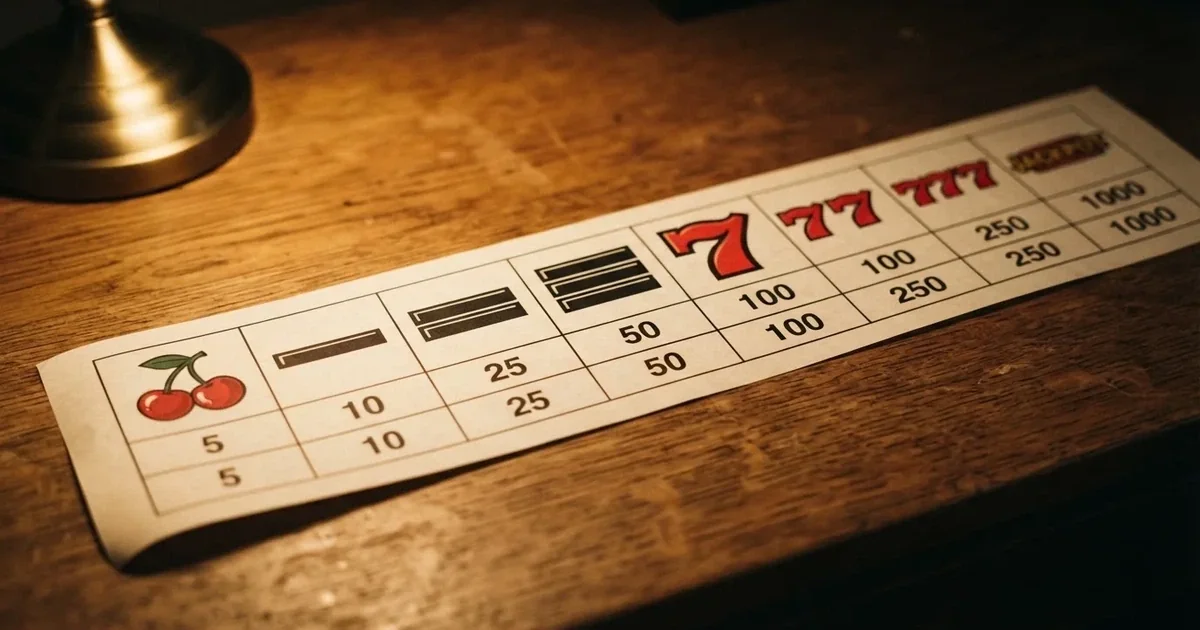
- What a Paytable Actually Shows, and Why Reading It Matters
- Australian Pokies, the Floor, and the Online Gap
- The Landscape: Offshore Brands the ACMA Has Formally Warned
- The Blocking Rate, and What It Tells the Reader
- Offshore Bonus Offers: What the Marketing Actually Promises
- Free Spins: What They Cover and What They Don’t
- Responsible Play and Where Help Is Available
- What the Data Actually Shows a Reader
- The Australian Reader’s Practical Bottom Line
- Frequently Asked Questions
What 7-Reel Slot Play Means, and Why the Number Matters
A slot machine’s reel count sets the geometry of the game: how many vertical strips of symbols spin at once, how many symbol stops each strip carries, and how a payline is built across them. Charles Fey’s original three-reel machine of the late 19th century used five symbols per reel — horseshoes, diamonds, spades, hearts and the Liberty Bell — and roughly a thousand possible combinations across three spins. Bally’s 1963 Money Honey added a bottomless hopper that paid out up to 500 coins without an attendant, freeing the reel mechanism from needing a staff member on hand. The first true video slot, developed by Fortune Coin Co. in 1976, replaced physical reels with a screen, and from there the format opened up.

Modern video slots commonly use five reels but can run with more, with 50 or more symbols per reel, producing odds against a top combination as high as 300 million to one — a sharp contrast with the thousand-combination range of a classic three-reel machine. A seven-reel configuration sits between those poles: more symbol stops than the original three, fewer than the most elaborate contemporary video slots, and most often drawn as a five-row, seven-column grid rather than a tall stack of physical reels.
Two consequences follow from that geometry. First, more reels multiplied by more symbols per reel multiplies the total combinations fast. Where a three-reel, ten-symbol-per-reel layout produces about a thousand outcomes, a seven-reel layout with even a modest symbol set runs into the tens of millions. Second, the visible paytable gets longer. A seven-reel paytable typically lists wins for combinations of three, four, five, six and seven matching symbols, plus any scatter and bonus-game triggers layered on top. Reading that paytable takes longer than reading a three-reel chart, and the cost of misreading it is correspondingly higher.
The reel count itself is not a proxy for volatility. A seven-reel slot can be built as a low-variance game with frequent small wins or as a high-variance game with rare large ones, and the paytable — not the reel count — is where that shows. What the reel count does change is the shape of a session: more reels means more visual information per spin and more symbol positions a player has to track, but it does not by itself make the game fairer or stingier.
The Australian Legal Frame: Prohibited Service, Offshore Operator
| Metric | Detail |
|---|---|
| Regulatory Authority | ACMA (Enforcement); NTRWC (Licensing) |
| Blocked Sites (Nov 2019–June 2026) | 1,751 |
| Recent Blocking Round (June 2026) | 12 sites |
| Annual Illegal Losses (est.) | A$3.9 billion |
The enforcement arm is the ACMA. It investigates complaints, issues formal warnings to operators and directs Australian internet service providers to block sites. As reported in June 2026, a total of 1,751 illegal gambling and affiliate marketing websites had been blocked since the first blocking request in November 2019, and more than 230 unlicensed services had left the Australian market since 2017. The most recently reported round added another twelve sites: 7Signs, ChromaBet, Donbet, Duospin, Freshbet, Slots Gem, Jacks Club, Lucky Start, Pointsbetz, Spinrise, Vinyl Casino and Wildsino. The blocking total accumulates; the warnings run in parallel.

The distinction matters. A block stops the site at the ISP layer for Australian connections; a formal warning puts the operator on the ACMA’s record, often naming the corporate entity behind the brand. Where the same operator shows up across multiple brands — Dama N.V. with Rocketplay, Wild Tornado, Cobra Casinos, Bambet, Dazard, Level Up, Woo Casino and Spirit Casino over a four-year span — the warning list tells a player something useful about the parent company that the brand page does not.
Two limits follow from this legal frame for any reader who finds an offshore site. First, the individual player is not the IGA’s target — the Act prosecutes the provider — but an offshore site gives no Australian consumer protection, no complaints body and no recourse if a withdrawal stalls or a balance is voided. A site can be blocked with funds still on it; the ACMA’s blocking request cuts access, not balances. Second, the protections a player has inside the Australian system do not extend to offshore play. The National Self-Exclusion Register, BetStop, binds Australian-licensed online and phone wagering services only; an offshore casino is not connected to it.
H2 Gambling Capital’s 2025 estimate put Australian losses to illegal gambling sites at about A$3.9 billion a year, and reported that the share of gambling going through legal channels fell from 74% in 2021 to 64%. The legal-channel number falling while the illegal-channel losses grow is itself the headline: more money is moving through offshore sites, which are subject to fewer Australian safeguards and more frequent blocking.
What a Paytable Actually Shows, and Why Reading It Matters
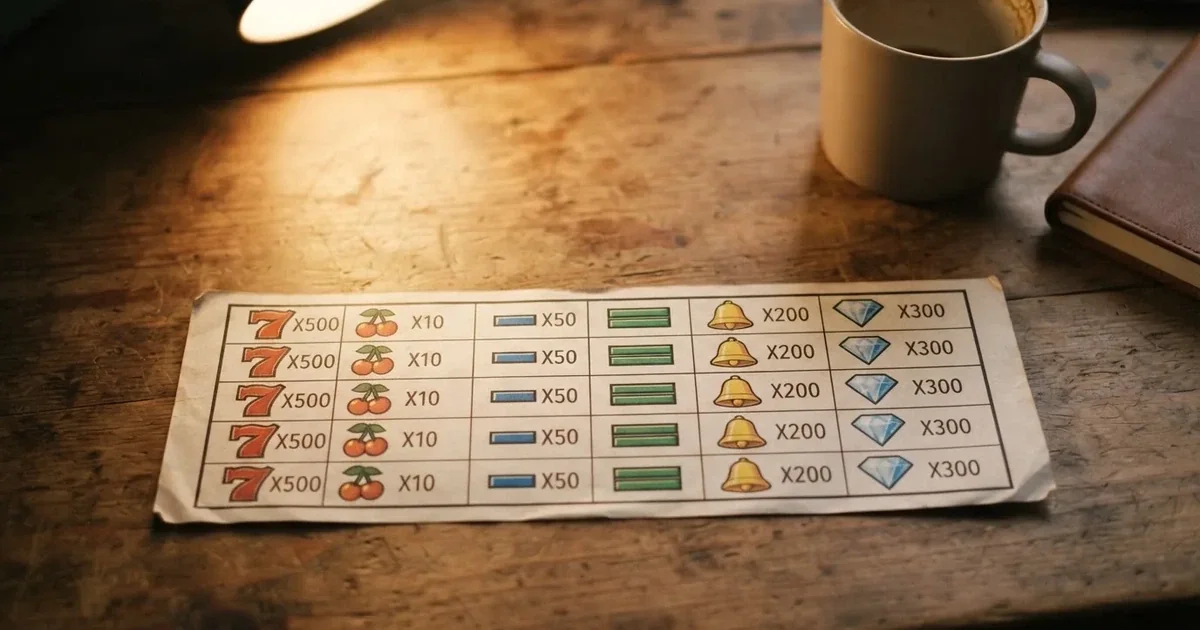
A paytable is the contract between the player and the machine. On a seven-reel slot it lists the value of each symbol, the combinations that pay, and any bonus-round triggers. Reading it before spinning is the single move that separates an informed session from a blind one.
The useful elements, in order:
- Symbol values. Each symbol pays a different amount. High-value symbols (often themed icons) pay more than low-value ones (often card ranks). The paytable states the credit amount for three, four, five, six and seven matches.
- Wild and scatter rules. Wilds substitute for other symbols; scatters usually pay anywhere on the reels and often trigger bonus rounds. A paytable that lists scatter pays but does not list the bonus trigger is incomplete.
- Bonus-game mechanics. Free spin rounds, pick-and-win features, hold-and-spin mechanics — each carries its own rules. The paytable explains entry conditions, what happens during the round and how winnings are calculated.
- Maximum payout and caps. Some games cap a single spin’s payout; others scale to a fixed jackpot. The paytable states the ceiling, and it is the same ceiling regardless of stake size.
What the paytable does not show is the game’s return-to-player percentage or its volatility — those figures are published separately, often in the game’s information screen, and are not always disclosed. A seven-reel paytable that lists symbols generously is not the same as a seven-reel game that returns a generous share of wagers. The two are independent, and a player who treats them as one is reading the wrong document.
The skill in reading any paytable, reel count aside, is comparing what the paytable promises against what the game’s bonus rules actually deliver. A game with a modest paytable and a generous free-spin round can pay out more over a session than a game with a generous paytable and a stingy bonus trigger. The paytable is the entry point, not the conclusion.
Australian Pokies, the Floor, and the Online Gap
Australia operates a large pokie market on the ground. By 2010 the country had an estimated 97,103 gaming machines outside casinos, a per-capita rate about five times that of the United States. The state-by-state count outside casinos as of the mid-2020s shows the scale: 87,298 machines in New South Wales (June 2023), 26,380 in Victoria (2021–22), 21,122 in Queensland (October 2023), 11,672 in South Australia (September 2023) and 3,587 in the ACT (November 2023).
Those are physical machines, in pubs and clubs, regulated by state authorities — not online slots. The legal split is clean. A pokie in a Sydney pub is governed by NSW’s gaming-machine regime; an offshore site running a seven-reel online slot is governed by the laws of whichever jurisdiction licensed it, which is not Australia. The two are different products, different regulators, and different consumer protections.
What does cross over from the floor to the screen is reel design. A seven-reel online slot is, mechanically, a descendant of the three-reel Liberty Bell and the 1963 Money Honey hopper. Modern video slots can carry any number of reels and any number of symbols per reel, and a seven-reel layout is one option among many. The geometry carries forward; the regulatory frame does not.
This split is the reason an Australian reader searching for a “real money” seven-reel online slot will find offshore sites only. State regulators authorise pokies in pubs and clubs; they do not authorise an online casino product. The ACMA’s enforcement record is the consequence.
The Landscape: Offshore Brands the ACMA Has Formally Warned
| Brand | ACMA Action and Date | Operator Named | Subject Support |
|---|---|---|---|
| RocketPlay | March 2026; May 2022 | Pulsup Ltd; Dama N.V. | no-data |
| Level Up Casino | May 2022 | Dama N.V. | listings-only |
| Woo Casino | March 2025 | Dama N.V. | no-data |
| Spirit Casino | May 2025 | Dama N.V. | no-data |
| National Casino | July 2025 | Consolutetish S.R.L. | listings-only |
| Bizzo Casino | July 2025 | Consolutetish S.R.L. | no-data |
| Ignition Casino | July 2025 | Bamboo Media | no-data |
| Instant Casino | February 2025 | EOD Code SRL | no-data |
| Jackbit | April 2026 | Ryker B.V. | no-data |
| Casino Intense | April 2025 | Sterplay Holding Ltd | listings-only |
| Sky Crown | September 2022 | Hollycorn N.V. | no-data |
The brand-level enforcement follows a pattern. For instance, the July 2025 warning to Consolutetish S.R.L. over Bizzo Casino was the second time the brand had attracted the ACMA’s attention, as TechSolutions (CY) Group Limited and TechSolutions Group N.V. had already been warned over Bizzo in 2022. Casino Intense, meanwhile, has appeared in media coverage alongside mainstream Australian-facing operators; Sterplay Holding Ltd remains the operator named in the ACMA’s formal warning for Casino Intense in April 2025.
The Blocking Rate, and What It Tells the Reader
The ACMA’s blocking requests accumulate. The total reported in June 2026 — 1,751 sites blocked since the first request in November 2019 — is the headline figure. Spread across roughly 79 months, that works out to a blocking rate of about 22 sites per month on average. The most recent reported round added 12 more, a little under that monthly average, and the rate is not steady: some months the ACMA moves in clusters, other months it issues warnings without adding to the blocking total.
The figure is best read as a band rather than a single number. Over the full 2019–2026 span, the rate averages around 22 per month. Over the most recent rounds, it has been closer to 12 per month. Over the busiest stretches, it has run higher. A player reading the headline number alone gets the scale; a player reading it as a steady monthly clip gets a misreading.
The more useful information sits in the relationship between warnings and blocks. A formal warning is the regulator’s first formal step against an operator; a blocking request is the step that follows when the warning does not produce withdrawal from the Australian market. The Dama N.V. sequence — warned in May 2022 over six brands, then warned again in March 2025 and May 2025 over Woo Casino and Spirit Casino — shows the warning-to-block gap in slow motion: three years between the first warning and the second, with the Australian reach continuing across the whole interval. The Bizzo sequence is similar — warned in 2022 under TechSolutions, then again in 2025 under Consolutetish S.R.L. — with the parent entity changing rather than the brand.
For a reader, the practical reading is this: a single ACMA warning does not stop an offshore operator from reaching Australian players. Repeated warnings do not necessarily stop it either. Blocking does, and blocking is a per-site action that leaves sister sites unaffected. The rate matters less than the pattern.
Offshore Bonus Offers: What the Marketing Actually Promises
An offshore seven-reel slot site will offer deposit bonuses and free spins — the standard marketing hooks of the offshore market. What the offer actually pays out depends on the wagering requirements, the game weighting and the max-cashout cap, three figures that determine whether the bonus is worth more than the conditions attached to it.
The structure of a typical offshore offer looks like this: a deposit match of a fixed percentage up to a fixed cap, sometimes with free spins attached, with a wagering requirement of around 40× the bonus amount. Game weighting matters because not every game contributes 100% of its turnover to the requirement; slots typically do, table games often do not. A max-cashout cap limits how much of the bonus balance a player can withdraw as winnings.
None of these specifics are verifiable from the ACMA record. The formal warnings name the operator, the brand and the date; they do not state wagering multiples, game-weighting tables or cashout caps. Affiliate marketing pages carry the figures, but the figures change when the bonus changes, and an offer today may not be the offer next week. A player who wants to know the terms needs to read them at the moment of deposit, on the operator’s own page, not in any third-party summary.
The deeper point is that the offer structure rewards volume. A 40× wagering requirement on a bonus amount is, in practice, an instruction to spin many times at a small stake rather than a few times at a large stake. The expected loss over that volume is what the offer actually costs the player, and that figure is not on the offer page. The maths runs the same way on a seven-reel slot as on a five-reel one: house edge multiplied by turnover.
Free Spins: What They Cover and What They Don’t
A free-spin offer is a small bundle of spins at a fixed stake on a named slot. The value of the bundle is the stake multiplied by the number of spins; the realised value depends on what the spins actually return, which is set by the game’s return-to-player percentage.
A typical free-spin offer carries wagering requirements on the winnings, sometimes 40×, sometimes lower. Game weighting again matters. A free-spin bundle on a seven-reel slot with a 96% return-to-player is, statistically, worth about 4% of the stake value as a net expected return, before any wagering requirement is applied. Once the wagering requirement is layered on, the realised value drops further. The arithmetic is the same as for any other slot; the reel count does not change it.
What is unique to free spins on offshore seven-reel slots is the legal frame. A free-spin offer in Australia on a licensed wagering service is one thing; a free-spin offer on an offshore casino that cannot be licensed in Australia is another. The promotional structure may look similar, but the consumer protection underneath it is not. If a free-spin win is refused or capped, an Australian player has no local complaints body to approach.
Responsible Play and Where Help Is Available
For anyone in Australia whose gambling is starting to feel compulsive or stressful, free confidential help is available around the clock through Gambling Help Online and the National Gambling Helpline on 1800 858 858. The National Self-Exclusion Register, BetStop, binds Australian-licensed online and phone wagering services — an offshore casino is not connected to it, which is a meaningful gap. Self-exclusion through BetStop stops licensed wagering accounts from accepting further bets, but it does not stop an offshore site from accepting a deposit or extending credit. A player who has registered with BetStop and is still receiving marketing from offshore sites should treat those messages as a signal, not as background noise.
The state-based help lines operate alongside the national one. Counselling is free, the contact is confidential, and a session does not require the caller to commit to any particular course of action. The most useful time to make contact is before gambling has become a problem, not after.
What the Data Actually Shows a Reader
Three points carry the page’s weight.
First, the ACMA blocking record grows steadily. From the first blocking request in November 2019 to the June 2026 total of 1,751 sites, the rate averages roughly 22 sites per month across 79 months. The most recent rounds have added 12 sites, a little below that monthly average. The rate is not steady, and reading the headline number as a per-month figure is a misreading.
Second, formal warnings and blocking requests are different tools with different effects. A warning puts an operator on the regulator’s record. A blocking request stops Australian ISP traffic to a named site. Sister sites under the same parent are not automatically blocked. Brand-level enforcement does not end a brand’s Australian operations when the operating entity behind the brand changes — as the Dama N.V. and TechSolutions sequences show.
Third, the legal frame leaves an offshore player with no Australian consumer protection. The Interactive Gambling Act 2001 targets the provider, not the player, so an Australian individual is not prosecuted for playing on an offshore site. But if a withdrawal stalls, a balance is voided or a bonus is refused, there is no Australian complaints body to approach, and the ACMA can block a site with funds still on it. The legal-channel share of Australian gambling fell from 74% in 2021 to 64% in 2025, which is the macro picture those numbers draw.
The Australian Reader’s Practical Bottom Line
A reader in Australia looking for a real-money seven-reel online slot is looking for a product that is not licensed for supply in their country. The legitimate channels — pubs, clubs and the licensed wagering market — do not offer seven-reel online slots. The offshore sites that do offer them are subject to a regulator that issues warnings, blocks sites at the ISP layer, and does not provide a complaints mechanism for Australian players.
The reel count itself is not the issue. A seven-reel slot is a valid mechanical format, descended from the original three-reel Liberty Bell and the 1963 Money Honey hopper. The issue is the regulatory frame around it for Australian players. Anyone comparing offshore seven-reel sites against each other is comparing the warning history of the parent entities, the bonus terms at the moment of deposit, and the game’s paytable and return-to-player — three things that are independently disclosed and that the ACMA’s record does not summarise.
Frequently Asked Questions
What makes a 7-reel slot different from a standard five-reel video slot?
The reel count changes the geometry: more vertical strips of symbols per spin, more symbol positions to track, and a paytable that typically lists wins for three, four, five, six and seven matching symbols. The reel count does not by itself determine volatility or return-to-player — those are set by the paytable and the game’s math model. A seven-reel game can be low variance or high variance, the same as a five-reel game.
Can 7-reel slot machines be found in licensed Australian pubs and clubs?
Yes. Australian pubs and clubs operate tens of thousands of gaming machines — 87,298 in New South Wales alone as of June 2023, with comparable counts in Victoria, Queensland, South Australia and the ACT. The machines on those floors cover a range of formats including multi-reel layouts. What is not available in licensed venues is an online version of the same product for real money; the Interactive Gambling Act 2001 prohibits that category.
Do 7-reel slots typically pay out differently than newer five-reel formats?
The reel count is not what determines payout. Return-to-player is a property of the game’s math model, not of the reel count, and a five-reel game can return a higher share than a seven-reel game. The most useful comparison is between games’ published return-to-player percentages rather than between reel counts. Where the games do differ is in the visible paytable length — a seven-reel paytable lists more symbol combinations — but that is a reading exercise, not a payout difference.
Is a 7-reel slot online the same game as a 7-reel machine on a casino floor?
No. A physical machine on an Australian pub or club floor is regulated by the relevant state authority and forms part of the country’s legal gaming market. An online seven-reel slot on an offshore site is regulated by the laws of whichever jurisdiction issued the site its licence, which is not Australia. The two are different products, different regulators, and different consumer protections, and the IGA treats them as different categories.
Are 7-reel slots for real money available legally from an Australian-based site?
No. The Interactive Gambling Act 2001 prohibits the supply of online casino games and online pokies to anyone in Australia, including seven-reel slots. No Australian state or territory issues a licence for this category. What is licensable is wagering on racing and sport placed before the event, lotteries and keno. The offshore sites that offer seven-reel online slots for real money are operating outside Australian law, and the ACMA’s enforcement record — 1,751 sites blocked since November 2019 — reflects that.
Is reel count still a useful way to compare volatility between older and newer slots?
No. Volatility is a property of the game’s math model — how often it pays and how much — not of the reel count. A three-reel game can be high volatility; a seven-reel game can be low. The useful comparison is between published volatility ratings, where they exist, or between observed session results across many spins, not between the number of reels on the machine.
Published by the Casino Ratings Info team.