
The Honest Picture: Online Pokies in Australia
Anyone searching for the best online pokies in Australia is looking for a ranking that does not exist, for a category of site the law does not allow. That gap is the point of this page. What follows is not a top ten; it is the picture the marketing copy leaves out: the prohibition, the enforcement record, and what actually happens when an Australian opens one of these sites.
Data current as of 28 October 2026 and checked against the Australian Communications and Media Authority’s published formal warnings and blocking notices.
Table of Contents
- Where the Money Goes in and Out
- Bonuses and Free Spins, Read Against the Law
- What an Aussie Pokies Catalogue Looks Like
- The Ranking the Search Cannot Produce
- Australian Online Pokies: The Fundamentals
- Legality, Regulation and the Enforcement Record
- Responsible Gambling and Where to Get Help
- Operators the ACMA Has Formally Warned
- The Comparison the Market Will Not Let a Ranking Make
- How the 2026 Reform Changes the Picture
- Tax and Money: What an Australian Player Owes the ATO
- What This Page Is Not
- Frequently Asked Questions
Where the Money Goes in and Out
The first thing any comparison would weigh is whether a deposit lands and whether a withdrawal comes back. In Australia, that question has a different shape for online pokies than for almost any other transaction a person makes online.
The legal channels for placing a bet online in Australia are restricted to pre-event wagering on races and sport, lotteries and keno. Those services are licensed, mostly through the Northern Territory Racing and Wagering Commission, and they accept a defined set of payment methods: debit card, bank transfer, PayID/Osko and BPAY. Credit cards, credit-related products and digital currency have been banned as payment for licensed online wagering since 11 June 2024, with penalties for operators up to $234,750 (the indexation-adjusted figure for 2024–25, against the $234,750 floor set by the relevant statutory instrument; penalties rise with inflation). A site asking for a credit card or crypto is not running inside the Australian framework.
For online pokies specifically, the framework does not exist. No Australian-licensed operator processes a deposit for them, because no Australian licence covers them. The transaction, when it happens, runs through an offshore site on whatever rails that site has chosen — and the Australian player has no regulator to complain to if a withdrawal stalls or never arrives. That is the practical difference between the licensed deposit channels listed above and whatever payment page an offshore pokies site presents.
PayID and Osko deserve a specific note, because they appear in marketing aimed at Australian players. PayID is the real-time payment addressing layer that runs over the New Payments Platform, and Osko is the participating banks’ branding for instant transfers settled through it. They work between Australian bank accounts in seconds, including outside banking hours. They are also exactly the kind of frictionless payment that offshore sites advertise, because the speed cuts both ways: the deposit leaves the buyer’s account as fast as the platform can move it, and a chargeback through an Australian bank against an offshore recipient is a different and harder process than one against a domestic merchant. Speed is not protection.
Bonuses and Free Spins, Read Against the Law
The offers that do most of the heavy lifting in pokies marketing — deposit matches, free spin bundles, “no deposit bonus” credits — are the same offers the law treats as inducements no licensed Australian product may extend. Section 15AA of the Interactive Gambling Act 2001 prohibits the advertising of prohibited interactive gambling services, and the 2017 amendments tightened the rules on what an Australian-facing operator or affiliate may publish. The 2026 reform package adds further advertising restrictions from 1 January 2027, but the underlying prohibition on the product itself has been in force since the IGA first took effect.
That is the legal frame. The economic frame is what a bonus actually costs the player who claims it, which is the same regardless of which side of the prohibition the offer sits on. A deposit match carries a wagering requirement: the bonus amount must be turned over a stated number of times before any winnings become withdrawable. A 100% match on a $200 deposit with a 40x wagering requirement means $8,000 in turnover before the bonus balance converts to real money, and the conversion happens at the house edge of the games the requirement is cleared on. Free spins carry their own version of the same arithmetic: whatever the spins win is bonus money subject to a wagering requirement, often with a cap on how much of it converts.
The marketing vocabulary is built to obscure this. “Bonus credit,” “free play,” “extra value” — each is a way of describing money that is only yours after you have already played through it several times over, at a house edge that takes its cut on every spin. The “no deposit” version is the sharpest formulation of all: nothing risked on entry, but a wagering requirement on whatever the spins or credits produce, and almost always a maximum cashout that caps the upside at a small multiple of the bonus. The point of the offer is to get a player on the site and playing. The arithmetic decides what the offer is actually worth.
The IGA does not stop these offers being advertised to Australians — it stops the licensed local product that would have carried them. Offshore sites are not bound by it, and their offers reach Australian inboxes and screens regardless. The Australian player who claims one is doing so on a site that the regulator has already identified, in many cases by name, as operating outside the law.
What an Aussie Pokies Catalogue Looks Like
The games themselves — the pokies — follow a standard structure across the offshore sites that carry them, and that structure is worth understanding on its own terms.
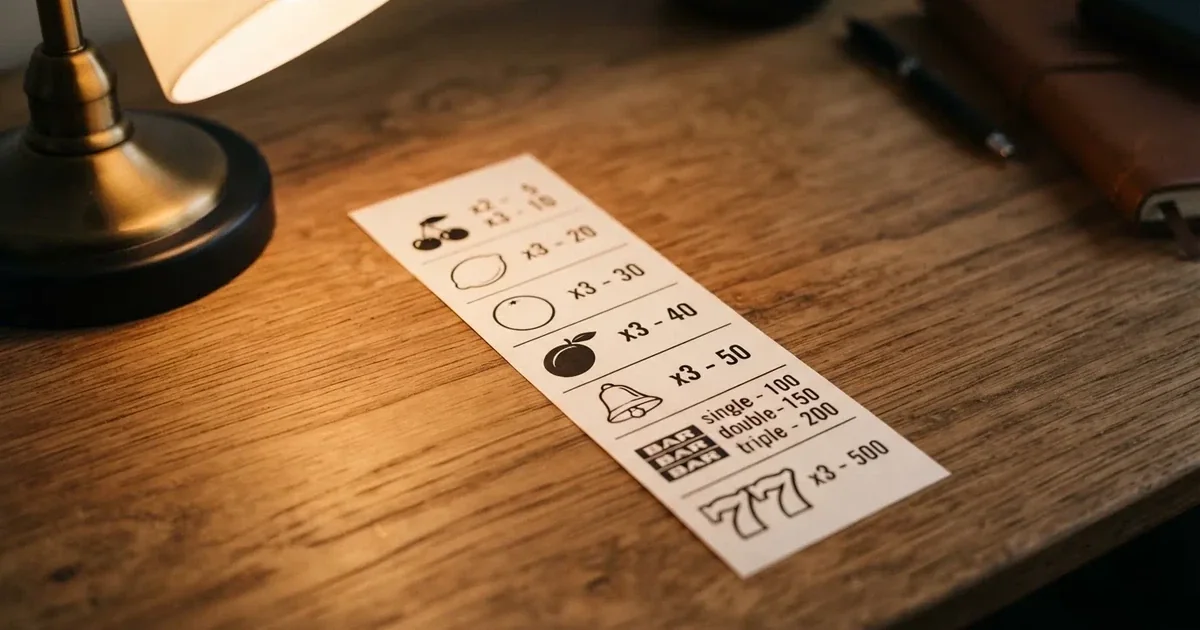
A paytable is the reference panel for any given pokie, and it does several jobs at once. It lists the symbol values, shows which combinations pay, indicates the scatter and wild symbols, and states the return-to-player — the percentage of all wagered money the game is designed to return over an effectively infinite number of spins. The RTP is a long-run statistical figure: a 96% pokie returns $96 for every $100 wagered across enough spins that variance averages out. Any individual session can sit well above or well below that figure.
The volatility rating sits alongside the RTP on most modern pokies, and it tells a different story. A low-volatility pokie pays out often, in small amounts, which keeps a session moving but caps the size of any individual win. A high-volatility pokie pays out rarely, in larger amounts, which makes a session feel barren until something lands. Bankroll management changes accordingly: the same $100 lasts longer on a low-volatility title and disappears faster on a high one, with the chance of a much larger win on the high-volatility side.
The catalogue at any offshore pokies site is organised by provider, by theme and by feature type — hold-and-win, megaways, cluster pays, progressive jackpots. The same handful of studios supply most of what the offshore market carries: Pragmatic Play, BGaming, Betsoft, Hacksaw Gaming, Nolimit City and a few others. A site that advertises thousands of titles is licensing those titles from the same suppliers the rest of the market draws on. “Aussie-themed” pokies — the titles that drape themselves in kangaroos, outback iconography and the word “Aussie” in the name — are usually licensed from the same providers and use the same engine as their non-Australian-branded siblings. The branding is local; the maths underneath is not.
One further note on what the catalogue does not contain: licensed Australian pokies, the machines inside pubs, clubs and casinos, do not appear on offshore sites at all. Their game logic is approved by state and territory regulators, their RTP minimums are set by jurisdiction (85% in New South Wales, the Northern Territory and Queensland; 87% in the ACT and Tasmania; 87.5% in South Australia; 90% in Western Australia), and the titles themselves are not licensed for distribution to offshore operators. An “Aussie pokies” catalogue on an offshore site is themed Australian; it is not the same product a person plays at the local pub.
The Ranking the Search Cannot Produce
A ranking of the best Australian online pokies sites would require, at a minimum, a set of legitimately licensed sites to rank. That set does not exist. What exists instead is a set of sites the regulator has acted against, and the ACMA’s record is the closest thing to a consumer guide the Australian framework produces.
What a fair comparison of those sites would weigh, had they been legitimate, is the same set of factors any online gambling comparison weighs: the size and composition of the game catalogue, the speed and reliability of withdrawals, the wagering requirements and caps on the bonuses, the actual RTP and volatility of the games carried, the licensing jurisdiction of the operating company, and the complaints and dispute history. Each of those factors maps to a different failure point on the offshore side. The licence is not Australian, regardless of what the footer says. The withdrawal is processed by an offshore entity with no obligation to an Australian consumer. The bonus terms are written by the operator and enforced by the operator. The RTP is published by the game provider but audited, if at all, by a regulator in another country. None of these are disqualifying in the abstract; they are disqualifying once the Australian framework is the standard, because the framework explicitly does not cover them.
The ACT Gambling and Racing Commission, the Liquor & Gaming NSW, the Victorian Gambling and Casino Control Commission and the Northern Territory Racing and Wagering Commission each maintain registers of the operators they license. A name on one of those registers means the operator holds an Australian licence for the activity covered; for online pokies, no name appears on any of them. The registers do cover licensed wagering providers, keno operators and, in some jurisdictions, the lotteries. They do not cover online casinos, online pokies, or any interactive gambling service other than pre-event wagering, lotteries and keno.
The practical effect: anyone offering to rank offshore pokies sites for Australian players is ranking sites the Australian regulator has already said should not be accessible here. The page the searcher wanted does not exist as a legitimate product. The next sections explain the enforcement record in more detail, the legal frame behind it, and where help is available if the search itself is the thing that has started to feel like too much.
Australian Online Pokies: The Fundamentals
Online pokies in Australia are the interactive, internet-delivered version of the electronic gaming machines that sit in pubs, clubs and casinos across every state and territory. The machines themselves are legal and heavily regulated. The interactive versions are prohibited.

The Interactive Gambling Act 2001 makes it an offence to provide online casino games — which explicitly includes online pokies — to a person physically in Australia. The Interactive Gambling Amendment Act 2017 strengthened the regime and gave the Australian Communications and Media Authority the enforcement powers it now uses: investigating complaints, issuing formal warnings, referring matters for civil penalty proceedings, and directing Australian internet service providers to block offending sites. The minimum age for any form of legal gambling in Australia is 18. The individual player is not prosecuted; the IGA targets the provider.
What is licensable online is narrower than most Australian players realise. Pre-event wagering on races and sporting events is licensed by the Northern Territory Racing and Wagering Commission and similar bodies in other jurisdictions. Lotteries and keno are licensed state by state. In-play betting — placing a wager on a sporting event after it has started — is prohibited under the same regime that prohibits online pokies. A licensed Australian online bookmaker offers pre-event wagering and not in-play betting; the same operator cannot, under Australian law, also offer online pokies.
The NTRWC itself is worth a brief note, because the shape of Australian online wagering licensing is unusual. The commission regulates 52 of Australia’s online bookmakers — including Sportsbet, Bet365 and Ladbrokes — from Darwin. The commission has no full-time staff and meets once a month. The Territory’s licensing regime is the de facto national regime for online wagering for tax reasons: the Territory collects the licence fees, and the operators are licensed in one jurisdiction but serve customers across the country. That structure is why a single commission sits behind most of the licensed Australian online wagering market.
For online pokies specifically, the structure produces nothing. No jurisdiction licenses them. The Northern Territory commission, the ACT Gambling and Racing Commission, Liquor & Gaming NSW, the Victorian Gambling and Casino Control Commission, the Queensland Office of Liquor and Gaming Regulation, the South Australian Liquor and Gambling Commissioner, the Tasmanian Liquor and Gaming Commission, the Western Australia Department of Local Government, Sport and Cultural Industries and the Northern Territory’s own licensing arrangements: none of them issue a licence for an online pokie. A footer on an offshore site claiming otherwise is a claim made by an entity with no standing in Australia.
Legality, Regulation and the Enforcement Record
The Interactive Gambling Act 2001 is the centre of the framework. The 2017 amendments gave it teeth, and the ACMA has used them steadily since.
According to the ACMA, as reported in June 2026, a total of 1,751 illegal gambling and affiliate marketing websites had been blocked since the first blocking request in November 2019. More than 230 unlicensed gambling services had left the Australian market since enforcement was strengthened in 2017. In a single round reported on 26 June 2026, the ACMA asked Australian internet service providers to block 12 more illegal gambling websites — 7Signs, ChromaBet, Donbet, Duospin, Freshbet, Slots Gem, Jacks Club, Lucky Start, Pointsbetz.com, Spinrise, Vinyl Casino and Wildsino — adding to the cumulative total.
The blocking arithmetic reads as follows. The first blocking request went out in November 2019; by June 2026 the cumulative count sat at 1,751 sites blocked. That is roughly 257 months of enforcement and a running average of close to seven sites blocked per month across the period, with the rate rising as the ACMA’s process became faster and the 2017 amendments matured. Stated as a band rather than a single figure: the enforcement rate has run between roughly four and ten sites blocked per month depending on the round, accelerating in the most recent years as the ACMA moved from one-off blocks to sustained monthly rounds. The number a reader should hold onto is not the monthly average but the cumulative trajectory — the list grows, it does not stabilise, and a site that is accessible today may be on the next blocking list.
Formal warnings are the ACMA’s other main tool, and the public record of them is the closest thing the regulator produces to a consumer warning list. In March 2026 the ACMA warned Pulsup Ltd over Rocketplay.com.au. In July 2025 the ACMA warned Bamboo Media over Ignition Casino and Consolutetish S.R.L. over National Casino and Bizzo Casino — the latter of which had already been the subject of a 2022 warning to TechSolutions (CY) Group Limited and TechSolutions Group N.V. In May 2025 the ACMA warned Dama N.V. over Spirit Casino, having already warned the same operator over Woo Casino in March 2025 and over six other brands in May 2022. In April 2026 the ACMA warned Ryker B.V. over Jackbit and CasinOK. In April 2025 the ACMA warned Sterplay Holding Ltd over Casino Intense. In February 2025 the ACMA warned EOD Code SRL over Instant Casino. Hollycorn N.V. was warned over Sky Crown and Blue Leo under a 2022 publication.
The pattern matters more than any individual warning. Operators change name, change corporate vehicle and rebrand, and the ACMA catches up. The same Dama N.V. group has been warned three times across four years for different brands under its umbrella. A site that closes under one warning is often replaced by another operating under a related entity, which is itself warned in turn. The enforcement effort is sustained and ongoing; it is not a single sweep.
The economic scale sits behind the enforcement effort. H2 Gambling Capital’s 2025 report estimates that Australians lose about A$3.9 billion a year to illegal gambling sites, and that the share of gambling going through legal channels fell from 74% in 2021 to 64%. The same report attributes roughly A$3.9 billion in annual losses to illegal sites specifically — a figure that reflects both the prohibition and its limits. The law does not prevent Australians from accessing these sites; it prevents the sites from being legally offered to them, and it gives the ACMA the power to make access harder. The economic flow is what the prohibition does not yet redirect.
Responsible Gambling and Where to Get Help
If any of this — the marketing, the bonus offers, the offshore sites, the losses — has started to feel like it is touching on something more than entertainment, free and confidential help is available at any time through Gambling Help Online, and the National Gambling Helpline is 1800 858 858, free, 24 hours a day. The service is run for the Australian government and is not connected to any gambling operator.
BetStop, the National Self-Exclusion Register, has been live since August 2023. It binds every Australian-licensed online and phone wagering service: a person who registers with BetStop cannot open a new account with a participating operator, and existing accounts are closed. The register does not bind offshore sites, which are not part of the Australian licensing framework and therefore not connected to it. Self-exclusion through BetStop is effective against the licensed product; it is not effective against an offshore casino.
For land-based pokies, the protections are state by state. Tasmania planned nation-leading mandatory pre-commitment cards for its poker machines, with implementation delayed until late 2025. New South Wales operates a self-exclusion scheme through Liquor & Gaming NSW. Other states and territories operate their own. Each scheme applies to the licensed venues in its jurisdiction and not beyond. Western Australia remains the only state where pokies are banned outside the casino: Crown Perth, the only casino in the state, holds the full machine count, now around 2,500.
The harm-reduction frame applies across the licensed and unlicensed markets. A$12.18 billion was lost on Australian gaming machines in 2020–21, against turnover of close to A$150 billion through the same machines. The same machines in the same venues that hold Australian licences and that account for the licensed product. The licensed product is not safe by default; it is regulated. The unregulated product offshore is neither licensed nor regulated, and the player on it has none of the protections that apply at the licensed pub or club — no complaint body, no dispute resolution, no requirement that winnings be paid, and no way to recover a balance once the site is blocked.
Operators the ACMA Has Formally Warned
The brands below are not a recommendation and not a ranking. Each is listed because the ACMA issued a formal warning over it for offering prohibited interactive gambling services to Australians. The order follows the regulator’s enforcement record, not any judgement about which is the “best” site to play on — because there is no such judgement to make under Australian law.
RocketPlay
The ACMA’s formal warning over Rocketplay.com.au was issued to Pulsup Ltd in March 2026. An earlier warning over the same brand had been issued to Dama N.V. in May 2022. The operator name and the warning date are the only verified identifiers the regulator publishes; the site itself sits outside the Australian licensing framework, and no Australian licence covers it regardless of what the site’s footer claims.
The verdict RocketPlay earns is straightforward: it is the same operator and the same brand the ACMA has now warned twice under different corporate vehicles, and the second warning is the most recent marker on its record. A reader who lands on the site is on a service the regulator has identified by name twice in four years.
Level Up Casino
The ACMA’s formal warning over Level Up Casino was issued to Dama N.V. in May 2022, as part of a six-brand warning covering Bambet, Dazard, Level Up, Rocketplay, Wild Tornado and Cobra Casinos. The warning date is the verified identifier; no subsequent action is recorded on the regulator’s published register.
The verdict Level Up earns sits on the broader pattern around it: Dama N.V. was warned again in March 2025 over Woo Casino and again in May 2025 over Spirit Casino, both of which are also covered elsewhere in this section. Level Up is the earliest warning in a sequence the regulator has kept returning to, and the absence of a fresh action on the Level Up brand specifically reflects the warning’s age more than any change in the site’s status.
Woo Casino
The ACMA’s formal warning over Woo Casino was issued to Dama N.V. in March 2025. It holds no Australian licence.
The verdict Woo Casino earns is the same shape as the Dama N.V. group’s wider record: the operator was warned over six brands in 2022, warned again over Woo Casino in March 2025, and warned again over Spirit Casino in May 2025. Three rounds of warnings across four years to the same parent entity is the regulator’s clearest signal that the operator’s Australian-facing activity has not changed in response to enforcement.
Spirit Casino
The ACMA’s formal warning over Spirit Casino was issued to Dama N.V. in May 2025. It is unlicensed in Australia.
The verdict Spirit Casino earns is the most recent entry in the Dama N.V. sequence: three formal warnings to the same parent in roughly three years, each over a different brand name. Spirit is the freshest warning, and the pattern it sits inside — parent warned, brand changes, parent warned again — is the pattern that defines the operator’s record at this site.
National Casino
The ACMA’s formal warning over National Casino was issued to Consolutetish S.R.L. in July 2025. It is not licensed for the Australian market.
The verdict National Casino earns is the same one Consolutetish’s other brand — Bizzo Casino — earns in the next entry: a single warning covering both brands under one operator, issued in the same month. A reader who has looked at one has effectively looked at the other from the regulator’s point of view.
Bizzo Casino
The ACMA’s formal warning over Bizzo Casino was issued to Consolutetish S.R.L. in July 2025, alongside the warning over National Casino. Bizzo had already been the subject of a 2022 formal warning to TechSolutions (CY) Group Limited and TechSolutions Group N.V. Two warnings over the same brand under different corporate vehicles is the same pattern Dama N.V. shows for the brands above.
The verdict Bizzo Casino earns is the recurrence: warned in 2022, warned again in 2025, two different parent entities, same brand name. The regulator’s record on the brand spans both corporate forms, and the continuity is the brand rather than the operator behind it.
Ignition Casino
The ACMA’s formal warning over Ignition Casino was issued to Bamboo Media in July 2025. It operates without an Australian licence.
The verdict Ignition Casino earns is a single fresh warning, but with the wider context: the operator name does not appear elsewhere on the regulator’s published register, which makes the July 2025 warning the first marker on the operator’s record rather than the latest in a sequence. The freshness is the main fact the regulator’s record carries on this brand.
Instant Casino
The ACMA’s formal warning over Instant Casino was issued to EOD Code SRL in February 2025. It is not covered by any Australian licence.
The verdict Instant Casino earns is one of the earliest warnings in the most recent enforcement round, issued in February 2025 — before most of the other warnings in this section. The brand is the first formal warning the regulator has recorded against this particular operator, and the date is the main fact the record carries.
Jackbit
The ACMA’s formal warning over Jackbit was issued to Ryker B.V. in April 2026, alongside a warning over CasinOK. It has no Australian licence.
The verdict Jackbit earns is the most recent warning on this list: April 2026, the same month as the warning over CasinOK. The operator appears to have run both brands through the same entity, and the regulator has warned over both in the same round.
Casino Intense
The ACMA’s formal warning over Casino Intense was issued to Sterplay Holding Ltd in April 2025. The site sits outside the Australian licensing framework and no Australian licence covers it.
The verdict Casino Intense earns is a single warning in the middle of the 2025 enforcement cluster, with no further action recorded on the operator since. The brand sits alone in the regulator’s published register under this operator name.
Sky Crown
The ACMA’s formal warning over Sky Crown was issued to Hollycorn N.V., as published in a September 2022 formal warning PDF that also covered Blue Leo. The site sits outside the Australian licensing framework and no Australian licence covers it.
The verdict Sky Crown earns is the oldest warning in this section: published in September 2022, two-parent and two-brand, the formal warning covers Sky Crown and Blue Leo together. The age of the warning is itself the marker — the record has not been refreshed, and no further action is published on the operator since.
The Comparison the Market Will Not Let a Ranking Make
The table below is not a recommendation. It records the ACMA’s published enforcement action against each of the brands in the section above, the corporate entity named in the warning and the date the warning was issued. The empty cells are themselves a finding — they are the subjects research could not verify for the brand in question, and what they leave out is information a consumer cannot get from the site itself.
| Brand | ACMA action and date | Operator named by the ACMA | Subject support |
|---|---|---|---|
| RocketPlay | Formal warning, March 2026 | Pulsup Ltd (Rocketplay.com.au); earlier Dama N.V., May 2022 | — |
| Level Up Casino | Formal warning, May 2022 | Dama N.V. | Listed by BGaming |
| Woo Casino | Formal warning, March 2025 | Dama N.V. | — |
| Spirit Casino | Formal warning, May 2025 | Dama N.V. | — |
| National Casino | Formal warning, July 2025 | Consolutetish S.R.L. | Mentioned in Wikipedia coverage |
| Bizzo Casino | Formal warning, July 2025; earlier 2022 | Consolutetish S.R.L. (2025); TechSolutions (2022) | — |
| Ignition Casino | Formal warning, July 2025 | Bamboo Media | — |
| Instant Casino | Formal warning, February 2025 | EOD Code SRL | — |
| Jackbit | Formal warning, April 2026 | Ryker B.V. (with CasinOK) | — |
| Casino Intense | Formal warning, April 2025 | Sterplay Holding Ltd | Mentioned in ABC and ACMA coverage and Crown Melbourne |
| Sky Crown | Formal warning, September 2022 | Hollycorn N.V. (with Blue Leo) | — |
The shape of the table is the point. There is no column for licence jurisdiction, because every cell would read the same: not licensed in Australia. There is no column for payout speed, because research cannot verify a withdrawal from a site the regulator has identified as illegal, and the marketing pages that publish figures are not independent sources. There is no column for game catalogue size or bonus terms, because the same providers and the same kinds of offers recur across this entire market and the differences between sites are not what an Australian reader should be weighing.
What the table does carry is what the regulator’s record shows: who has been warned, when, and under which corporate entity. The cells left empty are the cells where research could not verify a specific fact, and the absence is the point of those cells — not a gap in the record, but a finding about the record.
How the 2026 Reform Changes the Picture
The Interactive Gambling Amendment (Gambling Reform) Bill 2026 passed Parliament on 19 August 2026. The bill’s advertising and inducement measures commence on 1 January 2027, which makes it law with a start date rather than law in force. For a page published in 2026, the reform is the next thing, not the current thing.
What the reform does is extend the prohibitions on advertising prohibited interactive gambling services. The current regime already prohibits the advertising of prohibited services, and the 2026 amendments strengthen the rules around inducements — bonus offers, “free” credits and the like — and tighten the rules on how those offers reach Australians. The 2027 commencement date matters because the ACMA’s enforcement under the new measures will run from that date forward; until then, the ACMA continues to enforce under the existing framework.
The practical effect on the brands listed in the previous section is forward-looking. From 1 January 2027, the marketing apparatus around these brands — the affiliate sites, the bonus-code aggregators, the promotional emails — will be subject to the strengthened rules in addition to the prohibition on the product itself. The product prohibition does not change with the reform; the advertising prohibition around it does.
Tax and Money: What an Australian Player Owes the ATO
Gambling winnings of a recreational player are not assessable income in Australia. The rule sits in section 6-5 of the Income Tax Assessment Act 1997 and applies to the occasional punter whose gambling activity is a pastime rather than a business. Losses are not deductible against other income. The model assumes the person is not carrying on a business of gambling, and a person whose gambling activity has the character of a business — regular, systematic, organised as a source of income — is in a different tax position. The ATO’s guidance is the right place to confirm the position in any individual case, because the line between recreational and business gambling is a fact-based question that depends on the scale, frequency and organisation of the activity.
For an Australian playing on an offshore site, the tax position is the same as for one playing at a licensed Australian venue: recreational winnings are not assessable, recreational losses are not deductible. The offshore character of the operator does not change the Australian tax position of the player. The Australian consumer-protection position is a different matter and is covered in the section on legality above.
What This Page Is Not
A short note on what this page deliberately does not do, because the search that brought the reader here was probably looking for it.
The page does not name a “best” offshore pokies site for Australian players, because no offshore pokies site is licensed in Australia and ranking them as if they were licensed would mislead. The page does not list deposit bonus codes or working voucher codes, because inducement offers for prohibited services are themselves restricted and because the value of any offer is set by the wagering requirements and caps, which the bonus code does not change. The page does not tell the reader how to bypass the ACMA’s site blocks, because the blocks exist precisely to make access to prohibited services harder.
The page does describe what the offer is worth, what the law actually allows, what the regulator has done about it and where help is available. The page is written for an Australian reader who has searched for this and is owed the picture rather than the marketing.
Frequently Asked Questions
Does calling an online pokies site “Aussie” change where it is actually licensed?
No. The branding is local; the licence, where one exists, is in the jurisdiction where the operator is incorporated. No Australian licence covers online pokies, so an “Aussie” branded site is operating under a non-Australian licence regardless of its name or marketing.
Are the bonus credits and free spins on an “Aussie pokies” site legal to advertise here?
The product itself is prohibited under the Interactive Gambling Act 2001, and the 2017 amendments restrict the advertising of prohibited interactive gambling services. The 2026 reform package tightens the advertising rules further, with effect from 1 January 2027. An Australian-facing advertisement for bonus credits on a prohibited service is itself a breach of the regime.
Is there a dedicated app for Aussie-branded online pokies that is legal to install locally?
No licensed app exists. The Apple App Store and Google Play each enforce their own regional restrictions on gambling apps, and the ACMA’s blocking regime applies to the underlying sites. Any app an Australian reader finds for online pokies is operating outside the licensing framework.
Do state gaming regulators recognise any “Aussie online pokies” brand as licensed?
No. The ACT Gambling and Racing Commission, Liquor & Gaming NSW, the Victorian Gambling and Casino Control Commission, the Northern Territory Racing and Wagering Commission, the Queensland Office of Liquor and Gaming Regulation, the South Australian Liquor and Gambling Commissioner, the Tasmanian Liquor and Gaming Commission and the Western Australia Department of Local Government, Sport and Cultural Industries each maintain registers of the operators they license. None of those registers includes an online pokies operator, because no jurisdiction licenses the product.
How does an Aussie-branded online pokies catalogue differ from a licensed pub’s machines?
The licensed pub and club machines are state-regulated, with minimum RTP requirements set jurisdiction by jurisdiction and game logic approved by the relevant state regulator. The “Aussie-themed” titles on offshore sites are licensed from the same international providers that supply most of the offshore market, and the Australian theming is branding rather than a different underlying game. The licensed product is not licensed for distribution to offshore operators.
Can an Aussie-branded online pokies site accept a PayID deposit and still be unlicensed?
Yes. PayID is a payment rail, not a regulatory approval. A site that accepts PayID from an Australian account is using the New Payments Platform to settle the transaction; it is not, by that fact, licensed by any Australian regulator. The deposit speed is a property of the payment system, not of the site’s legal status.