
Online pokies for Australian players: what the law actually says, and what the offshore market offers anyway
The honest read of “best Australian pokies online” in 2026 is uncomfortable and clarifying at once. No Australian state or territory issues a licence for an online pokie; the Interactive Gambling Act 2001 prohibits the supply of one to anyone physically in Australia, and the ACMA has spent the last several years publicly naming the brands that have ignored that line. What this page does, then, is not the usual ranked-list-of-casinos exercise. It walks through the legal frame, the regulation record, the kind of offers that actually appear on the offshore sites the ACMA has acted against, and the protection architecture a player in Australia can — and cannot — reach when something goes wrong.
Snapshot: data current as of 28 October 2026, checked against the ACMA’s published formal-warning notices and the H2 Gambling Capital 2025 estimate of illegal-market losses.
Table of Contents
- How Australian pokies law actually works
- The paytable, the symbol set, and what an “online pokie” actually is
- The ACMA record: what has been warned, blocked, and named
- The offshore offer, described without illusions
- What a mobile version looks like — and what an “app” is, here
- Specific game formats and the provider stack
- The eleven brands the ACMA has publicly named
- What the protection architecture actually is — and isn’t
- The arithmetic the regulator’s record actually does
- What to read before any reader attaches weight to anything on this page
- Frequently asked questions
How Australian pokies law actually works
The Interactive Gambling Act 2001, sharpened by the Interactive Gambling Amendment Act 2017, makes it an offence to provide online casino games or online pokies to a person physically in Australia. No state or territory regulator licences them. What is licensable is wagering on races and sporting events placed before the event, lotteries and keno — in practice licensed, for tax reasons, by the Northern Territory Racing and Wagering Commission. That body oversees 52 of Australia’s online bookmakers, including Sportsbet, Bet365 and Ladbrokes, and it is, by any measure, lightly staffed — no full-time employees and a monthly meeting in Darwin.

Land-based “pokies” — electronic gaming machines — are a different animal entirely. They run in every state and territory, each jurisdiction regulating design and operation on its own terms, and the minimum legal return-to-player varies: 85% in New South Wales, the Northern Territory and Queensland, generally 87% in Victoria (87% at Crown Melbourne), 87% in the ACT and Tasmania, 87.5% in South Australia, and 90% in Western Australia. The federal state of 2020–21 was enormous: Australians bet almost A$150 billion through gaming machines and lost A$12.18 billion on them. New South Wales alone had 87,298 machines outside casinos across 2,195 venues in June 2023, with player losses of A$8.18 billion in 2022–23; Queensland had 21,122 in 351 venues in October 2023; Victoria had 26,380 outside Crown Casino in 488 venues in 2021–22 under a 30,000-machine statewide cap. Online pokies — the same machine logic, in browser form — sit on the other side of that line.
The paytable, the symbol set, and what an “online pokie” actually is
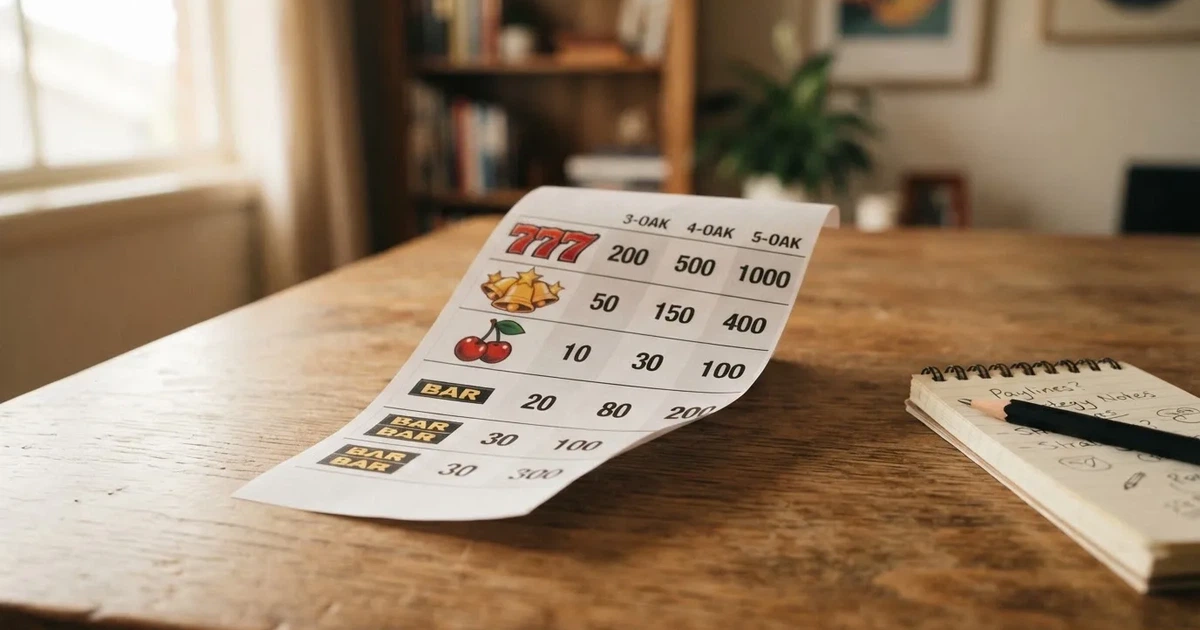
A paytable is a reference chart, not a live game. It lays out the symbol values, the win lines and the combinations that pay. A typical strip shows lower-paying symbols (often card ranks styled to the theme) and a short list of high-paying themed icons, alongside scatters, wilds and any bonus-round triggers. Reels spin on a random-number generator; the visible animation is decoration, not mechanism.

Where a licensed pub or club pokie in Australia publishes a return-to-player figure on the machine or on its signage — a number between 85% and 90%, depending on the state — there is no equivalent guarantee online. Offshore sites can publish any figure they like, and the offshore regulator the site claims to be licensed by may or may not require independent testing of the game. The frame a player reads at a Crown Melbourne baccarat table is not the frame an offshore pokie page provides: Crown Melbourne’s three baccarat variants are approved by the Victorian Gambling and Casino Control Commission, with copies of the approved rules available on request under section 66 of the NSW Casino Control Act 1992 in NSW venues. That paper trail does not reach the offshore site.
The ACMA record: what has been warned, blocked, and named
The ACMA enforces the prohibition by investigating, issuing formal warnings and directing Australian internet service providers to block illegal sites. By June 2026 a running total of 1,751 illegal gambling and affiliate marketing websites had been blocked since the first blocking request in November 2019, and more than 230 unlicensed gambling services had left the Australian market since enforcement was strengthened in 2017. In the round reported on 26 June 2026 the ACMA asked ISPs to block a further 12: 7Signs, ChromaBet, Donbet, Duospin, Freshbet, Slots Gem, Jacks Club, Lucky Start, Pointsbetz, Spinrise, Vinyl Casino and Wildsino.
The formal-warning record — the regulator’s name-and-shame arm — has its own shape. In May 2022 the ACMA warned Dama N.V. over six casino brands at once: Bambet, Dazard, Level Up, Rocketplay, Wild Tornado and Cobra Casinos. The same operator was warned again in March 2025 over Woo Casino and in May 2025 over Spirit Casino. In July 2025 the ACMA warned Bamboo Media over Ignition Casino and Consolutetish S.R.L. over National Casino and Bizzo Casino — Bizzo Casino having already been the subject of a 2022 warning to TechSolutions. In February 2025 the ACMA warned EOD Code SRL over Instant Casino. In April 2026 it warned Ryker B.V. over Jackbit and CasinOK. Pulsup Ltd was warned over Rocketplay in March 2026. Sterplay Holding Ltd was warned over Casino Intense in April 2025. Hollycorn N.V. was warned over its Sky Crown and Blue Leo services in September 2022.
The pattern is plain: the warnings cluster around a small number of operator companies running dozens of front brands. A punter seeing a new name at the top of a list is, statistically, looking at another Dama, Consolutetish or Hollycorn wrapper.
The offshore offer, described without illusions
For all that the law reads the way it does, the offshore sites continue to advertise heavily in Australian-facing media. Three things to know about the offer before any reader attaches weight to it.
First, sign-up bonuses and welcome packages are marketing instruments, not bankroll. A “200% match” headline is the amount the site credits in bonus funds, not cash, and bonus funds are nearly always gated by a wagering requirement — a multiple of the bonus that must be turned over before any of it converts to withdrawable balance. A 35x bonus means a $200 bonus needs $7,000 of turnover before it pays out. Max-cashout caps, game-restriction lists and expiry windows sit underneath the headline. The page on an offshore site that describes this is the page a player should read before depositing anything; the headline is not that page.
Second, free spins work the same way. A “50 free spins” line item is 50 spins at a fixed stake, on a fixed game, with the resulting winnings almost always paid as bonus funds subject to a wagering multiple. Free-spin value to the player is roughly (spins × stake × RTP of the named game) minus what the wagering requirement takes back. The number that matters is the post-wagering balance, not the headline count.
Third, the loyalty and reload architecture — the regular promos an offshore casino runs to keep a depositor coming back — works the same arithmetic. Each new bonus resets the wagering clock. A player who takes every offer is grinding through turnover most of the time, and the house edge on a pokie — anywhere from a few percent to over 10% on the highest-volatility titles — eats into the bonus faster than the headline suggests.
What a PayID-friendly offshore site actually means
PayID is an Australian fast-payment rail operated through the New Payments Platform, and Osko runs on the same plumbing. A site that lists PayID as a deposit option is using an Australian bank account, somewhere, to receive money from an Australian player. That is a fact about payment routing, not about legality: the site can still be operating from Curaçao, the Seychelles, Cyprus or anywhere else, taking Australian dollars through PayID because the receiving bank account happens to be local. A PayID-friendly “Australian online pokies” site can absolutely still be operating from offshore, and the ACMA’s published blocking and warning record shows that many of them are.
The licensed-wagering deposit list reads differently: licensed Australian bookmakers may take debit card, bank transfer, PayID/Osko and BPAY. Credit cards, credit-related products and digital currency have been banned as payment for licensed online wagering since 11 June 2024, with penalties up to $247,500 for operators. A site asking an Australian for a credit card or a crypto deposit is operating outside the Australian rules. The licensed/unlicensed split is partly legible in the deposit box.
What a mobile version looks like — and what an “app” is, here
A licensed Australian bookmaker with a betting app delivers it through the Apple App Store and Google Play, age-gated and signed by the wagering provider. The offshore pokie market does not distribute that way. What most of them offer is a mobile-responsive browser site — the same site, scaled to a phone — sometimes wrapped in a thin Android APK that a player downloads directly from the operator’s site rather than from Google Play. The “Australian pokies app” promise in an ad is, in the offshore context, usually one of those two things; neither is a regulated Australian app store product.
There is no legal Australian online pokies app because there is no licensed Australian online pokies product for an app to wrap. The browser site and the APK both route to the same offshore operator, the same offshore terms and the same absence of local consumer protection.
Specific game formats and the provider stack
The game catalogue on a typical offshore pokie site is a portfolio assembled from a handful of large studios — Pragmatic Play, BGaming, NetEnt, Microgaming’s successors, Play’n GO, Evolution for live tables — plus a long tail of smaller studios white-labelling into the same aggregators. A site brand (“RocketPlay”, “Level Up”, “Woo Casino”) is a wrapper; the games underneath are bought in from this shared pool. The site the punter sees and the studio that made the game are different legal entities in different jurisdictions.
Two structural consequences. First, RTPs vary by title and by studio and may differ across sites carrying the same game — the site can sometimes select a lower-RTP configuration of a Pragmatic slot. Second, the volatility profile of any given title is a property of the math model the studio wrote; it does not change between operators. High-volatility slots produce long dry stretches punctuated by large wins; low-volatility slots pay small and often. Neither is “better” — they cost the player the same in expectation over time, but the variance feels different. The site rarely tells the player which configuration it is running.
Live tables follow the same structure: Evolution runs most of the offshore live-dealer product, and the brand on the page is the skin on top.
The eleven brands the ACMA has publicly named
Each of the brands below has been the subject of a formal ACMA warning for offering prohibited interactive gambling services to Australians. The names appear on the ACMA’s website. They are not reviewed for playability, payout speed or bonus generosity — only for what the regulator has actually said about them.
RocketPlay — warned twice, through two operators
RocketPlay carries the unusual distinction of two ACMA formal warnings: the first to Dama N.V. in May 2022, and the second to Pulsup Ltd over Rocketplay in March 2026. A brand that has been warned under two different operating companies is, in practical terms, a brand whose operating vehicle keeps changing while the front end stays put.
The site’s claim to a Curaçao licence is the standard offshore wrapper and grants no Australian consumer protection. Withdrawals are processed by the operator on its own terms, with no Australian complaints body to appeal to if a payout stalls. Whether a PayID or bank-transfer withdrawal reaches the player depends entirely on the operator’s standing policies, which the ACMA’s warning does not name and which are not auditable from outside. Verdict: a brand with two regulator letters against it, still trading under a familiar front end — a reader weighing it should weigh that fact at the top of the scale.
Level Up Casino — Dama’s 2022 cohort
Level Up was one of six Dama N.V. brands named in the May 2022 warning, alongside Bambet, Dazard, Rocketplay, Wild Tornado and Cobra Casinos. BGaming’s own listings catalogue it as a partner carrying BGaming titles — a useful data point on the studio side of the catalogue, not a statement about the operator’s standing. The site’s offshore licence and the absence of an Australian complaints path are the same as the rest of the cohort.
What sets Level Up apart inside that cohort is the timing: it was warned in the 2022 round that also pulled in the bulk of Dama’s stable, and it has not been the subject of a follow-up warning since. That is not an endorsement — a warning is not a clearance — but it is a different shape from a brand the ACMA keeps returning to. Verdict: a 2022 cohort member; the regulator’s silence on it since is a thinner data point than it looks.
Woo Casino — the March 2025 Dama return
Woo Casino drew a fresh ACMA warning to Dama N.V. in March 2025, three years after the original 2022 cohort letter. A repeat warning to the same operator, on a different brand, indicates the operator has continued offering prohibited services despite the earlier letter. The site’s standard offshore wrapper applies; the standing of the brand inside Dama’s stable is not externally auditable. Verdict: a brand the regulator returned to in 2026 — the relevant fact, since the 2022 letter was already on file.
Spirit Casino — May 2025, same operator
Spirit Casino drew the ACMA’s May 2025 warning to Dama N.V., the third Dama brand named in the same general enforcement arc. The pattern — Dama, then Woo, then Spirit — is the regulator working through a stable that keeps adding fronts. The site’s terms, the offshore licence and the absence of an Australian complaints route are the standard offshore picture; nothing in the ACMA record suggests Spirit is different from its stablemates on any of those axes. Verdict: a same-operator follow-up, with the same protection gap that gap implies.
National Casino — July 2025, new operating vehicle
National Casino drew the ACMA’s July 2025 warning to Consolutetish S.R.L., in the same enforcement round that named Bizzo Casino under the same operator. Wikipedia’s listings note it as a brand operating in this space — a third-party catalogue observation, not a regulatory one. The site’s standard offshore frame applies, with the same absence of Australian consumer protection.
National is, in the cohort, the better-known of the two Consolutetish brands the warning named in July 2025. That wider recognition cuts both ways: more brand exposure in Australian-facing media tends to draw more attention from the regulator, and the warning arrived through that channel. Verdict: a brand with regulator attention already on file, with the same protection absence the rest of the cohort carries.
Bizzo Casino — warned twice under different operators
Bizzo Casino is unusual in having two ACMA warnings on file under two different operating companies: the 2022 warning to TechSolutions (CY) Group Limited and TechSolutions Group N.V., and the July 2025 warning to Consolutetish S.R.L. A brand that has changed operating hands while keeping its name is, in practical terms, a brand whose legal substrate has shifted twice. The site’s claims of any current offshore licence belong to the current operator, not to the chain.
The double warning is the data point. The site itself has been around the regulator’s record under two different company names; whatever protection the operator claims to offer is the current operator’s protection, not a continuous record. Verdict: a name with two regulator letters against it and a changed operating substrate — a fact the brand does not put on its homepage.
Ignition Casino — July 2025, Bamboo Media
Ignition Casino drew the ACMA’s July 2025 warning to Bamboo Media. The site operates under the standard offshore frame and offers no Australian consumer protection. The casino’s name is well-known in the broader international market, and the Australian-facing version of that recognition has been the ACMA’s route to it.
What Ignition shows in the ACMA record is a brand whose international profile dragged it into an Australian-specific enforcement action — a different pathway from the smaller, less-branded names the regulator catches through routine monitoring. Verdict: a well-known international brand, now on the Australian regulator’s record under a named operating vehicle.
Instant Casino — the February 2025 warning
Instant Casino drew the ACMA’s February 2025 warning to EOD Code SRL — a single-brand warning, with no earlier cohort letter to thread it into. The brand’s profile in Australian-facing media is modest compared to the bigger names in the cohort, which is consistent with the regulator catching it through standard monitoring rather than through high-visibility ad campaigns. Verdict: a single-warning brand with the same standard offshore picture as the rest.
Jackbit — April 2026, alongside CasinOK
Jackbit drew the ACMA’s April 2026 warning to Ryker B.V., in the same enforcement action that named CasinOK. Two brands, one operator, one warning letter — the same pattern the regulator has applied to Dama and Consolutetish. Jackbit’s standing in the broader crypto-friendly casino market is wider than its Australian footprint suggests; the Australian-facing version of that footprint drew the warning. Verdict: a brand the regulator caught alongside its stablemate, with the same protection gap the cohort carries.
Casino Intense — April 2025, Sterplay Holding
Casino Intense drew the ACMA’s April 2025 warning to Sterplay Holding Ltd. The site operates under the standard offshore frame. ABC News and ACMA listings catalogue it; Crown Melbourne’s baccarat page and the regulator’s baccarat framing sit alongside in research, which is itself a useful reminder that the licensed Australian product and the offshore product are different markets with different rules. Verdict: a named-regulator brand with no specific consumer-protection differentiator from the rest of the cohort.
Sky Crown — Hollycorn’s 2022 warning
Sky Crown drew the ACMA’s September 2022 warning to Hollycorn N.V., in the same enforcement action that named Blue Leo. The Hollycorn stable has been a recurring presence in the regulator’s record; Sky Crown sits inside that pattern. The site’s offshore frame and the absence of Australian consumer protection are standard. Verdict: a 2022 cohort member under a large multi-brand operator, with the regulator’s silence on it since the original letter being the only subsequent data point.
What the protection architecture actually is — and isn’t
A punter playing on a licensed Australian bookmaker has several layers of protection that are simply absent on an offshore pokie site. BetStop, the National Self-Exclusion Register, has been live since August 2023 and binds Australian-licensed online and phone wagering services; an offshore casino is not connected to it. A self-excluded punter who moves from a licensed bookmaker to an offshore pokie site has not self-excluded anywhere that matters.
The complaints architecture differs. A licensed operator answers to a state regulator and, in some cases, to an alternative dispute resolution body; an offshore operator answers to its own terms page and to the regulator named in its licence footer, which may be real or may be theatrical. The IGA targets the provider, not the individual player — an Australian punter is not personally at risk of prosecution for placing a bet — but the absence of recourse when a withdrawal stalls, an account is closed or a balance is confiscated is itself the cost. The ACMA’s blocking power includes the power to block a site with a balance still on it; the punter’s money does not survive the block.
For thinking that starts to feel compulsive or stressed, free confidential help is available around the clock: Gambling Help Online (chat and web) and the National Gambling Helpline on 1800 858 858. Both are Australian-funded, both are confidential, both work for any punter regardless of which market they have been playing in.
The arithmetic the regulator’s record actually does
The page’s one piece of derived arithmetic is the rate at which the ACMA’s blocking list has grown, and what that growth says about the size of the market the regulator is working against. The first blocking request went out in November 2019. By June 2026 the running total was 1,751 illegal gambling and affiliate marketing websites blocked, and more than 230 unlicensed gambling services had left the Australian market since enforcement was strengthened in 2017. Between November 2019 and June 2026 is roughly 79 months; 1,751 blocked sites across that span is a band of roughly 18 to 25 sites blocked per month on average, accelerating toward the higher end as the rounds have grown in size — the June 2026 round alone was 12 sites. H2 Gambling Capital’s 2025 estimate puts the annualised loss to illegal gambling sites at about A$3.9 billion, with the share of gambling going through legal channels falling from 74% in 2021 to 64%. The arithmetic the record does, in other words, is the arithmetic of a market that has been growing faster than the regulator can name names in it — the block rate is high because the underlying flow is high.
What to read before any reader attaches weight to anything on this page
Three things to hold in mind, none of which the offshore marketing will say.
The first is that the ACMA’s formal-warning record is the closest thing to a public compliance audit the Australian market has, and it is partial. The regulator names the operators it has caught through a specific enforcement action; it does not certify operators it has not named. A brand not on the warning list is not, on that account alone, safe — it is simply not yet caught.
The second is that an offshore licence — Curaçao, Anjouan, the Seychelles — is a payment for a registration, not a compliance regime in the Australian sense. The dispute resolution, the game-testing regime, the responsible-gaming obligations and the consumer protections are whatever the operator’s terms page says they are. A punter who has not read the terms has not read the contract.
The third is that the house edge on a pokie is structural. Whether the title is 95% RTP or 96% RTP, the site takes its cut on every spin; no bonus undoes the cut, only delays it through the wagering requirement. A punter playing a $1 spin at 95% RTP loses 5 cents per spin in expectation, before any bonus arithmetic. That figure is independent of how generous the welcome package looks.
Frequently asked questions
Is “Australian pokies online” a category that any Australian state regulator recognises?
No. The Interactive Gambling Act 2001 prohibits the supply of online casino games, including online pokies, to anyone in Australia, and no state or territory issues a licence for them. The closest licensed equivalent is the pokie inside an Australian pub, club or casino — a different product, regulated by the state, with a published return-to-player floor between 85% and 90% depending on jurisdiction. Any site presenting itself as an “Australian pokies online” operator is using the geography in its marketing, not in its licence.
Is there a legal Australian online pokies app?
No, because there is no licensed Australian online pokies product for an app to wrap. What an offshore casino offers is either a mobile browser site or an Android APK downloaded directly from the operator. Neither is distributed through Apple’s App Store or Google Play as a regulated Australian product, and neither is connected to BetStop or any state complaints body. A punter who wants app-store distribution and Australian consumer protection is, structurally, looking at a licensed wagering product — races, sport, lotteries, keno — and not at online pokies.
What’s the difference between “Australian pokies online” and pokies in an Australian venue?
A venue pokie sits inside a licensed pub, club or casino, on a machine the state regulator has approved, with a return-to-player floor written into law (between 85% and 90% depending on the state), with on-site harm-minimisation measures, and with the venue subject to state complaints and compliance regimes. An offshore “Australian pokies online” site has none of those — no state regulator, no return-to-player floor, no venue-level harm-minimisation, no local complaints body. The two products share a name and share a game mechanic; they do not share a regulatory frame. The honest read is that they are different markets, and a punter moving from one to the other has moved from a regulated market to an unregulated one.
Do the sign-up bonuses on offshore “Australian pokies online” sites come from a local Australian operator?
No. The bonus is paid by the offshore operator behind the site, in whatever currency the operator’s terms specify, governed by the wagering requirements and max-cashout caps the same terms impose. The “Australian” in the site’s marketing is geography, not incorporation. The bonus structure is also the standard offshore instrument — bonus funds, not cash, gated by a wagering multiple that may run from 30x to 50x or higher, with game restrictions and expiry windows. None of those terms are set by an Australian regulator.
Can a PayID-friendly “Australian online pokies” site still be operating from offshore?
Yes, and most of them are. PayID is a payment rail; it routes money from an Australian bank account to a receiving bank account, and the receiving account can sit anywhere an Australian bank holds money. A PayID-friendly offshore site is using an Australian bank account somewhere in its deposit stack; it is not licensed in Australia, not connected to BetStop, and not subject to the credit-card and crypto bans that apply to licensed wagering from 11 June 2024. The presence of PayID on the deposit page is a payment-routing fact, not a regulation fact.
Does the word “Australian” in a pokies site’s name indicate where it is actually licensed?
Almost never. The brand name is a marketing choice; the licensing jurisdiction is named in the site’s footer, and it is almost always Curaçao, Anjouan or the Seychelles for the offshore cohort. A punter who wants to know where the site is licensed reads the footer, not the homepage headline. The ACMA’s formal-warning record names the actual operating company behind the brand — Dama N.V., Consolutetish S.R.L., Hollycorn N.V., Bamboo Media, Ryker B.V., Sterplay Holding Ltd, EOD Code SRL, Pulsup Ltd — and those names are the ones that matter for any reader trying to follow the regulator’s trail.