
Real Money Online Pokies in Australia: Where the ACMA Draws the Line
Data current as of 28 October 2026 · verified against ACMA formal warning notices and the Interactive Gambling Act 2001
The search for “best online pokies” often promises a shortlist, a leaderboard, or a winner. In Australia, however, no such list exists. The Interactive Gambling Act 2001 prohibits offering online casino games, including online pokies, to anyone physically present in Australia. No state or territory licenses them. This article is not a ranking; it is a description of the gap between what the search implies is available and what Australian law actually permits, set out with the operator names the regulator itself has acted against and the lawful alternatives that do exist.
That gap matters because the marketing around real money online pokies is built on it. The eleven brands below are all offshore, all formally warned, and all unable to point to an Australian licence for the product they sell. Reading this page before depositing with any of them is the single most useful thing a prospective Australian player can do.
Table of Contents
PayID, Cards, and Crypto: How Money Would Move
The Australian payment story for real money online pokies has two layers, and they are not the same layer. For licensed Australian wagering, the federal rules have been clear since 11 June 2024: credit cards, credit-related products and digital currency cannot be used to fund an account. The legal deposit routes are debit card, bank transfer, PayID/Osko and BPAY. The fines for an operator breaking this are real, up to A$247,500 per breach.

For an offshore casino the situation is different. PayID works because PayID is just the New Payments Platform; it has no opinion about what is being bought with the transfer. An Australian bank will accept a PayID transfer to an account, and the casino will accept that deposit. The bank is not blocking anything, because the IGA targets the provider, not the player. What the bank cannot do is recover money once it has been sent, because the recipient is an offshore entity with no Australian regulatory nexus. Visa and Mastercard debit rails work the same way. So does crypto, though crypto carries the extra problem that once a transaction is on-chain it is functionally irreversible.
The settlement question is the other half of the money story. PayID transfers clear in seconds; bank-to-bank Osko transfers in under a minute; BPAY settles next business day. None of that tells you how long the casino takes to release a withdrawal. Offshore sites report payout windows ranging from a few hours to several business days, but the only Australian recourse when a withdrawal is refused is the operator’s own complaints process, because no Australian regulator has jurisdiction. A blocked balance sits there with no path home.
The Phone-Screen Experience
A real money pokies app for Australian players does not exist as a legal product. The Google Play and Apple App Store policies prevent licensed Australian wagering apps from carrying casino games, and no developer ships a compliant Australian real money pokies app. What exists are two adjacent things: licensed Australian wagering apps for sports and racing (Sportsbet, Ladbrokes, bet365, all Northern Territory–licensed), and offshore casino apps that accept Australian players but sit outside any Australian regulatory perimeter.
On a phone browser the offshore product looks identical to a desktop product. The same catalogue, the same lobby, the same deposit screen. The difference is that the screen is closer to the player’s face and the session is more likely to be a long one in a quiet moment, which is itself a meaningful risk variable. No technical barrier separates the experience from the Australian-legal experience; only the regulatory status does.
That is also where the fingerprint of the offshore product shows up in ways a desktop user does not see. Push notifications prompt play at hours that have nothing to do with Australian daylight. Geo-targeting can detect that a player has moved between states, but no Australian state-level regulator has reach into the operator to enforce a state-level rule. The phone is where the marketing finds the player, not where the protection does.
Game Catalogue and What Is Actually Playable
The catalogue an offshore real money pokies site offers is the standard global one: pokies (slots) at the centre, plus blackjack, baccarat, roulette and live dealer tables. The math behind the games does not change because the player is in Australia. The house edge on a banker bet in baccarat is 1.06%, on a player bet 1.24%, on a tie 14.36%. Optimal-play blackjack under liberal Las Vegas Strip rules carries about 0.28%, about 0.43% under Atlantic City rules. These numbers are the same on a Sydney phone screen as they are in a Las Vegas casino.
What does change is the regulatory floor on the land-based machines Australians can actually play. The minimum return-to-player for poker machines varies by jurisdiction: 85% in New South Wales, the Northern Territory, Queensland and generally Victoria (87% at Crown Melbourne), 87% in the Australian Capital Territory and Tasmania, 87.5% in South Australia, and 90% in Western Australia. Western Australia banned poker machines in pubs and clubs when Crown Perth opened in 1985; Crown Perth’s own machine count has since grown from roughly 200 in 1985 to about 2,500, all approved by the state’s Gaming and Wagering Commission. Queensland had 21,122 gaming machines in 351 venues in October 2023. Victoria had 26,380 outside Crown Casino in 488 venues in 2021–22, capped at a statewide limit of 30,000. New South Wales alone had 87,298 machines outside casinos across 2,195 venues as of June 2023, with player losses of A$8.18 billion in 2022–23. These are the machines Australians can legally sit in front of, and the floor on their return is a state-level decision.
The offshore product’s catalogue is broader but unrated. No Australian authority checks the return-to-player on a slot running from Curaçao or Costa Rica. The figure printed on the operator’s game-info page is self-reported and not independently verified. Players who treat those numbers as comparable to the land-based RTP floors are taking the operator’s word for it.
Minimum Return-to-Player Floors by Jurisdiction
| Jurisdiction | Min RTP Floor |
|---|---|
| New South Wales | 85% |
| Northern Territory | 85% |
| Queensland | 85% |
| Victoria | 85% (87% Crown) |
| ACT | 87% |
| Tasmania | 87% |
| South Australia | 87.5% |
| Western Australia | 90% |
What the ACMA Has Done, and the Brands Named
The ACMA’s enforcement record is the closest thing Australia has to a public ledger of which offshore brands target Australian players.
| Brand | ACMA Action and Date | Operator Named by ACMA | Subject Support |
|---|---|---|---|
| RocketPlay | March 2026 | Pulsup Ltd | No-data |
| Level Up | May 2022 | Dama N.V. | Listings-only |
| Woo Casino | March 2025 | Dama N.V. | No-data |
| Spirit Casino | May 2025 | Dama N.V. | No-data |
| National Casino | July 2025 | Consolutetish S.R.L. | Listings-only |
| Bizzo Casino | July 2025 | Consolutetish S.R.L. | No-data |
| Ignition Casino | July 2025 | Bamboo Media | No-data |
| Instant Casino | February 2025 | EOD Code SRL | No-data |
| Jackbit | April 2026 | Ryker B.V. | No-data |
| Casino Intense | April 2025 | Sterplay Holding Ltd | Listings-only |
| Sky Crown | September 2022 | Hollycorn N.V. | No-data |
The pattern behind those blocks is the reason this page cannot honestly present a ranking. Each of the eleven brands below is on the ACMA’s enforcement list. Several are repeat offenders under different corporate names. Some run on a Curaçao licence; some on no licence at all. None are licensable in Australia for the product they sell.
The Blocking Rate
The first blocking request under the regime was issued in November 2019. By the June 2026 report, 1,751 sites had been blocked over roughly 80 months. That works out at an average of just under 22 blocked sites per month, or about 262 per year, across the period the regime has been active. The figure is uneven in practice: some months see rounds of a dozen or more, others see none. But the headline arithmetic is plain: enforcement has averaged more than one new blocked site per working day over the seven years the system has run, and the rate has not slowed down.
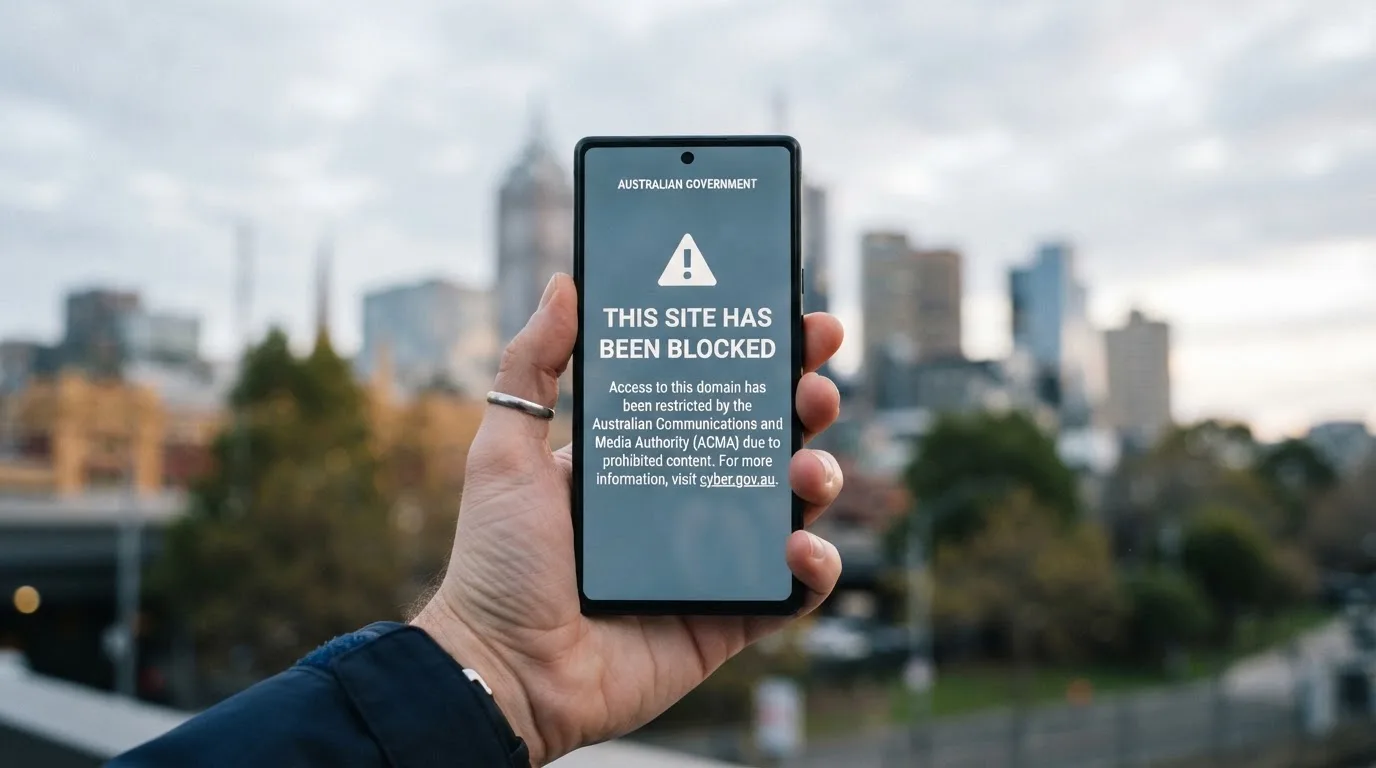
That matters because it shows the legal position is not theoretical. The IGA’s prohibition is enforced in a way that produces a measurable, ongoing stream of removals. A site visible to an Australian today may be on tomorrow’s block list. An Australian with an open balance at the time of a block has no Australian channel for getting it back; the operator is offshore and the block is on the Australian ISP side.
RocketPlay
Rocketplay was the subject of an ACMA formal warning issued in March 2026 to Pulsup Ltd. The Dama N.V. corporate group behind an earlier version of the brand had already been warned in May 2022, covering six casino brands. The site cannot point to an Australian licence for its product. As an offshore brand, Australian consumer protection does not apply: there is no Australian complaints body, no recourse through the ACMA or the Australian Financial Complaints Authority, and no guarantee that a withdrawal request will be honoured. The name change from one corporate entity to another is itself part of the pattern: a warned operator rebrands, relaunches, and continues targeting the same market.
Level Up Casino
Level Up Casino received an ACMA formal warning in May 2022 as one of the six Dama N.V. brands warned in that round. The site is listed by game-provider directories as carrying BGaming content, which is the only verifiable third-party signal about its catalogue. No Australian licence covers it. As an offshore brand with a known ACMA history, its standing under Australian consumer law is the same as any other warned operator: zero local protection, zero local recourse.
Woo Casino
Woo Casino was the subject of an ACMA formal warning issued in March 2025, with the operator named as Dama N.V. The same corporate group had been warned over Level Up and Rocketplay earlier. The brand has not been verified to carry any Australian-licensable product. A player depositing here sends money to an offshore entity; a player trying to withdraw sends a request to the same entity, with no Australian regulator behind the request.
Spirit Casino
Spirit Casino was formally warned by the ACMA in May 2025, again with Dama N.V. named as the operator. It is the fourth Dama N.V. brand on this page and the most recent. The pattern of repeated warnings under one corporate name suggests that warnings alone are not slowing the operator’s activity; blocking rounds and site relaunches continue. No Australian consumer protection applies to a balance held at Spirit Casino.
National Casino
National Casino received an ACMA formal warning in July 2025, with Consolutetish S.R.L. named as the operator. Wikipedia references place it among the brands operating in the offshore Australian-targeting space. The corporate name Consolutetish S.R.L. is one Australian readers are unlikely to recognise, which is itself a flag: the entity behind the brand is not the brand itself, and the brand is not the entity that holds any licence it claims to hold.
Bizzo Casino
Bizzo Casino received an ACMA formal warning in July 2025 (Consolutetish S.R.L.) and an earlier one in 2022, when the operator was named as TechSolutions (CY) Group Limited and TechSolutions Group N.V. Two warnings, two different corporate names, the same brand. Australian consumer law does not reach any of the three. A player who signed up in 2022 thinking the brand had stabilised would, by 2025, be dealing with a new corporate entity on the other end of the balance.
Ignition Casino
Ignition Casino received an ACMA formal warning in July 2025, with Bamboo Media named as the operator. No verifiable Australian-licensable product sits behind the brand. The corporate name does not match the casino name, which is again typical for this market: the brand is the marketing surface, the corporate entity is the legal surface, and they are designed to be replaceable independently.
Instant Casino
Instant Casino received an ACMA formal warning in February 2025, with EOD Code SRL named as the operator. The name “Instant” is a marketing promise about speed of withdrawal that no Australian regulator stands behind. Whether the brand pays out quickly or slowly is a property of the operator’s own policies and the payment rails it accepts, not a feature Australian law enforces.
Jackbit
Jackbit received an ACMA formal warning in April 2026, with Ryker B.V. named as the operator. Ryker B.V. was also warned in the same round over CasinOK. Two brands, one corporate entity, one month. The reuse of corporate shells across multiple brand fronts is the structural feature of this market that an Australian player cannot see from the lobby.
Casino Intense
Casino Intense received an ACMA formal warning in April 2025, with Sterplay Holding Ltd named as the operator. The brand is referenced in ABC reporting and the ACMA’s own formal-warning publication. No Australian licence covers it. Like the rest of this list, it sits in the offshore space with no local recourse for a refused withdrawal.
Sky Crown
Sky Crown was the subject of an ACMA formal warning over Hollycorn N.V., the same corporate group warned over Blue Leo. The formal warning is published as a PDF on the ACMA site (September 2022). Hollycorn N.V. operates a portfolio of brands using a common platform; an Australian player encountering any of them is encountering the same operator behind a different name.
What These Eleven Brands Share
Every brand on this list has been the subject of a formal ACMA warning. Several appear more than once, under different corporate names. None are licensable in Australia for the product they sell. The ACMA’s June 2026 blocking-round update is the regulator’s own confirmation that the offshore pipeline feeding Australian players has not slowed; it has averaged more than one new blocked site per working day over the life of the regime. A reader comparing these brands is comparing eleven variants of the same proposition, each with the same structural risk.
What the Interactive Gambling Act 2001 Actually Says
The Interactive Gambling Act 2001, as strengthened by the Interactive Gambling Amendment Act 2017, creates offences for providing online casino games, online pokies and in-play betting to a person physically present in Australia. What remains licensable is wagering on races and sporting events placed before the event, lotteries and keno. In practice, online sports and racing wagering is licensed by the Northern Territory through the Northern Territory Racing and Wagering Commission, which regulates 52 of Australia’s online bookmakers, including Sportsbet, bet365 and Ladbrokes. The commission has no full-time staff and meets once a month in Darwin.
The 2017 amendments gave the ACMA the powers it has used to block 1,751 sites and force 230 operators out of the market since 2017. The August 2026 reform, the Interactive Gambling Amendment (Gambling Reform) Bill 2026, passed Parliament on 19 August 2026 and introduces new advertising and inducement measures that commence on 1 January 2027. Law with a start date, not yet in force at the time of writing. The minimum age for any form of Australian wagering is 18.
The individual player is not prosecuted under the IGA. The Act targets the provider. That is the structural reason the offshore market persists: the legal pressure falls on operators who are already offshore and have no Australian assets to seize. An Australian who plays at a warned offshore brand faces no criminal exposure; what they lose is the Australian consumer-protection perimeter that would otherwise apply to their balance.
The Player-Protection Layer
The safeguards an Australian player can actually use sit on a different shelf from the offshore products. BetStop, the National Self-Exclusion Register, has been live since August 2023. It binds Australian-licensed online and phone wagering services to honour a registered player’s request to be excluded. It does not bind offshore casinos. A player who registers with BetStop is excluded from Sportsbet, Ladbrokes, bet365 and the rest of the Northern Territory–licensed set; they are not excluded from any of the eleven brands above.
The National Gambling Helpline is 1800 858 858, free, 24/7, with chat available at Gambling Help Online. These are the channels that work, regardless of which offshore brands a player has used. They are the channels a prospective player should know about before they deposit anywhere, because the offshore product does not connect to them.
Tasmania planned nation-leading mandatory pre-commitment cards for its poker machines, but implementation of the reform was delayed until late 2025. New South Wales, Victoria and the larger jurisdictions have their own state-level frameworks for the land-based machines. None of those frameworks reaches the offshore product.
The Offshore Caveat in One Sentence
Every brand above runs on its own house rules, with its own complaints process, no Australian regulator, and no Australian legal channel if a withdrawal is refused. An offshore casino can be blocked by the ACMA while a player still has a balance on it, and the block does not refund that balance.
The Lawful Alternatives
What an Australian can legally do, in summary, falls into three categories. Licensed land-based gaming machines in pubs, clubs and casinos, regulated state by state. Licensed online and phone wagering on racing and sport, placed before the event, through Northern Territory–licensed operators. Lotteries and keno, through state-licensed products. Each of these has a regulatory perimeter, a complaints body and a consumer-protection framework attached.
The numbers behind the land-based market are the context for any comparison. In 2020–21 Australians bet almost A$150 billion through gaming machines and lost A$12.18 billion on them. Australia has about 3% of the world’s pub and club poker machines with 0.3% of the global population. Registered clubs operated Australia’s first legal poker machines from 1956, in New South Wales. The Federal Group held a monopoly licence over all of Tasmania’s poker machines from 1968; legislation passed in November 2021 ended that monopoly, moving oversight to the Tasmanian Liquor and Gaming Commission.
The point of these numbers is not to make the land-based product look attractive. It is to show that the Australian gambling market is real, regulated and enormous without the offshore online pokies layer. The product a reader searched for is real, but the online version of it is not the version the regulatory perimeter covers.
Tax and Recreational Play
Gambling winnings of a recreational player are not assessable income under section 6-5 ITAA 1997, and losses are not deductible. That holds whether the gambling is at Crown Melbourne, at the local pub, or at an offshore casino. The exception is a person who carries on a business of gambling; for anyone who is not a professional, the rule is that winnings are not taxed and losses cannot be claimed. The model is described as “check with the ATO” because the boundary between recreational and professional play is fact-specific.
Frequently Asked Questions
What is the difference between a free-play pokie and a real money one?
A free-play pokie runs on the same software and the same reels but does not require a deposit and does not pay out real money; the return-to-player figure published by the game provider still applies, but no cash is at risk. A real money pokie requires a funded account and pays out (or fails to pay out) in cash according to the game’s published RTP. The two are mechanically identical, but only the second involves money the player can lose.
Can real money online pokies be played using PayID in Australia?
PayID itself works in Australia for any transfer between Australian bank accounts, and an offshore casino that accepts PayID will accept a deposit from an Australian account. The block is upstream of PayID: the Interactive Gambling Act 2001 prohibits offering online casino games to Australians, and no operator accepting PayID from an Australian player can be licensed in Australia for the product. The deposit clears; the regulatory status of the destination does not change.
Is it legal for an online casino to offer real money pokies to Australians?
No. Under the Interactive Gambling Act 2001, as amended in 2017, it is an offence to provide online casino games, online pokies or in-play betting to a person in Australia. No Australian state or territory licenses online casino games. The ACMA enforces the prohibition through formal warnings and by directing Australian ISPs to block offending sites; 1,751 sites have been blocked since the first blocking request in November 2019. The player is not prosecuted; the operator is.
Is there a dedicated real money pokies app for Australian players?
There is no Australian-licensed real money pokies app, because no Australian licence for the product exists. App-store policies prevent licensed Australian wagering apps from carrying casino games. What exists are licensed Australian wagering apps for sports and racing, and offshore casino apps that accept Australian players but sit outside any Australian regulatory perimeter. An Australian who downloads an offshore casino app is using a product whose Australian-law status is the same as the desktop version: prohibited for the provider, unprotected for the player.
How much did Australians wager on gaming machines in 2020–21?
In 2020–21 Australians bet almost A$150 billion through gaming machines and lost A$12.18 billion on them. New South Wales alone had 87,298 machines outside casinos across 2,195 venues as of June 2023, with player losses of A$8.18 billion in 2022–23. Queensland had 21,122 machines in 351 venues in October 2023; Victoria had 26,380 outside Crown Casino in 488 venues in 2021–22, under a 30,000 statewide cap. These are the licensed land-based figures; they do not include play at offshore online casinos.