
Where online slots in Australia actually stand in 2026
Data current as of 28 October 2026; formal warnings and blocking orders cross-checked against the Australian Communications and Media Authority’s published register.

Every casino on this page sits inside a paradox the marketing refuses to name. The slot games are real, the jackpots are real, the bonuses are real — and the operator offering them to a person sitting in Sydney or Perth is breaking Australian law. The Interactive Gambling Act 2001 makes it an offence to provide online casino games and online pokies to anyone in Australia. The only licensed exceptions are state-licensed land-based venues and the Northern Territory’s wagering licences, which cover racing and sport — not casino games.
This page is a comparison of eleven offshore casinos that the ACMA itself has warned over offering slots to Australians. Each one is real, each one accepts deposits from Australian players in practice, and each one operates outside Australian law. That contradiction is the load-bearing fact for the whole article, and it is the first thing to settle before any welcome offer is worth reading.
Table of Contents
- The landscape: eleven offshore casinos, one prohibition
- What offshore play actually costs the player
- The legality, plainly
- What the slot machine actually does
- The standard offshore offer, decoded
- Comparing the eleven brands
- Comparison of ACMA Warnings by Operator
- Self-exclusion and the limits of Australian tools
- Slots, pokies and the game vocabulary
- The math behind a session
- What an offshore “trusted” claim is actually worth
- The reforms on the horizon
- Reading the table the regulator publishes
- Where the offshore offer ends
- What the pokies machine looks like in the ACT
- The line the marketing never quite crosses
- Where this leaves a player in 2026
- Frequently asked questions
The landscape: eleven offshore casinos, one prohibition
Australia’s online casino market is structurally simple. There is no licensed segment to shop inside: state and territory regulators do not issue casino game licences, and the Interactive Gambling Act 2001 makes the supply of online pokies or casino games a federal offence. The eleven brands reviewed here are the operators who supply the product anyway, and they are listed because the ACMA has issued a formal warning over each one for offering prohibited services to Australian residents.

| Brand | ACMA action and date | Operator named by the ACMA | Subject support |
|---|---|---|---|
| RocketPlay | Formal warning, March 2026 (also covered by a 2022 warning to Dama N.V.) | Pulsup Ltd | — |
| Level Up Casino | Formal warning, May 2022 | Dama N.V. | listed by Bgaming as a partner |
| Woo Casino | Formal warning, March 2025 | Dama N.V. | — |
| Spirit Casino | Formal warning, May 2025 | Dama N.V. | — |
| National Casino | Formal warning, July 2025 | Consolutetish S.R.L. | — |
| Bizzo Casino | Formal warning, July 2025 (second formal warning since 2022) | Consolutetish S.R.L. | — |
| Ignition Casino | Formal warning, July 2025 | Bamboo Media | — |
| Instant Casino | Formal warning, February 2025 | EOD Code SRL | — |
| Jackbit | Formal warning, April 2026 | Ryker B.V. | — |
| Casino Intense | Formal warning, April 2025 | Sterplay Holding Ltd | listed by sources consulted |
| Sky Crown | Formal warning, September 2022 | Hollycorn N.V. | — |
The pattern is what the marketing never quite says out loud. Dama N.V. alone accounts for four of the eleven brands on this page, and the ACMA has come back to it twice in three years — once in May 2022 covering six brands, then again in 2025 over Woo Casino and Spirit Casino. Consolutetish S.R.L. drew a second warning over Bizzo Casino in 2025 after an earlier 2022 warning to TechSolutions. The same operator shell reappears behind a new domain name, and the warning lands again. That recycling is itself the most informative thing in it.
A formal warning is not the heaviest tool the ACMA has. It sits between an investigation and a referral to the Federal Court, and it precedes the next step, which is asking Australian internet service providers to block the domain. Between November 2019 and the round reported on 26 June 2026 the ACMA has directed ISPs to block 1,751 illegal gambling and affiliate marketing websites, and more than 230 unlicensed gambling services have left the Australian market since enforcement was strengthened in 2017. The blocking requests work by giving Australian customers a dead end at the ISP level — a player with money on the site at the time of the block has no Australian complaint body to write to and no Australian licence holder to chase.
The calculation that puts a number on this matters because the numbers move. If 12 new sites were added in the round reported on 26 June 2026 and 1,751 sites have been blocked since the first blocking request in November 2019, then the ACMA has added blocked sites at an average rate of roughly 263 per year across the roughly six-and-two-thirds years between the two dates — a band that captures both the slow early years of enforcement and the stepped-up pace since 2017. The same band also covers the operators who simply leave the market once the warning lands: more than 230 have done so since 2017 without needing a blocking order at all. The cleanest read of the data is that, per working week, the ACMA’s enforcement machine clears more than one site from the Australian side of the internet. That pace is what the word “prohibition” actually means in this market — not a single closed door but a moving barrier, with the ACMA closing sites behind the supply as it tries to move forward.
The brand list above is therefore not a market map. It is a sample of the warnings the regulator has chosen to publish, and the offshore market contains more brands than these eleven by an order of magnitude. A player who walks past this list into another brand has simply not yet met an ACMA action — and given the recycling pattern across Dama N.V. and Consolutetish S.R.L., an unwarned brand is usually a brand the regulator has not yet turned to, not one it has found to be compliant.
What offshore play actually costs the player
The arithmetic behind a slot session is what offshore marketing relies on the reader not doing. A modern video slot uses five reels with fifty or more symbols per reel, which produces odds as high as three hundred million to one against a top combination. A classic three-reel mechanical machine with about ten symbols per reel offered roughly one thousand combinations. The number of possibilities is so different that comparing the two is barely meaningful — what is comparable is the share of every wager that the machine keeps, because that figure has not changed since Charles Fey first rigged three reels in San Francisco with a Liberty Bell as the top symbol paying ten nickels.
The share is the house edge, and the house always has one. A slot configured to return 96% to the player keeps 4% of every dollar wagered, on average, across a very long run of spins. Across a session of, say, A$200 in spins, the expected loss is the turnover multiplied by the edge: A$200 × 0.04 = A$8. That is the cost of the session on average, with the variance absorbed. Any individual session can swing a long way either side of A$8 — variance is the noise around the edge — but the long-run average holds.
Offshore welcome packages are usually framed around a deposit match plus free spins, and the load-bearing number is not the headline. It is the wagering multiple, the maximum cashout, the game weighting and the expiry window. A A$1,000 bonus with a 40× wagering requirement on the bonus alone means A$40,000 of slot turnover before any withdrawal clears. At a A$1 spin, that is 40,000 spins; at five seconds per spin it is 200,000 seconds, or roughly 55.6 hours of continuous play. The bonus is not the gift it is framed as — it is the requirement it carries with it.
The clearest way to read an offshore welcome package is as a price. The deposit the player funds it from is real money that earns no interest and is not insured by an Australian deposit guarantee. The bonus turns part of that real money into locked funds that can only be unlocked by completing the wagering requirement, and the wagering requirement is calibrated to keep the house edge intact. If the slot is a 96% return game, the A$40,000 turnover keeps roughly A$1,600 on average before the bonus is cleared. The bonus that “added A$1,000 to the account” has, on average, cost A$600 to unlock. That is the actual price.
The legality, plainly
The Interactive Gambling Act 2001, strengthened by the Interactive Gambling Amendment Act 2017, makes it an offence to provide online casino games, online pokies or in-play betting to a person in Australia. The Act targets the provider, not the player — there is no prosecution risk in opening an account at an offshore casino from a Sydney address — but the corollary is that the player is also outside the Australian protection regime. No Australian dispute resolution body covers it. No Australian licence condition binds it. No Australian regulator can compel it to pay a disputed withdrawal. The site can be blocked by the ACMA with the player’s balance still sitting on it, and the player has no recourse under Australian law.
What is licensed in Australia is wagering on races and sport placed before the event, lotteries and keno. In practice the licensed online bookmakers — including Sportsbet, Bet365 and Ladbrokes — are licensed in the Northern Territory for tax reasons. The Northern Territory Racing and Wagering Commission regulates 52 of Australia’s online bookmakers, has no full-time staff and meets once a month in Darwin. Casino games, however, are not part of that wagering licence: the NT licence covers the betting exchange and the sportsbook, not the slot floor.
The payment channel narrows further. Since 11 June 2024 credit cards, credit-related products and digital currency have been banned as a payment for licensed online wagering, with penalties of up to A$247,500 for operators that take them. The licensed deposit routes are debit card, bank transfer, PayID, Osko and BPAY. The offshore casinos on this page accept a wider range — including crypto — precisely because they are not licensed in Australia. The convenience the marketing praises is the mechanism the Australian rules forbid.
The 2026 reform picture matters because it sets a clock. The Interactive Gambling Amendment (Gambling Reform) Bill 2026 passed Parliament on 19 August 2026, and its advertising and inducement measures commence on 1 January 2027. The bill is law with a start date, not yet in force on a 2026 page. What it changes for offshore operators is a question the ACMA’s enforcement record answers in advance: it adds inducement exposure to the existing supply prohibition, and the same blocking lever follows.
What the slot machine actually does
The reason a slot outcome cannot be predicted is the random number generator. Every spin, the RNG picks a number, that number is mapped to a position on each reel, and the reels display the symbol that corresponds to that position. There is no memory: a spin is not “due” because the last one missed, and a streak of wins does not mean a win is more likely next spin. Each spin is independent and the long-run return converges on the configured percentage.
The machine has to keep enough money in to pay the jackpots it advertises, and it does that by setting the symbol weighting — the mix of high-paying and low-paying stops on each reel. A modern video slot can carry fifty or more symbols per reel across five reels, and the weighting is set so that the rare symbol combinations pay large amounts but land rarely enough that the long-run return still favours the house. A three-hundred-million-to-one top combination is the price the house pays for marketing material that prints “win up to A$500,000” across the slot icon.
The history is shorter than the marketing suggests. Charles Fey’s late-nineteenth-century automatic mechanism used three reels with five symbols — horseshoes, diamonds, spades, hearts and the Liberty Bell — and three bells in a row paid the top prize of ten nickels. Bally’s 1963 Money Honey was the first machine with a bottomless hopper and automatic payout of up to 500 coins without an attendant. The first video slot machine was developed in 1976 by Fortune Coin Co. in Kearny Mesa, California. New South Wales legalised slot machines in 1956, and by 2010 Australia operated an estimated 97,103 gaming machines outside casinos — a per-capita rate about five times that of the United States.
The Australian pokies figure is the headline. New South Wales alone counted 87,298 pokies-style machines outside casinos in June 2023, ahead of Victoria’s 26,380, Queensland’s 21,122, South Australia’s 11,672 and the ACT’s 3,587. Those are land-based machines in pubs and clubs — not online, but the same game mechanic with the same RNG-driven outcome and the same house edge. The pub pokie and the offshore slot are closer cousins than the marketing of either suggests.
The standard offshore offer, decoded
The marketing of an offshore casino typically runs the same shape. A welcome package of deposit match plus free spins, a reload offer on the second deposit, a weekly cashback, a VIP tier with a personal account manager. The shape is consistent because the numbers behind it are consistent: every offer on the comparison page is calibrated against the same house edge, and the wagering multiple is the lever the operator uses to keep that edge intact while paying out a bonus.
The wagering multiple is the first number to read. A 35× requirement on a bonus is industry-standard; 40× and above is heavy; below 30× is generous but rare. The second number is game weighting, which is what fraction of every slot spin counts toward clearing the requirement. Most slots count at 100%; table games often count at 10% or are excluded entirely. The third is the maximum cashout, which caps how much of the bonus-derived balance can be withdrawn. A “no maximum cashout” line is the closest thing to a clean offer the offshore segment produces, and even that comes with a withdrawal-pending window and a KYC review.
The expiry window is where most players lose the bonus before they clear it. A bonus that expires in seven days at 40× on a A$500 bonus means A$20,000 of turnover, or 200,000 spins at A$0.10 a spin. That is roughly 277.8 hours of continuous play at three seconds a spin — a clearance window measured in work weeks. Most players run out of either time or balance before the bonus is cleared, and the operator keeps whatever is left.
The free spins component carries its own math. A “200 free spins” headline at A$0.10 a spin is A$20 of slot action, with the same edge applied. If the spins pay out A$18 on average across the 200 spins, the player has lost A$2 in expected value from the spins themselves — and any winnings from those spins are themselves subject to the wagering requirement. The free spins are not the gift the headline suggests; they are a small additional stake with the same expected loss.
Comparing the eleven brands
The eleven brands here are sorted in the order the ACMA first took action over them, with the most recent action noted where the operator has been warned more than once. Each brand is real, each accepts Australian customers in practice, and each operates outside the Interactive Gambling Act 2001. The license displayed on the footer of any of these sites — Curacao, Anjouan, Costa Rica — is not an Australian licence, and the Australian regulator cannot compel any of these operators to honour a withdrawal dispute.
RocketPlay
RocketPlay was the subject of an ACMA formal warning in March 2026 over its Australian-facing domain RocketPlay. The operator named in the warning is Pulsup Ltd, and the warning sits on top of an earlier May 2022 warning to Dama N.V. covering six brands including Rocketplay. The brand has therefore drawn a fresh warning from a new operator shell — the same pattern of recycling the ACMA’s records document at Dama N.V. and Consolutetish S.R.L.
The supply RocketPlay offers is the standard offshore casino product: several thousand slots, live dealer tables, a sportsbook. None of that product is licensable in Australia under the Interactive Gambling Act 2001, and the licence on the site footer is not an Australian licence. The consequence of the warning is that the domain is on the ACMA’s published register, and the next step in the regulator’s playbook is an ISP block.
Verdict: a brand the ACMA has chased across two operator shells in four years, and the cleanest evidence on this page that the regulator’s enforcement record is durable. For a player choosing between offshore options, the warning itself is the headline and the bonus terms behind it are not the point.
Level Up Casino
Level Up Casino sits in the May 2022 Dama N.V. warning, alongside Bambet, Dazard, Rocketplay, Wild Tornado and Cobra Casinos. Bgaming lists Level Up as a partner site, which is the only third-party corroboration of the brand available in the materials consulted. The ACMA named Dama N.V. as the operator of record, and the warning was issued for offering prohibited online casino games to Australian residents.
The brand’s Australian-facing presence is unchanged by the warning in practical terms — the site still accepts deposits and still pays out where the KYC review passes. The legal exposure, however, has moved: a player whose withdrawal is held has no Australian complaint body, and a player whose balance is on the site when the ACMA directs ISPs to block the domain has no recourse under the IGA.
Verdict: a Dama N.V. brand that has lived with the warning for four years without a follow-up action, but with the same operator shell named again over Woo Casino and Spirit Casino in 2025. The brand’s continued operation is not the regulator’s endorsement.
Woo Casino
Woo Casino drew a fresh ACMA warning in March 2025, the second time Dama N.V. has been named by the regulator over an offering to Australian residents. The first warning, in May 2022, covered six brands; Woo Casino is the first of those six to draw a follow-up action under a new warning rather than a blocking order. The regulator’s pattern here is the one to watch: a warning over the operator in 2022, a warning over a specific brand three years later, and the same operator shell still serving Australian customers in between.
The site carries the standard offshore casino product and the standard offshore licence footer. There is no Australian licence and no path to one — the Interactive Gambling Act 2001 does not provide for an Australian online casino licence.
Verdict: a brand whose regulator history is the marketing’s opposite. The headline product is slots; the load-bearing fact is the second warning.
Spirit Casino
Spirit Casino is the second Dama N.V. brand to draw a follow-up ACMA warning in 2025, after Woo Casino in March. The May 2025 warning puts Spirit Casino alongside Woo Casino as evidence that Dama N.V. did not leave the Australian market after the 2022 warning — it rebranded or added brands and continued supplying the same product to the same audience.
The pattern across Dama N.V.’s four brands on this page — RocketPlay, Level Up, Woo Casino and Spirit Casino — is the structural story the ACMA’s published register tells. One operator shell, four brands, three warning rounds across four years.
Verdict: a brand whose place on this list is most useful as evidence of the recycling pattern, not as a discrete casino choice. The operator behind the marketing has been told twice and is still serving Australian customers.
National Casino
National Casino drew a July 2025 ACMA warning naming Consolutetish S.R.L. as the operator, a shell that has not previously appeared in the regulator’s published register. The warning is therefore the regulator’s first action over this particular operator shell, but the brand is closely associated with Bizzo Casino — both brands have been marketed together, both feature the same game providers, and the ACMA issued warnings over both in the same month.
A player’s experience of National Casino is functionally indistinguishable from Bizzo Casino at the slot floor: same providers, same RTPs, same house edge. The only difference that matters to a regulator is the operator shell.
Verdict: a brand whose warning marks the ACMA’s entry to a new operator shell. The supply is the standard offshore product and the legal status is the standard offshore legal status.
Bizzo Casino
Bizzo Casino is the brand on this page with the most regulator history. The ACMA warned TechSolutions (CY) Group Limited and TechSolutions Group N.V. over Bizzo Casino in 2022, then warned Consolutetish S.R.L. over Bizzo Casino and National Casino in July 2025. Two formal warnings, three years apart, two different operator shells named — and the brand is still operating.
The consequence of that history is what an Australian player should actually weigh. A second warning is not a blocking order, but the regulator’s pattern across Dama N.V. shows that a first warning does not produce a withdrawal from the market and a second warning is the step before a blocking request. The next move the ACMA makes over Bizzo Casino is the move that removes the brand from Australian ISP resolution.
Verdict: the brand with the longest warning tail on this page and the most informative predictor of what comes next. The slot product is unremarkable; the regulator file is the fact.
Ignition Casino
Ignition Casino drew a July 2025 ACMA warning naming Bamboo Media as the operator. The brand sits separately from the Dama N.V. and Consolutetish S.R.L. cluster, which is itself useful: a fresh operator shell, a single warning, no history of follow-up action. The Australian-facing product is the same offshore casino offering — slots, table games, live dealer — operating outside the Interactive Gambling Act 2001.
What is informative here is the warning’s date relative to the rest of the cluster. July 2025 is the same month as the warnings to Consolutetish S.R.L., which suggests the ACMA was working through a queue of operator shells in that period rather than responding to a single complaint.
Verdict: a brand with a single warning and a single operator shell on the ACMA’s record, which makes the regulator history less informative than Dama N.V.’s or Consolutetish S.R.L.’s.
Instant Casino
Instant Casino drew a February 2025 ACMA warning naming EOD Code SRL as the operator. The brand sits alone in the regulator’s published register, with no prior action over the same operator shell and no follow-up action in the months since. The supply to Australian customers is the standard offshore product — slots, live casino, a sportsbook — under a non-Australian licence.
The February 2025 warning sits six months before the July 2025 cluster of actions, which is itself a useful marker for the regulator’s pace. The ACMA’s enforcement record is not a one-off campaign; it is a moving baseline.
Verdict: a single-warning brand that sits at the early end of the 2026 regulator cycle. The product is the standard offshore casino; the legal exposure is the standard offshore legal exposure.
Jackbit
Jackbit drew an April 2026 ACMA warning naming Ryker B.V. as the operator. The brand has a crypto-first product — deposits and withdrawals in bitcoin, ethereum and other coins — which is a sharper version of the offshore convenience proposition than a card-funded site. The Australian rules have banned digital currency as a payment for licensed online wagering since 11 June 2024, and a brand that takes crypto from Australian customers is operating outside that rule by construction.
The legal consequence for a player is the same offshore consequence: no Australian licence, no Australian complaint body, no Australian regulator to compel a withdrawal. The crypto channel adds a layer of irreversibility on top — once a deposit is on-chain, the only path back is through the operator’s withdrawal process, which is the same KYC review that card-funded offshore sites run.
Verdict: the clearest case on this page of the offshore supply channel that the Australian rules have explicitly closed. The crypto convenience is the marketing headline; the no-recourse withdrawal is the cost.
Casino Intense
Casino Intense drew an April 2025 ACMA warning naming Sterplay Holding Ltd as the operator. The warning is single — no prior action over the same operator shell, no follow-up — and the brand sits as one of the more recent entries to the ACMA’s published register.
The product is the standard offshore casino offering. There is no Australian licence and no path to one. The penalty for taking Australian customers is the same IGA penalty any other brand on this page faces.
Verdict: a brand at the early end of the regulator’s file, with one warning and no follow-up. The product is unremarkable; the regulator history is short.
Sky Crown
Sky Crown is the oldest entry on this page. The ACMA’s formal warning over Sky Crown and Blue Leo, naming Hollycorn N.V. as the operator, was published in September 2022. The brand has operated continuously since the warning, and no further ACMA action over Sky Crown or Hollycorn N.V. appears in the regulator’s published register.
The 2022 vintage of the warning matters because it sets the longest clearance window on this page. Three years is enough time for the ACMA to have moved to a blocking order; the regulator has not done so, which is the most informative thing about the brand’s standing.
Verdict: the brand with the oldest warning and no follow-up, which is a different signal from the brand with the oldest warning and a follow-up. The slot product is the standard offshore casino offering.
Comparison of ACMA Warnings by Operator
| Operator | Brands Warned | Number of Warnings |
|---|---|---|
| Dama N.V. | RocketPlay, Level Up, Woo Casino, Spirit Casino | 2 |
| Consolutetish S.R.L. | National Casino, Bizzo Casino | 1 |
| TechSolutions | Bizzo Casino | 1 |
| Hollycorn N.V. | Sky Crown, Blue Leo | 1 |
The recycling is the load-bearing pattern. The same operator shell returns behind a new domain, the ACMA’s enforcement file names it again, and the warning repeats. A player who reads the regulator’s file as a quality signal — a “trusted” site is one the regulator has not touched — is reading it backwards. The ACMA’s file documents the warnings the regulator has chosen to publish; it does not endorse the unwarned.
The pace is the second pattern. The first ACMA blocking request went out in November 2019. Between then and the round reported on 26 June 2026, the ACMA directed ISPs to block 1,751 illegal gambling and affiliate marketing websites. The arithmetic across roughly six-and-two-thirds years works out to roughly 263 blocks per year on average, though the actual pace has stepped up since 2017. Per working week, the regulator clears more than one site from the Australian side of the internet. The pace has held while the offshore supply has continued to renew.
The losses the offshore market captures are the third pattern. H2 Gambling Capital’s 2025 report estimates that Australians lose about A$3.9 billion a year to illegal gambling sites, and that the share of gambling going through legal channels fell from 74% in 2021 to 64%. The A$3.9 billion is the cost of the supply prohibition not holding — the difference between what is licensable in Australia and what is actually being played. The 74% to 64% shift is the trajectory of the legal channel’s share under the weight of that supply.
Self-exclusion and the limits of Australian tools
The Australian protection regime is built around licensed operators. BetStop, the National Self-Exclusion Register, has been live since August 2023 and binds Australian-licensed online and phone wagering services. A person who registers with BetStop cannot open a new account with a licensed bookmaker for the exclusion period they choose, and existing accounts are closed.
BetStop does not bind an offshore casino. The eleven brands on this page are not connected to BetStop, and registering with BetStop does not close an account at any of them. A player who wants to exclude from an offshore site has to do it manually, site by site, and the operator is under no obligation to honour the request.
The National Gambling Helpline, 1800 858 858, is free, available 24/7, and offers chat at Gambling Help Online. The helpline is independent of any operator and can help with self-exclusion across multiple channels, financial counselling referrals and a treatment plan. It is the one Australian tool that works regardless of where the gambling happens.
The licensed wagering side has tighter rules. Since 11 June 2024, credit cards, credit-related products and digital currency have been banned as a payment for licensed online wagering, with penalties of up to A$247,500 for operators that take them. The legal deposit routes for licensed wagering are debit card, bank transfer, PayID, Osko and BPAY. A site asking an Australian for a credit card or a crypto deposit is operating outside the Australian rules by construction. Jackbit’s crypto-first product is the clearest example on this page.
Slots, pokies and the game vocabulary
The Australian vocabulary is the only point at which the offshore supply and the Australian product genuinely diverge. A “pokie” is a slot machine in the local idiom — short for “poker machine,” a name that stuck through the 1950s and 1960s. The pub pokie and the offshore slot are the same game family: reels, RNG, weighted symbols, configured return percentage. The offshore marketing sometimes uses “pokies” to signal local familiarity and sometimes uses “slots” to signal global reach, but the underlying machine is the same.
The land-based pokie footprint is the comparator the offshore marketing avoids. New South Wales alone counted 87,298 pokies-style machines outside casinos in June 2023 — more than three times Victoria’s 26,380, more than four times Queensland’s 21,122, more than seven times the ACT’s 3,587. These are machines in pubs and clubs, regulated by state authorities, with state-set return percentages and state-licensed venues. The pub pokie is what a licensed Australian slot experience looks like; the offshore slot is what the same game looks like with no Australian licence on it.
The game mechanics inside the venues are also regulated. Under section 66 of the NSW Casino Control Act 1992, a casino operator must not permit a game such as baccarat to be played unless the game and its rules are approved by the regulator, and the operator must make a copy of the approved rules available to patrons on request. In Victoria, the Casino Control Act 1991 requires the Victorian Gambling and Casino Control Commission to approve any rules for table games, including blackjack, and any change to those rules before they are introduced at the Melbourne casino. The offshore supply carries no equivalent approval step.
The math behind a session
A single session on a 96% slot at A$1 a spin, run for 500 spins, is A$500 of turnover. The expected loss, at a 4% edge, is A$20. That figure is what an average session costs across a long series; the actual outcome can swing well above or well below A$20 because variance is large at the single-session level. A 500-spin session can plausibly pay out anywhere from roughly A$300 to A$700 in a single standard deviation — and either tail is a real outcome, not a malfunction.
A 5,000-spin session at the same stake is A$5,000 of turnover with an expected loss of A$200. The variance scales with the square root of the number of spins, so the standard deviation of the 5,000-spin session is ten times that of the 500-spin session — but the relative variance (the standard deviation as a fraction of the expected loss) shrinks by a factor of about 3.16. The longer the session, the closer the actual outcome comes to the configured return, and the less room the player has to outrun the house edge.
The bonus layer changes the math without changing the edge. A A$500 bonus with a 35× wagering requirement is A$17,500 of turnover to clear. At 96% return, the expected loss on that turnover is A$700 — the bonus costs A$200 to receive and A$700 to clear, for a net expected cost of A$500 to the player. The “free” money in the welcome package is, on average, fully priced. The player who clears the bonus has, on average, broken exactly even; the player who does not clear it has paid for the privilege of trying.
What an offshore “trusted” claim is actually worth
A site that markets itself as “trusted” or “safe” is making that claim about itself. The Interactive Gambling Act 2001 makes the Australian regulator’s endorsement impossible — there is no Australian licence for online casino games. Any safety claim on the site footer is therefore a claim by the operator about the operator, supported by a non-Australian licence (Curacao, Anjouan, Costa Rica) that does not bind the operator to Australian consumer law.
The only Australian-trustable mechanisms are the ones that do not depend on the offshore site. BetStop’s exclusion applies to Australian-licensed wagering services and is enforceable. The National Gambling Helpline is independent. Australian deposit guarantees apply to deposits at Australian-authorised deposit-taking institutions, not to balances held by an offshore casino. The credit card ban since 11 June 2024 applies to licensed wagering and is enforceable against the licensed operator; an offshore site that accepts credit cards from Australian customers is breaking the Australian rule by construction.
The audit a player can run themselves is limited. The site’s licence can be checked on the regulator’s register of the licensing jurisdiction. The site’s RNG can be tested by a third-party lab; the site’s published return percentages can be read against the lab certificates. The site’s payment routes can be checked against the Australian credit card and crypto ban. None of those verifications replace an Australian licence, because none of them are Australian.
The reforms on the horizon
The Interactive Gambling Amendment (Gambling Reform) Bill 2026 passed Parliament on 19 August 2026, and its advertising and inducement measures commence on 1 January 2027. The bill is law with a start date, not yet in force on a 2026 page. What the bill changes for offshore operators is the inducement exposure — the welcome package, the reload offer, the affiliate marketing — alongside the existing supply prohibition. The ACMA’s enforcement record is the predictor of how the new measures will land: more blocking orders, more warnings, more operator shells recycled behind new domains.
The pace of enforcement is the line that connects 2017 to 2026. The Interactive Gambling Amendment Act 2017 strengthened the supply prohibition and gave the ACMA the tools that produced the 1,751 blocked sites by June 2026. The 2026 reform extends the same lever to advertising and inducement. The trajectory of the legal channel’s share — from 74% in 2021 to 64% per H2 Gambling Capital’s 2025 estimate — is the test the reform will be measured against.
Reading the table the regulator publishes
The ACMA publishes a list of formal warnings and a list of blocking requests. The two lists together are the most informative single document an Australian player can read about the offshore supply. The warnings name the operator shell and the date; the blocking requests name the domain and the date. The two lists cross-reference each other: a warning that is not followed by a blocking order within twelve months is the regulator signalling that the operator has changed or withdrawn; a blocking order that follows a warning within six months is the regulator closing the site.
The reverse — a brand that is not on either list — is not the regulator’s endorsement. The offshore supply contains more brands than the ACMA has had the bandwidth to action, and the regulator’s published list is a sample, not a census. A player who treats the absence of a warning as evidence of compliance is reading the data backwards.
Where the offshore offer ends
The offshore offer does not end with a regulator action. It ends with the deposit channel. The credit card ban since 11 June 2024 closed that route for licensed wagering, and the offshore sites that still take credit cards from Australian customers are doing so outside the Australian rule. The crypto ban closed the same route for digital currency at licensed operators; an offshore site that takes bitcoin from an Australian customer is also outside the Australian rule. The debit card, bank transfer, PayID, Osko and BPAY channels are the legal deposit routes, and an offshore site that uses them is using them at the Australian bank’s discretion.
The practical consequence for a player is that the offshore deposit channel is the channel the Australian rules have explicitly narrowed, and the offshore operators that still accept a wider range are accepting it in breach of the Australian rules. The convenience is real; the protection is absent; the legal exposure sits with the player.
What the pokies machine looks like in the ACT
The ACT’s 3,587 pokies-style machines outside casinos (November 2023) are the smallest of the five state totals, but the jurisdiction is the most uniformly regulated. Each machine is licensed by the ACT Gambling and Racing Commission, each venue has a capped number of machines, and the return percentage is published by the regulator. The pub pokie in Canberra is what a licensed slot experience looks like at the small end: regulated, capped, transparent.
Compare that to the offshore supply: an unknown return percentage, an unknown regulator, an unknown operator shell, and a domain that the ACMA can block at any time. The two are not the same product, even though the underlying game mechanic is.
The line the marketing never quite crosses
The line is the Interactive Gambling Act 2001. The marketing copy on an offshore site speaks of “Australian players” and “AUD deposits” and “trusted” and “secure” and never quite says out loud that the operator offering the product to a person in Australia is breaking Australian law. The line is the reason the ACMA’s enforcement record is a list of operator shells rather than a list of brands: the operator is the legal target, the brand is the marketing wrapper, and the regulator’s file documents the former while the latter gets renamed.
A player who reads the marketing and the regulator’s file together gets the picture neither one paints alone. The marketing describes the product; the regulator’s file describes the legal exposure; the slot math describes the cost. None of those three sources is complete without the other two, and the page that omits any of them is the page that lets the marketing do its work unopposed.
Where this leaves a player in 2026
The decision an Australian player actually faces is not “which offshore casino.” It is “whether to play offshore at all.” The Interactive Gambling Act 2001 makes the supply unlawful; the ACMA’s enforcement makes the supply intermittent; the slot math makes the supply expensive; the consumer protection regime leaves a player with no Australian recourse if a withdrawal is held.
The licensed alternatives are not slot sites — there are no Australian-licensed online slots. They are land-based pokies in pubs and clubs in New South Wales, Victoria, Queensland, South Australia and the ACT, plus the licensed casino floors in each state capital. Those venues are regulated, the machines are state-licensed, and the regulator’s complaint body is Australian. The slot math is the same; the legal status is different; the protection regime is real.
A player who chooses offshore anyway has accepted three things. They have accepted that the operator is breaking Australian law. They have accepted that there is no Australian recourse if a withdrawal is held. They have accepted that the slot’s house edge will, on average, take a defined share of every dollar wagered, and that the welcome bonus is priced against that edge rather than alongside it. Those three acceptances are the terms of the offshore offer, and they are not written in the marketing.
Frequently asked questions
Is real-money online casino gambling legal for someone based in Australia?
The Interactive Gambling Act 2001 makes it an offence to provide online casino games and online pokies to a person in Australia; no state or territory licenses them. The player is not prosecuted, but the offshore operator is acting unlawfully, and the player has no Australian complaint body or regulator to appeal to if a withdrawal is held. The licensed Australian alternatives are land-based pokies in pubs and clubs, plus state-licensed casino floors.
How does a slot machine’s random number generator decide the result of a spin?
Each spin, the RNG picks a number, that number is mapped to a position on each reel, and the reels display the corresponding symbol. There is no memory of previous spins and no “due” pattern; every spin is independent. The long-run return across many spins converges on the configured percentage, and the house keeps the difference.
Do crypto gambling casinos use the same slot software as card-funded sites?
Yes. The slot titles are the same regardless of the deposit channel — the same providers, the same RTPs, the same house edge. The difference is the funding layer: a blockchain wallet instead of a bank card. The Australian rules have banned digital currency as a payment for licensed online wagering since 11 June 2024, so an offshore crypto casino is operating outside that rule.
What is the difference between an online slot and a pub or club pokies machine?
The game mechanic is essentially the same — reels, weighted symbols, RNG-driven outcome, configured return percentage. The difference is the regulation: a pub pokie is state-licensed, with state-set return percentages and an Australian regulator to complain to. The offshore slot carries no Australian licence and no Australian complaint body. New South Wales alone had 87,298 pokies outside casinos in June 2023, against a much smaller regulated footprint for offshore supply.
Does a site calling itself trusted or safe mean it has been independently checked?
No. The Interactive Gambling Act 2001 makes an Australian licence impossible for online casino games, so the safety claim on the site is a claim by the operator about the operator. The non-Australian licence on the footer is real but does not bind the operator to Australian consumer law. The only Australian-trustable mechanisms — BetStop, the National Gambling Helpline, the credit card and crypto ban — apply to Australian-licensed wagering services, not to offshore casino sites.
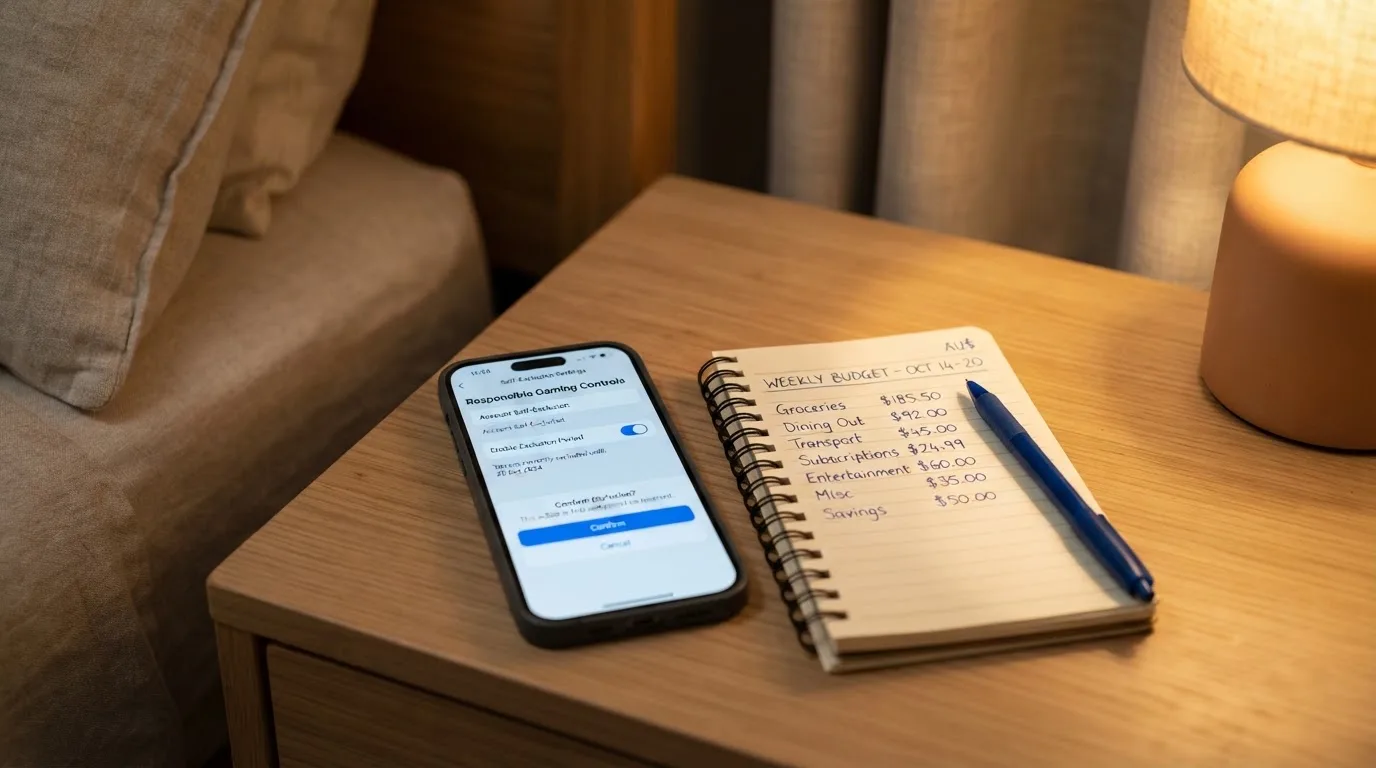
What tools can help someone track and limit time spent playing online slots?
BetStop, the National Self-Exclusion Register, has been live since August 2023 and binds Australian-licensed online and phone wagering services, but it does not bind offshore casinos. A player who wants to exclude from an offshore site has to do it site by site. The National Gambling Helpline, 1800 858 858, is free and 24/7 with chat at Gambling Help Online, and it works regardless of where the gambling happens.