
Plinko casino Australia in 2026: the pitch, the law, and what sits between them
A ball drops, pegs deflect it, and the slot it lands in decides what you win. That is the entire mechanism of every Plinko-style casino game pitched at Australian players in 2026, and it is the only piece of the proposition that holds up regardless of which offshore brand is selling it. Everything else — the licence badge in the footer, the crypto deposit button, the “99% RTP” line in the lobby, the AUD conversion widget — is decoration laid over a product that no Australian regulator has approved for sale to Australians, and that the ACMA has been progressively cutting off from the Australian internet since 2019.
Data current as of 28 October 2026 and cross-checked against the ACMA’s published formal-warning register and blocking-request notices.
Table of Contents
- Crypto and the Plinko pitch: why the currency change does not move the legal line
- Payments and payout claims: what offshore Plinko pages actually list
- The Plinko game itself: paytable, pegboard, and the 99% claim
- Offshore Plinko brands and the ACMA: a comparison
- Overview: what an offshore Plinko casino actually is
- Legality and regulation: the line the offshore pitch does not cross
- Responsible play: what stays in place when an offshore site does not
- RocketPlay
- Level Up Casino
- Woo Casino
- Spirit Casino
- National Casino
- Bizzo Casino
- Ignition Casino
- Instant Casino
- Jackbit
- Casino Intense
- Sky Crown
- What the offshore pitch leaves out
- What the data shows on 28 October 2026
- Frequently asked questions
Crypto and the Plinko pitch: why the currency change does not move the legal line
Cryptocurrency is the load-bearing claim on most Plinko casino pages that target Australian players. The pitch runs in two halves. First, that paying with Bitcoin or Ethereum bypasses the credit-card ban that took effect on 11 June 2024 for licensed Australian wagering. Second, that an on-chain deposit protects the player’s identity in a way a bank transfer never could.

Neither half survives contact with what the Interactive Gambling Act actually prohibits. The IGA outlaws the supply of online casino games to people in Australia; the currency the player uses to pay is irrelevant to that offence, because the offence sits with the provider, not with the player. A site that accepts only crypto from an Australian customer is still providing a prohibited interactive gambling service, and the penalty regime is unchanged: up to A$220,000 per day for individuals and up to A$1.1 million per day for corporations. The IGA does not prosecute the punter, but it does let the regulator order Australian ISPs to block the site, and an offshore operator keeps no obligation to return a balance once that happens.
The identity argument is the half that does more damage. Crypto deposits are pseudonymous, not anonymous — every transaction sits on a public ledger that an investigator, an exchange compliance team, or a court order can trace. An Australian player who deposits from an exchange that enforces KYC has not bought privacy so much as deferred the moment it disappears. And the offshore Plinko site accepting that deposit has not bought itself Australian legitimacy by accepting it; the operator is still unbound by Australian consumer law, so a withdrawal dispute cannot be taken to VCAT, QCAT, NCAT or any other local tribunal.
What crypto does change, and what the marketing rarely admits, is the chargeback route. A debit-card deposit can in principle be reversed through the card issuer when an offshore operator refuses a withdrawal. A Bitcoin deposit on the same outcome gives the player nothing equivalent — the transaction is final the moment it is confirmed on-chain. The pitch sells freedom from a card ban; the trade, in practice, is the loss of every Australian recourse the card would have offered.
Payments and payout claims: what offshore Plinko pages actually list
Payment pages on offshore Plinko sites converge on a familiar shape: a deposit column showing Bitcoin, Ethereum, Litecoin, Tether and a handful of altcoins, paired with a withdrawal column listing the same coins, plus an e-wallet or two. AUD is sometimes shown but is rarely the unit the wallet actually settles in; the deposit is converted at the site’s quoted rate, the wagering happens in USD or EUR, and the withdrawal is converted back. The rate is the operator’s, not the Reserve Bank’s.
The no-deposit bonus is the most repeated payment-adjacent promise on these pages. In practice, no-deposit offers on offshore Plinko casinos carry the same shape research has documented across the offshore market: a small credit applied on sign-up, a wagering multiple in the 40x to 60x range before any of it can be withdrawn, a max-cashout cap that converts most of the cleared bonus into a non-withdrawable balance, and a list of “eligible games” that often excludes the title the player actually opened the account to play. The marketing line “no deposit needed” describes the moment of signup, not the conditions under which any of it becomes withdrawable.
The payout-time claim is the second repeated promise, and it is the one most often quoted in AUD: “withdrawals in 24 hours”, “instant crypto payouts”, “AUD withdrawals processed within an hour”. What these statements cover is the operator’s internal queue, not the path the funds then travel. A crypto withdrawal can be queued inside the hour and still take a day or two to confirm on-chain during a congested period, and an AUD withdrawal by bank transfer goes through a third-party payment processor that has its own cut-off times and its own minimums. The headline number is true; the experience is the headline number plus the steps it omits.
The legal layer underneath these pages is the part the marketing omits. Since 11 June 2024, credit cards, credit-related products and digital currency have been banned as payment methods for licensed online wagering in Australia. The ban applies to operators licensed under Australian regimes — which an offshore Plinko site is not — but the direction of travel is what matters: the Australian regulator’s position is that these are not appropriate ways to fund wagering, and an offshore site asking for either is operating outside that position.
The Plinko game itself: paytable, pegboard, and the 99% claim
The Plinko casino game pitched at Australian players is the digital descendant of a pricing game that premiered on the US television show The Price Is Right on 3 January 1983. The television version dropped chips down a pegboard into nine bottom slots valued from the outside in at $100, $500, $1,000 and $0, with the centre slot worth $10,000, for a maximum possible win of $50,000. Before 1998, the centre slot was worth $5,000 and the maximum was $25,000. The casino version keeps the pegboard and the slot values but replaces the fixed payout with a multiplier ladder, and the chip with a ball the player wagers on.
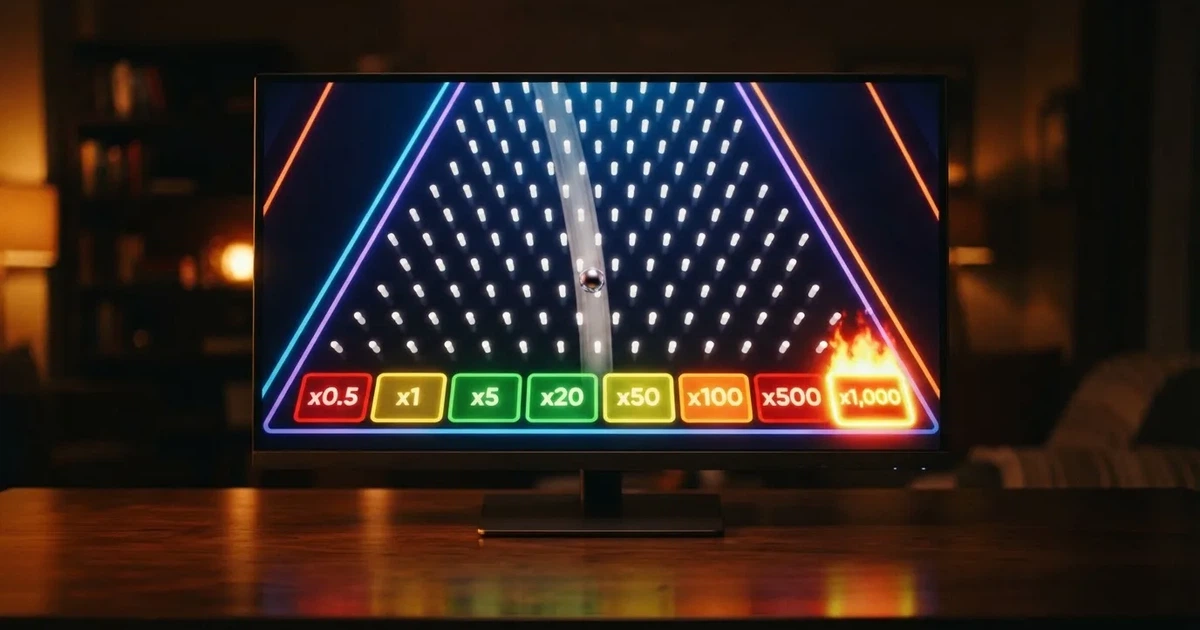
BGaming’s Plinko, the most-cited version in offshore marketing, advertises a 99% return-to-player figure and a top multiplier of ×1,000. The player sets a risk level — low, normal or high — and the number of lines, from 8 to 16, before each drop. Auto-bet is available; manual drop is the default. Each ball falls through the pyramid, deflects off the pegs, and lands in one of the slots at the bottom, where the multiplier attached to that slot is applied to the stake.
The 99% RTP is the figure that needs the most reading. It is a long-run average over a very large number of drops, computed against the game’s full paytable, and it sits well above the house edge on the standard table games Australians would encounter at a licensed venue. As a comparator, the house edge on baccarat is 1.06% on the Banker bet, 1.24% on the Player bet and 14.36% on the Tie; in blackjack, optimal play brings the house edge down to about 0.28% under liberal Las Vegas Strip rules; in craps, the Pass/Come bet carries a 1.41% edge. A 99% RTP means a 1% edge, which is competitive with anything on a casino floor — and which is why the marketing repeats it so often.
What the RTP line does not cover is the shape of the variance. A ×1,000 top multiplier paid only on a high-risk line, with most outcomes clustering in the middle slots, is the structure that produces the 99% long-run number. A session of a few hundred drops does not look like the long-run number; it looks like the cluster of outcomes a particular risk and line combination produces in that window, which is often heavily negative. The RTP is a property of the game; the experience is the game played for whatever session length the punter bought.
The auto-bet slider is the second feature worth naming. It lets a player set a number of drops in advance and walk away, which is precisely the structure responsible for the “I left it running” complaints that fill affiliate-review comment sections. A 99% RTP does not protect a player who runs 500 auto-drops at the high-risk setting; it describes the average of those 500 drops in aggregate, not the balance at the end of them.
Offshore Plinko brands and the ACMA: a comparison
Eleven brands surface in the ACMA’s formal-warning register as having offered prohibited casino services to Australians, including Plinko-style games. Each row below carries the brand name, the ACMA action as published, the operator entity named, and a note on subject support drawn from the listings research surfaced. None of these is licensed to supply online casino games to Australians; the comparison is here to show what is actually being offered and under what banner, not to rank or recommend.
| Brand | ACMA action | Operator named by the ACMA | Subject support |
|---|---|---|---|
| RocketPlay | Formal warning, March 2026 | Pulsup Ltd (RocketPlay); earlier Dama N.V., May 2022 | — |
| Level Up Casino | Formal warning, May 2022 | Dama N.V. | Plinko listed (BGaming) |
| Woo Casino | Formal warning, March 2025 | Dama N.V. | — |
| Spirit Casino | Formal warning, May 2025 | Dama N.V. | — |
| National Casino | Formal warning, July 2025 | Consolutetish S.R.L. | Plinko listed |
| Bizzo Casino | Formal warning, July 2025; earlier TechSolutions, 2022 | Consolutetish S.R.L. | — |
| Ignition Casino | Formal warning, July 2025 | Bamboo Media | — |
| Instant Casino | Formal warning, February 2025 | EOD Code SRL | — |
| Jackbit | Formal warning, April 2026 | Ryker B.V. | — |
| Casino Intense | Formal warning, April 2025 | Sterplay Holding Ltd | Plinko listed in sources |
| Sky Crown | Formal warning | Hollycorn N.V. | — |
The columns that matter are the first two and the third. Every brand in the table was the subject of a formal warning under the Interactive Gambling Act 2001 for offering prohibited services to Australians; every operator named is an offshore entity; every “subject support” cell that says “Plinko listed” reflects what the public listings carry, not a confirmation that Plinko is the game’s marquee title on that brand. The gaps in the last column are the more honest finding: for most of these operators, the research surfaced no public listing that names Plinko specifically, which means the marketing pitch and the actual lobby content are out of step in directions the punter has no way to verify from outside an account.
Three patterns emerge. First, several operators recur across multiple brands under different licence-holder names — Dama N.V. appears four times across this set alone, and Consolutetish S.R.L. twice. The brand is the front; the operator entity behind it can change while the marketing keeps the same pitch. Second, warnings cluster in 2025 and 2026, which matches the ACMA’s broader enforcement push over the same period rather than any sudden rise in offending. Third, the brands that have faced repeated warnings (RocketPlay, Bizzo) are the brands the ACMA has had to warn about more than once, which is the kind of repetition that converts a warning from a deterrent into a line item.
Overview: what an offshore Plinko casino actually is
A Plinko casino in the offshore pitch is a website running BGaming’s Plinko, or one of its licensed clones, alongside a wider lobby of slots and live tables. The Plinko game itself is a single HTML5 title that takes a few seconds to load and runs identically across desktop and mobile browsers. The lobby is what varies: most pitch a hundred-plus slots, a handful of live-dealer tables, a sportsbook on the bigger sites, and a small sportsbook or none at all on the Plinko-first brands.
The app distinction is a marketing line, not a separate product. Pages that advertise a “Plinko casino app” are wrapping the same HTML5 game in a PWA shell or, less often, a downloadable APK. The game inside is identical to the browser version, the wallet is identical, the licence is identical, and the legal status is identical. The app is a wrapper that lets the operator push notifications and adds a tile to the home screen; it does not add a layer of Australian regulation.
The free-spins pitch is a Plinko-shaped version of the standard casino free-spin offer: a number of drops at a fixed stake credited on sign-up or on first deposit, with the same kind of wagering multiple and max-cashout cap that applies to the no-deposit bonus. Free drops on Plinko are rare in practice — most sites that mention them restrict the bonus to slot titles and exclude the multiplier game — but where they exist, they convert to a real-money balance only after the same playthrough requirements the rest of the bonus carries.
The licence badge is the most consistently misleading element. Offshore Plinko sites display Curacao, Anjouan or Kahnawake badges in their footers, sometimes alongside a corporate registration number, and treat these as evidence of legitimacy. What they are is evidence of registration with the named jurisdiction’s gaming authority, which has no standing in Australia. An Australian player cannot escalate a dispute to the Curacao Gaming Authority in any practical sense; the badge is a banner, not a recourse.
Legality and regulation: the line the offshore pitch does not cross
Online casino games cannot be licensed for supply to Australians anywhere in Australia. The Interactive Gambling Act 2001, as strengthened by the Interactive Gambling Amendment Act 2017, makes it an offence to provide online casino games, online pokies and in-play betting to customers in Australia, with penalties of up to A$220,000 per day for individuals and up to A$1.1 million per day for corporations. The IGA targets the provider, not the player, which is why individual Australians are not prosecuted for opening an offshore account — but the site itself is in breach from the moment it accepts an Australian customer.
What is licensed is narrower. Wagering on races and sporting events placed before the event, lotteries and keno can be licensed; in practice, 52 of Australia’s online bookmakers — including Sportsbet, Bet365 and Ladbrokes — are licensed through the Northern Territory Racing and Wagering Commission, which regulates them for tax reasons and has no full-time staff of its own, meeting once a month in Darwin. The NT licences cover wagering services, not casino games; a bookmaker licensed in Darwin is not licensed to offer Plinko, and no state or territory licence does.
The Interactive Gambling Amendment (Gambling Reform) Bill 2026 passed Parliament on 19 August 2026, with its advertising and inducement measures commencing on 1 January 2026. That is a law with a start date, not yet in force on this page, and its effect when it commences will be on licensed Australian operators’ advertising rather than on the offshore supply the page is about.
Enforcement runs through the ACMA. The regulator investigates complaints, issues formal warnings to operators, and directs Australian ISPs to block illegal sites. In a round reported on 26 June 2026, the ACMA asked Australian ISPs to block 12 more sites: 7Signs, ChromaBet, Donbet, Duospin, Freshbet, Slots Gem, Jacks Club, Lucky Start, Pointsbetz, Spinrise, Vinyl Casino and Wildsino. Across the whole enforcement period, the ACMA reports that 1,751 illegal gambling and affiliate marketing websites had been blocked since the first blocking request in November 2019, and more than 230 unlicensed gambling services had left the Australian market since enforcement was strengthened in 2017. The blocking rate over the enforcement period, computed against the ACMA’s own published totals, runs at roughly 26 sites per month averaged across the years since November 2019 — a band that reflects both the surge in new offshore brands and the ACMA’s expanding enforcement capacity, not a clean trend line. What the band does not capture is the cycle behind it: a blocked site returns under a new domain within weeks, the new domain joins the queue, and the queue grows faster than it is cleared.
H2 Gambling Capital’s 2025 report estimates that Australians lose about A$3.9 billion a year to illegal gambling sites, and that the share of gambling going through legal channels fell from 74% in 2021 to 64%. The fall is the number to watch: legal channel share dropping ten points in four years is the kind of shift that converts a regulator’s posture from periodic enforcement into sustained pressure, and the 2025 warning round is one of the things that pressure looks like in practice.
Responsible play: what stays in place when an offshore site does not
An offshore Plinko casino is not connected to Australia’s responsible-gambling infrastructure, because it is not part of the Australian system in the first place. BetStop — the National Self-Exclusion Register, live since August 2023 — binds only Australian-licensed online and phone wagering services. A player who has registered with BetStop is excluded from those services; an offshore casino has no obligation to honour the exclusion and no technical integration that would let it do so even if it wanted to.
The same gap applies to deposit limits, time-out tools, and the reality-check pop-ups that licensed wagering operators are required to surface. None of these are present on an offshore Plinko site in any form an Australian player can rely on, because the operator is not bound by the ACMA’s consumer-protection conditions and has no commercial reason to add them. What is present varies by brand: most offer a self-exclusion toggle inside the account, some offer deposit caps, and the more reputable ones publish their RNG certification. None of those pieces is equivalent to BetStop, because none of them connects to the player’s other wagering accounts or to the support services a BetStop registration triggers.
The support services themselves remain available regardless of where the player has been wagering. The National Gambling Helpline on 1800 858 858 is free, available 24/7, with online chat at Gambling Help Online. Both are funded to help Australian residents irrespective of whether the gambling that prompted the call happened on a licensed Australian site or on an offshore Plinko casino, and the conversation is the same in either case: what is happening with the play, what the player wants to change, and what the next concrete step is. The helpline does not adjudicate the legality of the offshore site; it works with the player wherever they are.
The financial side of responsible play also runs outside the offshore site. Credit cards, credit-related products and digital currency are banned as payment for licensed Australian online wagering since 11 June 2024, with penalties up to $247,500 for operators that accept them. A licensed bookmaker cannot take a credit-card deposit from an Australian customer. The ban is the regulator’s position that these instruments are inappropriate ways to fund wagering; it does not stop an offshore site asking for either, and a player who has self-excluded through BetStop can still deposit by crypto on an offshore Plinko site the next morning. The Australian protections cover the licensed perimeter; outside it, the player is their own perimeter.
RocketPlay
The ACMA issued a formal warning to Pulsup Ltd over RocketPlay in March 2026, on top of an earlier May 2022 warning to Dama N.V. that named Rocketplay among six brands. Two warnings to two different corporate entities on the same brand is the kind of repetition that turns a name on the register into a recurring line item, and the most recent warning is the one that defines what the brand is selling to Australians in 2026. The site displays a Curacao badge in the footer and runs BGaming content; the research surfaced no listing that names Plinko as a marquee title on Rocketplay, which means the game is available in the lobby but is not the front-of-house pitch.
What stands out is the operator-entity history. Rocketplay was first warned under Dama N.V. in 2022, and re-warned under Pulsup Ltd in 2026; the brand name survived the operator change and the marketing kept running across the transition. The block-the-domain route the ACMA uses does not catch that pattern by itself, because a blocked domain is a domain, not a brand — and a brand that re-emerges under a new corporate envelope is the failure mode the current enforcement setup is still working through. The Rocketplay case is the clearest illustration in this set of the cycle that the blocking-rate band in the previous section runs against.
For an Australian reader, the verdict is short. The site is prohibited; the warnings are published; the brand has resurfaced under a new operator entity once already. The case for opening an account is a case for ignoring both warnings.
Level Up Casino
The ACMA’s formal warning to Dama N.V. in May 2022 named Level Up alongside five other brands — Bambet, Dazard, Rocketplay, Wild Tornado and Cobra Casinos — and Dama N.V. reappears in the 2025 and 2026 rounds against sibling brands. The research surfaced a Plinko listing against BGaming’s catalogue for Level Up, which is more than the table shows for most of the other brands in the set: the game is named in public listings as available on this site, even if it is not the lead pitch.
The cluster pattern is the read here. Dama N.V. as an operator runs at least six brands across this set and beyond, and the formal warnings cluster against the operator rather than the individual brand. Level Up is one front on a multi-brand operation; the warning is to the operator entity behind all of them, and the same playbook runs across the lot. For an Australian reader, the case is the case against the operator, not specifically against this brand — and the case against the operator is six brands and counting on the ACMA register.
The verdict is that this is a Dama N.V. property, with everything that implies about the ACMA’s history with the operator entity behind it. The Plinko listing is a data point, not an endorsement.
Woo Casino
The ACMA issued a formal warning to Dama N.V. over Woo Casino in March 2025. Like the other Dama N.V. brands in the set, Woo sits inside the operator entity that has now accumulated multiple formal warnings across multiple brands, and the 2025 warning is the one that defines its current status on the ACMA register. The research surfaced no Plinko-specific listing for Woo Casino; the game is available in the BGaming-fuelled lobby but is not the headline pitch the brand runs.
Woo’s position in the comparison is as another data point on the Dama N.V. cluster rather than as a Plinko-specific story. The 2025 warning was a fresh action on a fresh brand, and the pattern of warning-after-warning-after-warning against the same operator is the read the ACMA register supports. The marketing pitch on Woo’s site is the usual offshore pitch — a welcome package, a VIP tier, a Curacao badge — and none of it changes the fact that the brand sits inside an operator entity the Australian regulator has had to warn multiple times across multiple brands.
For an Australian reader, Woo is one of the four Dama N.V. brands in this set, and the case against the operator applies to the brand by inheritance. The verdict is that this brand is one warning into a cluster, with more on the same operator behind it.
Spirit Casino
The ACMA issued a formal warning to Dama N.V. over Spirit Casino in May 2025 — the third Dama N.V. brand on this list and the second in the 2025 round alone. The pattern is the same as Woo and Level Up: a Dama N.V. brand, a formal warning, no Plinko-specific listing in the research. Spirit is the brand the ACMA warned Dama N.V. about most recently of the three, and that recency is the most useful piece of information for an Australian reader — the brand is on the current ACMA radar, not the archived one.
What the recency means operationally is that the brand is unlikely to be high on any list of sites about to be blocked, because the ACMA’s enforcement cadence runs warnings first, blocks later. A player who arrived at Spirit through an affiliate link and read the warning would be reading about a brand the regulator is currently engaging with, not one it has already given up on. The verdict is that this is the freshest Dama N.V. warning of the three on this page, and the case is the same case as the other two.
National Casino
The ACMA issued a formal warning to Consolutetish S.R.L. over National Casino in July 2025, alongside a separate warning over Bizzo Casino the same month. National is one of two brands in this set under the Consolutetish operator entity, and the Plinko listing surfaced in research as available on the brand — one of the few cases in this set where the public listings name the game against the brand specifically.
The Consolutetish pair is the second multi-brand cluster in this comparison, after Dama N.V. The lesson is the same: the brand is the front, the operator entity is the entity the ACMA has warned, and the warning applies across the brands under that entity. The Plinko listing is the one piece of brand-specific information in this write-up, and what it tells the reader is that the game is named in the public-facing listings for National, not that the regulator has cleared the brand.
For an Australian reader, the verdict is that National is one of two Consolutetish brands warned in the same round, with Plinko named against it in public listings. The brand-specific data point does not move the case against it.
Bizzo Casino
The ACMA issued a formal warning to Consolutetish S.R.L. over Bizzo Casino in July 2025, with an earlier 2022 warning to TechSolutions (CY) Group Limited and TechSolutions Group N.V. also naming the brand. Two warnings to two different operator entities on the same brand is the same pattern RocketPlay shows under Dama N.V. and Pulsup Ltd — a brand that has outlived its first operator entity on the ACMA register and surfaced under a second.
Bizzo’s position in the comparison is as the brand with the longest ACMA history in this set, going back to the 2022 TechSolutions round. The warning is now four years old on one operator entity and a year old on the other, and the brand has continued operating across the transition. This long-running history is the most informative piece of the write-up for anyone checking the brand’s status.
Ignition Casino
The ACMA issued a formal warning to Bamboo Media over Ignition Casino in July 2025. Ignition is one of two brands in this set under an operator entity that does not appear elsewhere in the table — Bamboo Media is named only against this brand in the research — which makes Ignition the cleanest single-brand read in the comparison. The research surfaced no Plinko-specific listing for Ignition, and the brand’s Australian pitch has historically skewed toward poker rather than casino table games or multiplier titles.
The single-brand structure means the case is the case against Bamboo Media rather than against a multi-brand operator entity. The warning is recent, the operator is named once, and the brand’s history on the ACMA register is a single line. This remains a prohibited service, but one with less cluster noise than the Dama N.V. and Consolutetish brands carry.
Instant Casino
The ACMA issued a formal warning to EOD Code SRL over Instant Casino in February 2025. The research surfaced no Plinko-specific listing for the brand; Instant Casino markets itself on speed and breadth of catalogue rather than on a marquee multiplier game. The brand is on the early-2025 list of ACMA actions, and the operator entity EOD Code SRL does not appear elsewhere in this set.
For an Australian reader, Instant Casino is the brand with the earliest 2025 warning on the list, which makes it the brand most likely to have been considered for further enforcement action by 2026. The ACMA’s cadence runs warnings first and blocks later, and a brand sitting on a 2025 warning is closer to the front of the queue than a brand warned in 2022. The verdict is that this is a single-brand, single-operator case with the freshest 2025 warning of any in the set.
Jackbit
The ACMA issued a formal warning to Ryker B.V. over Jackbit and CasinOK in April 2026. Jackbit is the brand the operator Ryker B.V. is best known for in offshore marketing, and CasinOK is a sibling brand sharing the warning. The research surfaced no Plinko-specific listing for either brand, and the marketing pitch on Jackbit leans heavily on crypto sportsbook and casino coverage rather than on a marquee multiplier game.
The Jackbit/CasinOK pair is the second multi-brand single-operator warning in this set, after the Consolutetish pair over National and Bizzo. The pattern is the same: the operator entity is the unit the ACMA has warned, and the warning applies across the brands under it. These brands operate in a current-year warning context, with no Plinko-specific data to soften the read.
Casino Intense
The ACMA issued a formal warning to Sterplay Holding Ltd over Casino Intense in April 2025. The research surfaced Plinko as listed against Casino Intense in the sources reviewed — one of three brands in this set where the game is named in public listings, alongside Level Up and National Casino. Casino Intense is a single-brand operator entry under Sterplay Holding Ltd, with no other brands named in the research under that operator.
For an Australian reader, Casino Intense is the cleanest single-brand case in the set with a Plinko-specific listing against it. The listing does not move the case — the brand is prohibited regardless of which games it surfaces in public listings — but it does make the write-up a Plinko-specific one, which is the reason this brand is named in a Plinko page rather than left as an undifferentiated line in the table. The verdict is that this is a single-operator, single-brand, current-recent-warning case with the Plinko game actually named in the listings.
Sky Crown
The ACMA issued a formal warning to Hollycorn N.V. over its Sky Crown and Blue Leo casino services, as published in September 2022. The warning is the oldest in this set by some margin, and the brand is one of two under the Hollycorn operator entity. The research surfaced no Plinko-specific listing for Sky Crown; the brand’s pitch has historically been on the wider casino lobby rather than on a marquee multiplier game.
The age of the warning is the most useful piece of information here. A 2022 warning is on the older end of the ACMA register, and a brand that has continued operating under that warning is a brand the regulator has not yet escalated to blocking. Viewing the brand’s continued operation across the intervening years provides the clearest picture of its status.
What the offshore pitch leaves out
Three things sit underneath every Plinko casino page that targets Australians, and none of them appear in the marketing.
The first is the licence. No state or territory in Australia licenses online casino games, which means the licence badge in the footer — Curacao, Anjouan, Kahnawake — is a registration with a regulator that has no jurisdiction in Australia. A dispute over a withdrawal cannot be taken to that regulator in any practical sense; an Australian player has no Australian tribunal to take it to either.
The second is the recourse. A licensed Australian wagering operator is bound by Australian consumer law, by the ACMA’s responsible-gambling conditions, and by BetStop. An offshore Plinko casino is bound by none of these. A withdrawal that is refused, a bonus term that is applied retroactively, or an account that is closed with a balance still on it gives the Australian player no practical path to resolution.
The third is the balance. An offshore Plinko site can be blocked at the ISP level by the ACMA, and balances sitting in player accounts at the moment of blocking are not returned by the Australian regulator. The regulator’s job is to block the supply; the operator’s obligation to return balances sits in the operator’s own jurisdiction, which is not Australia. A player whose balance is on a blocked site is owed money by an entity the Australian regulator has just cut off from the Australian internet, and the recovery path runs through that entity’s own jurisdiction on its own terms.
These three omissions are not unique to Plinko or to the brands in this comparison — they apply to every offshore casino game pitched at Australian players. The reason they belong in a Plinko page is that the Plinko pitch is unusually clean in its silence about them: a 99% RTP line, a ×1,000 top multiplier, an auto-bet slider, and a Curacao badge in the footer, with no row in the comparison table that names what an Australian player gives up by being on the other side of the page.
What the data shows on 28 October 2026
The page reflects two numbers that travel together. The first is the ACMA’s running total — 1,751 illegal gambling and affiliate marketing websites blocked since the first blocking request in November 2019, with 230-plus unlicensed services having left the Australian market since 2017. The second is the brand-level register — eleven brands warned under the IGA in this set alone, most of them within the last twenty-four months.
The blocking rate across the enforcement period runs at roughly 26 sites per month averaged over the years since November 2019. That band is the page’s core statistic: not a single figure, but the rate at which the ACMA is clearing the queue it has built, with the caveat that the queue grows faster than it is cleared and that blocked sites return under new domains. The arithmetic sits next to the law and the pitch, and what it shows is that the regulator’s posture is sustained pressure rather than a one-off sweep, and that the pressure is producing real movement on the supply side — just not the kind of movement that ends the market for the brands on the receiving end.
Frequently asked questions
What is the Plinko casino game, and how does the ball-drop mechanic actually determine a payout?
A ball is dropped from the top of a pegboard, deflects off the pegs as it falls, and lands in one of the slots at the bottom. Each slot carries a multiplier, the multiplier is applied to the stake, and the payout is the result. The game is a chance-based multiplier game in the same broad family as a pokie reel, with the outcome decided by the path the ball takes rather than by a symbol combination. The BGaming version, the most-cited in offshore marketing, advertises a 99% RTP and a ×1,000 top multiplier.
Does a crypto version of Plinko pay out any differently to a standard real-money version?
The game itself does not change — the pegboard, the multipliers, the RTP figure are properties of the title, not of the currency the player uses to deposit. What changes is everything around the game: the deposit is on-chain rather than through a card, the withdrawal is in the same crypto rather than in AUD, and the chargeback route a card deposit would offer disappears. The marketing line “crypto Plinko” describes the payment rail; the math inside the game is the same math.
Is playing Plinko for real money at an offshore casino something Australians are legally allowed to do?
The Interactive Gambling Act 2001 prohibits the supply of online casino games to people in Australia; it does not prosecute the individual player. Opening an account and playing from Australia is not the offence. The site offering the game to Australians is the offence, and the ACMA enforces against the operator. The practical consequences for the player are different from the legal ones: an offshore site gives no Australian consumer protection, no local complaints body, and no recourse if a withdrawal is refused.
What return-to-player rate do offshore sites typically advertise for their Plinko game?
BGaming’s Plinko, the most-cited title in offshore marketing, advertises a 99% RTP, which would put the house edge at around 1% — competitive with the table games Australians would find at a licensed venue. The figure is a long-run average over a very large number of drops; the experience of any single session can sit well below it. A session of a few hundred drops at the high-risk setting is the structure that produces the 99% in aggregate, and it is also the structure that produces the largest negative balances in individual play.
Why do Plinko casino apps get advertised separately from ordinary Plinko casino websites?
The app is a wrapper, not a separate product. Offshore Plinko sites that advertise a downloadable app or a PWA shortcut are running the same HTML5 game inside a mobile shell, with the same wallet, the same licence, and the same legal status. The app adds a tile to the home screen and lets the operator push notifications; it does not add a layer of Australian regulation. The legal position is identical, and so is the recourse — or the lack of it.
How does a Plinko game’s payout table differ from a pokies reel in terms of the odds involved?
A pokie reel determines its outcome by the random position of its virtual reels at the moment the spin stops, and the symbol combination across the paylines sets the payout. A Plinko game determines its outcome by the path the ball takes through the pegboard, and the slot the ball lands in sets the multiplier. Both are chance-based with a published RTP; both carry the same kind of house edge. The visible difference is the presentation — a spinning reel versus a falling ball — and the structural difference is that Plinko’s variance is concentrated in the top multiplier, with most outcomes landing in the middle slots.