
GameBeat Online Casinos for Australian Players in 2026: What the Interactive Gambling Act Leaves Standing
Anyone searching for a working shortlist of GameBeat-powered online casinos for use in Australia is searching for something that cannot lawfully be supplied. The Interactive Gambling Act 2001, as tightened by the Interactive Gambling Amendment Act 2017, makes it an offence to provide online casino games — online pokies, table games, live dealer rooms, slots, the lot — to anyone physically in Australia. No state or territory regulator issues a licence for it. The Australian Communications and Media Authority (ACMA) keeps a public list of formal warnings it has issued to offshore operators and a separate list of websites it has directed Australian internet service providers to block.

That is the foundation under every recommendation, comparison or “best of” list below. The page does not pretend otherwise. What follows is the legal frame first, then the safeguards Australians can actually use, then the enforcement record the ACMA has built up against offshore brands that marketed GameBeat-style casino games to Australian traffic — because each one of those brands is the answer the search is fishing for, and each one of them is precisely the kind of offer the IGA 2001 prohibits.
Currency and licence checks current as of 28 October 2026, verified against the ACMA’s formal warnings register and the Interactive Gambling Act 2001 as in force at that date.
Table of Contents
- Legality and regulation under the Interactive Gambling Act 2001
- Responsible gambling safeguards Australians can use
- How money moves at GameBeat-style online casinos (and why it matters)
- Bonuses, free spins and what they cost a GameBeat-style casino player
- Mobile and app access for GameBeat-style casino games
- GameBeat’s catalogue, the providers that sit beside it, and the wider market
- GameBeat-style operators the ACMA has acted against
- The blocking record and the rate the regulator is moving
- What an Australian can lawfully do instead
- Frequently asked questions about GameBeat online casinos in Australia
Legality and regulation under the Interactive Gambling Act 2001
The Interactive Gambling Act 2001 (IGA) is the Commonwealth statute that governs what may and may not be supplied to a person in Australia over the internet. It was strengthened by the Interactive Gambling Amendment Act 2017, which widened the offence to cover any “prohibited interactive gambling service” and gave the ACMA the explicit power to direct Australian internet service providers to block offending websites at the domain or URL level. The Act targets the provider, not the player — an Australian who logs in to an offshore casino commits no offence under the IGA — but the site itself is operating against Australian law, and the protections that exist for Australian-licensed wagering simply do not extend to it.

What is prohibited, in plain terms, is the supply of online casino games to someone in Australia. Online pokies, online blackjack, online roulette, online baccarat, online craps, online sic bo, online “instant win” games, online scratch cards, online lottery products that take more than a minor stake — all of these are caught. What is licensable is wagering on racing and sporting events placed before the event starts (the pre-match bookmaker market), lotteries, and keno; in practice these are licensed at the federal level through the Northern Territory Racing and Wagering Commission, which regulates 52 of Australia’s online bookmakers — Sportsbet, Bet365 and Ladbrokes among them — from a small office that meets once a month in Darwin. None of those licences extends to an online casino product.
The minimum age for any gambling activity in Australia is 18. There is no carve-out for “free play” or “demo mode” if the provider is otherwise supplying to an Australian audience; the prohibition sits on the act of supplying, not on whether a stake changes hands.
A site that displays a Curaçao, Anjouan or Malta seal on its footer is not, by that fact, lawful in Australia. Australian law looks at where the player is, not where the licence was issued. The seal the site displays is a licence issued by a foreign regulator to a foreign operator; it permits the operator to offer the service from that jurisdiction, not to offer it to Australians. Every formal warning the ACMA has issued to date has been issued to offshore operators whose licences are, on their own terms, perfectly in order — it is the targeting of Australia that is the offence.
A consequence worth stating plainly. An Australian who deposits with an offshore casino has no Australian complaints body to take a dispute to, no Australian statutory guarantee that a refused withdrawal will be paid, and no guarantee that the balance on the account survives an ACMA block — the ACMA has directed ISPs to block illegal sites on a continuing basis since 2019, and a blocked site has no obligation to refund players. The consumer protections the IGA withholds from offshore supply are the same protections the page would normally hold up as a reason to choose one operator over another; the IGA withholds them from the entire category.
Responsible gambling safeguards Australians can use
The lawful Australian system is built around a small number of pieces, and they do not touch offshore casinos. Knowing what they do and do not cover matters before any discussion of operator choice.
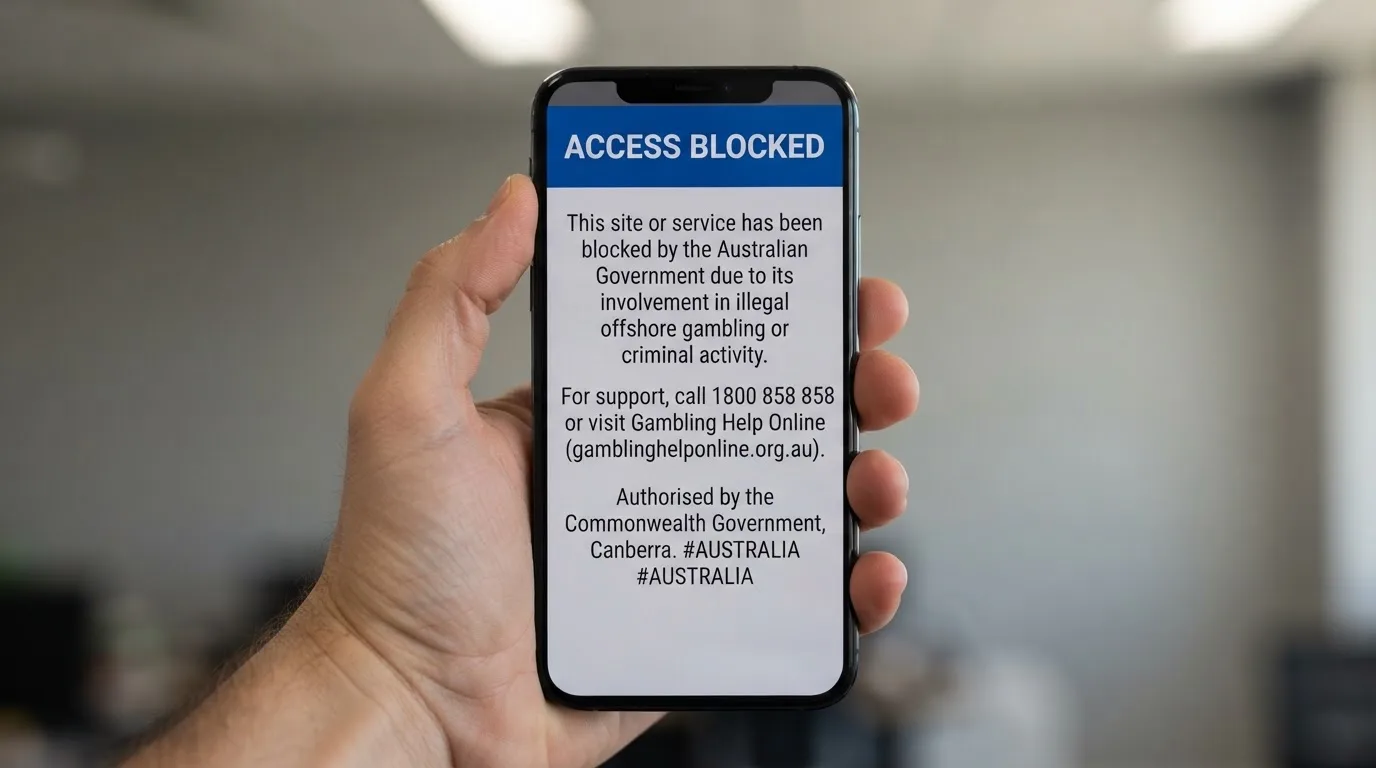
BetStop is the National Self-Exclusion Register, run by the ACMA and live since August 2023. A person can register a self-exclusion of three months or longer against their own name, and every Australian-licensed wagering service and online bookmaker is required to refuse to let that person open an account, deposit or bet while the exclusion is in force. BetStop covers online and phone wagering — pre-match sports and racing bets placed with a licensed Australian bookmaker. It does not cover land-based venues (clubs, hotels and casinos run their own self-exclusion schemes) and it does not cover offshore online casinos. An Australian who has registered with BetStop and then opens an account with an offshore casino has not defeated their own exclusion by doing so — they have simply stepped outside the system that enforces it. That distinction matters: BetStop is a strong tool against Australian-licensed wagering and not a tool at all against the offshore casino this page is about.
The National Gambling Helpline is 1800 858 858, free, available 24 hours a day. Gambling Help Online runs a chat service on the same provider network. Both services are staffed by counsellors and are independent of any operator. They are the right first call for an Australian who feels their own play is drifting outside what they want it to be, whether the platform they are playing on is licensed or offshore.
State and territory gambling support services exist alongside the national helpline, with their own self-exclusion arrangements for clubs, hotels and land-based casinos. In practice an Australian who wants to stop playing at a club or pub poker machine uses the state-based scheme for their jurisdiction, and an Australian who wants to stop wagering online uses BetStop. Offshore casino play sits outside both.
A consequence to name plainly. There is no BetStop-style exclusion that touches an offshore casino. If self-exclusion matters to a reader, the only enforceable exclusion sits at the licensed Australian bookmaker, and any other site the reader opens is a separate decision that BetStop will not lock down. That is the limit of the Australian system, and it is the limit the IGA 2001 leaves in place by design.
How money moves at GameBeat-style online casinos (and why it matters)
GameBeat is a slot game studio set up in 2021; it describes itself as a business-to-business supplier that builds games for licensed operators and commercial partners, not for players directly. The deposit and withdrawal mechanics the page is about are the mechanics of the casino brand that hosts GameBeat’s catalogue, not mechanics GameBeat itself sets. Different offshore casinos list different payment menus, and the ones they list are the ones the ACMA’s consumer guidance warns about.
For an Australian-licensed online bookmaker, the legal deposit routes are debit card, bank transfer, PayID, Osko and BPAY. Credit cards, credit-related products and digital currency (cryptocurrency) have been banned as payment for licensed online wagering since 11 June 2024, with penalties of up to A$247,500 for operators that accept them. An Australian bookmaker asking for a credit card number or a Bitcoin wallet address is operating outside the rules — and the rules bind the licensed Australian bookmaker, not the offshore casino that wants the deposit.
The offshore casino an Australian player ends up at typically accepts a wider menu: debit and credit cards (where the card issuer permits), e-wallets such as Skrill and Neteller, prepaid vouchers, bank transfer, and one or more cryptocurrencies (Bitcoin, Ethereum, Tether, sometimes Litecoin). On the credit-card side, Australian issuers began declining gambling transactions at offshore merchants in the late 2010s under their own risk policies, in advance of the formal ban; the ban codified the position. On the crypto side, an offshore casino is free to ask for one, and an Australian who supplies crypto wallet details for a gambling deposit is doing so outside the Australian consumer-protection perimeter entirely.
Payout speed on the offshore side is the figure the marketing pages quote, and the figure the marketing pages quote is the figure that lands in an Australian bank account only after the offshore casino’s own internal processing plus whatever the receiving bank and any intermediate e-wallet add. An e-wallet withdrawal that the casino markets as “instant” lands in the wallet in seconds and reaches the Australian bank when the user pushes it on, with a separate processing clock attached. A bank-transfer withdrawal that the casino markets as “one to three business days” can take longer where the receiving Australian bank runs a name-match check against the deposit, which is the rule rather than the exception on first withdrawal. The marketing number is the casino’s internal number, not the door-to-door number.
A consequence worth naming. The reader who chose an offshore casino for payout speed has chosen it on a number the casino chose to publish. The door-to-door number on an Australian bank account can be two or three times the marketing number and is rarely disclosed. For the player who can use a licensed Australian bookmaker, the comparison is unfavourable on speed and overwhelming on protection; for the player who has decided to play offshore regardless, the comparison that matters is between the marketing number and the door-to-door number, not between two marketing numbers.
Bonuses, free spins and what they cost a GameBeat-style casino player
GameBeat-style casinos advertise bonuses and free spins the way every offshore casino does, with a headline figure and a turnover — or wagering — requirement sitting underneath it. The pattern is consistent: a deposit match (often 100 per cent up to a stated cap), sometimes stacked with a fixed number of free spins on a named GameBeat slot, and a multiplier that runs anywhere from 35x to 60x the bonus amount (and sometimes the deposit plus the bonus amount combined) before the bonus balance converts to withdrawable cash.
A 100 per cent match of $100 with a 45x wagering requirement on the bonus alone, at a $1 stake per spin, asks the player to turn over $4,500 before the bonus is cleared — at five seconds per spin, around 6.25 hours of continuous play on a single slot. The same bonus with the wagering requirement applied to the deposit plus the bonus — the formulation some sites use — asks the player to turn over $9,000. The arithmetic is mechanical and is the same arithmetic on every site: turnover = bonus × wagering multiple, divided by the stake per spin, multiplied by the spin interval to reach hours. What changes between sites is the size of the bonus, the multiple, and which of the two formulations the small print applies.
Free-spin offers look free and are not. A “200 free spins on Book of GameBeat” promotion credits the winnings as bonus money, applies the same wagering requirement to those winnings, and caps the maximum cashable amount from the free spin at a stated figure — often $100, sometimes lower. The cap is the point at which a lucky outcome stops adding to the withdrawable balance, and the cap is set by the casino, not by the slot’s mathematics. A player who lands the bonus game’s top payout during the free spins and finds the cap still in force is experiencing the offer’s design, not an accident.
GameBeat’s own catalogue is a separate matter. GameBeat publishes the mathematics of each of its slots — the RTP (return to player, expressed as a percentage of stake returned over the long run), the volatility (the variance of the payout distribution: low, medium, high or “very high”), the hit rate (the share of spins that return any win at all) and the reel and payline structure. Those figures are GameBeat’s own and apply to its own games; they are not modified by the casino brand that hosts the slot. A GameBeat slot at one offshore casino has the same mathematics as the same GameBeat slot at a different offshore casino — the difference between the two brands sits in the bonus terms, the withdrawal mechanics, and whether the brand accepts Australian deposits at all.
The voice to use on this is the one that fits the arithmetic. A bonus with a 60x wagering requirement on the bonus plus the deposit is a heavy bonus by any market standard; the same headline number on a 30x requirement is light. The marketing material does not foreground the difference, and the small print does not soften it. The reader who acts on the headline figure alone is acting on a number the rest of the page is asking them to read past.
Mobile and app access for GameBeat-style casino games
GameBeat builds its slots in HTML5, the same web standard that lets a page render in a mobile browser without a separate app install. An Australian who reaches an offshore casino’s site from a phone browser gets the same catalogue the desktop gets, with the same mathematics and the same promotional offers. The casino brand is free to wrap the experience in a downloadable app distributed through its own site or a third-party app store that does not enforce Australian content rules; the Google Play and Apple App Store stores do not carry real-money casino apps targeting Australia, and a “GameBeat casino app” the reader sees advertised is, with very few exceptions, an Android package sideloaded from the casino’s own download page rather than an app from the main stores.
The small-screen experience is the catalogue, not a separate product. GameBeat’s slots are designed to render in portrait and landscape on phone screens and to keep the maths identical across form factors — a 96.5% RTP on a desktop browser is a 96.5% RTP on a phone browser. What changes on mobile is the casino’s own UX: where the cashier sits, how the bonus notification overlays the screen, whether the verification step lives behind a separate login. The same offshore casino on the same phone is the same legal situation: an Australian deposit on a phone browser is the same IGA 2001 offence on the supplier’s side as a desktop deposit.
A consequence that follows. The phone screen does not change the law. An Australian who plays a GameBeat slot on the bus is playing it offshore, on an IGA-prohibited supply, with no BetStop coverage, under whatever bonus terms the offshore casino has written — and the ACMA can direct the Australian ISP to block the site on the same notice it would block the desktop version. The convenience of mobile is not a permission under Australian law.
GameBeat’s catalogue, the providers that sit beside it, and the wider market
GameBeat describes itself as a business-to-business slot studio, founded in 2021, supplying games only to licensed operators and commercial partners — not to players directly. That positioning is the studio’s own: GameBeat is the supplier, the offshore casino is the storefront, and the Australian reader is the player at a site whose own relationship with Australian law is the question this page is built on. The catalogue at any one operator is the catalogue GameBeat has placed there, and the rest of the lobby is filled by the operator’s other suppliers.
Several supplier names recur across the offshore casino market GameBeat’s titles appear in, and a few of them are worth naming for what they say about the wider industry. BGaming, a brand that debuted in 2018 and operates under a Malta-licensed parent, Stable Games Ltd of Valletta, holds an MGA B2B Critical Gaming Supply Licence (number MGA/B2B/785/2020, issued 18 March 2021), and runs 250+ certified games across slots, video poker, lottery, card, scratch, crash and casual formats. Betsoft, founded in 2006, publishes more than 200 RNG games and quotes licence arrangements with Italy’s ADM and RNG certification from Quinel and Gaming Labs International. Booming Games, headquartered in Malta, holds an MGA B2B licence numbered MGA/B2B/459/2018 and a UK Gambling Commission account. 1spin4win, founded in 2021 and Curaçao-licensed, runs more than 190 slots built in HTML5 for low-bandwidth connections and reports more than 1,000 operator and aggregator partnerships.
The domestic Australian supplier is Aristocrat Leisure Limited, founded in 1953 by Leonard Ainsworth, listed on the ASX since 1996 under the ticker ALL, and reporting 2025 revenue of A$6.30 billion on 7,400 employees. Aristocrat’s electronic gambling machines — the Australian poker machine — are licensed for supply to Australian clubs, hotels and casinos; Aristocrat’s online real-money arm, Aristocrat Interactive, was formed in April 2024 from the merger of the Anaxi unit with the newly acquired NeoGames group, and supplies licensed online and lottery operators in regulated jurisdictions outside Australia. Aristocrat’s online real-money games do not target Australian players: an Australian searching for an “Aristocrat online casino” finds, instead, a list of offshore casinos the ACMA has been formally warning since 2017.
Two consequences follow from the supplier pattern. The offshore casinos that carry GameBeat’s catalogue also carry titles from BGaming, Betsoft, Booming, 1spin4win and the wider aggregator market, and the same legal frame applies to every one of them — the IGA 2001 prohibits the supply, the ACMA enforces, the offshore licence on the casino’s footer does not change Australian law. And the Australian manufacturer in the same product category sits with Aristocrat, whose electronic gambling machines are lawful in Australian venues and whose online products are lawful only outside Australia. The page does not recommend one supplier over another; it points out that the lawful path for an Australian player is the land-based venue, the licensed Australian bookmaker, or the choice not to play.
GameBeat-style operators the ACMA has acted against
The eleven brands below are listed because the ACMA has issued a formal warning to each one for offering prohibited interactive gambling services to Australians. They are not a ranked shortlist. They are not a recommendation. Each one is the answer a search for “best GameBeat online casinos Australia” is fishing for, and each one is an offshore casino the ACMA has named as operating against Australian law. The set exists so the reader can see what the market looks like on the ACMA’s own register; the lawfulness question does not turn on which is best.
The table lists each brand, the date the ACMA’s formal warning was issued, the operator name the ACMA published in that warning, and whether GameBeat-style games are listed at the brand by an independent supplier or aggregator source rather than by the brand’s own marketing.
| Brand | ACMA action and date | Operator named by the ACMA | Subject support |
|---|---|---|---|
| RocketPlay | Formal warning, March 2026 (and earlier May 2022) | Pulsup Ltd (Rocketplay.com.au); earlier Dama N.V. | — |
| Level Up Casino | Formal warning, May 2022 | Dama N.V. | listings only |
| Woo Casino | Formal warning, March 2025 | Dama N.V. | — |
| Spirit Casino | Formal warning, May 2025 | Dama N.V. | — |
| National Casino | Formal warning, July 2025 | Consolutetish S.R.L. | listings only |
| Bizzo Casino | Formal warning, July 2025 (and earlier 2022) | Consolutetish S.R.L.; earlier TechSolutions | — |
| Ignition Casino | Formal warning, July 2025 | Bamboo Media | — |
| Instant Casino | Formal warning, February 2025 | EOD Code SRL | — |
| Jackbit | Formal warning, April 2026 | Ryker B.V. | — |
| Casino Intense | Formal warning, April 2025 | Sterplay Holding Ltd | listings only |
| Sky Crown | Formal warning, September 2022 | Hollycorn N.V. | — |
The “subject support” column reflects the only thing research could verify: whether an independent listing — a third-party supplier catalogue, an aggregator index, a public Wikipedia entry — names GameBeat among the providers carried by the brand. Where independent sources do, the column reads “listings only”; where they do not, the entry is a plain em dash and the brand is presented on its other fields. The ACMA action is a fact, dated and sourced; the supplier relationship is a listing, and the listings do not warrant the same confidence as the ACMA register.
Two patterns the table makes visible. First, the ACMA has issued formal warnings to operators behind several brands — Dama N.V. sits behind RocketPlay (one of the two warnings), Level Up, Woo and Spirit; Consolutetish S.R.L. sits behind National and Bizzo. A warning to an operator is a warning to every brand that operator runs. Second, the dates span five years and are still running, with the most recent warning in the set issued in the most recent reporting cycle. The enforcement pattern is not a one-off; it is the standing posture of the regulator.
RocketPlay
RocketPlay was the subject of an ACMA formal warning issued in March 2026 to Pulsup Ltd over the domain Rocketplay.com.au, and an earlier ACMA formal warning issued in May 2022 to Dama N.V. covering six brands including RocketPlay. The two warnings name the same brand from two different operators across a four-year span — the brand has changed hands at least once and has continued to operate against Australian law under both owners. The casino presents a GameBeat-style lobby and accepts Australian traffic; the ACMA register says it should not.
For an Australian reader, the picture is the one the ACMA’s own action already describes. A brand that has been the subject of two formal warnings across two owners is a brand the regulator has had to warn twice; the fact that the brand is still running an Australian-facing site at the time of the most recent warning is, on its own, the verdict. The legal risk sits with the operator; the consumer risk — refused withdrawal, blocked domain, abandoned balance — sits with the player.
Level Up Casino
Level Up Casino was named in the ACMA’s May 2022 formal warning to Dama N.V., which covered six brands at the same time. Level Up is the brand with the longest ACMA record in the table: a formal warning in 2022 is now four years in the rear-view mirror, and the brand has continued to operate an Australian-facing site across that period. Independent supplier listings show Level Up among the brands Wazdan’s distribution catalogue lists.
The older warning does not soften the newer reality. A 2022 warning is still a public record, and the brand is still a brand an Australian reader is being asked to deposit with. The brand’s own compliance position is the one the ACMA warned about; nothing on the brand’s site changes that.
Woo Casino
Woo Casino received an ACMA formal warning in March 2025 to Dama N.V. The warning is one of two Dama N.V. warnings in this set within twelve months — the other is the May 2025 warning over Spirit Casino. Woo is the older of the two by a couple of months and the one with the larger marketing footprint to Australian traffic. Independent sources do not place Woo on a GameBeat supplier listing.
The pattern is the same one Dama N.V. attracts across its portfolio. A repeat operator on the ACMA’s list is a repeat operator for a reason, and the brand-by-brand reading does not change the underlying operator’s record. Woo sits inside Dama N.V. the way Spirit sits inside Dama N.V., and the Australian reader is being asked to take Dama N.V. at the word of Dama N.V.
Spirit Casino
Spirit Casino received an ACMA formal warning in May 2025 to Dama N.V. — the second Dama N.V. warning in this set within twelve months. Spirit is the newer of the two Dama brands in 2025, by a couple of months. Independent sources do not place Spirit on a GameBeat supplier listing.
Spirit is the brand to read as the freshest data point on Dama N.V.’s posture toward Australian traffic. A formal warning in May 2025 is a current warning, not a historical one; the brand is being told now that it is offering prohibited services to Australians, and the warning is public.
National Casino
National Casino incurred an ACMA formal warning in July 2025 to Consolutetish S.R.L. Independent supplier listings — including entries on Betsoft, Pragmatic Play and Wikipedia — place National Casino in the catalogues of suppliers that operate alongside GameBeat-style slot studios. The warning is the most recent ACMA action against Consolutetish S.R.L. in this set, and the brand sits inside an operator whose other brand in this set — Bizzo Casino — has already been warned twice.
National is the brand where the supplier picture is more readable than the operator picture. A reader who arrives at the page through a GameBeat search will find supplier listings pointing at the brand; the ACMA’s own record is the part that does not change.
Bizzo Casino
Bizzo Casino became subject to an ACMA formal warning in July 2025 to Consolutetish S.R.L., and an earlier ACMA formal warning issued in 2022 to TechSolutions (CY) Group Limited and TechSolutions Group N.V. The two warnings name the same brand from two different operators across roughly three years — the brand has changed hands and has continued to operate an Australian-facing site under both owners. Independent sources do not place Bizzo on a GameBeat supplier listing.
The double-warning pattern is the same one RocketPlay shows. A brand that has been warned twice across two owners is a brand the regulator has had to approach twice; the fact that it is still operating an Australian-facing site is the data point that does not need interpretation.
Ignition Casino
Ignition Casino drew an ACMA formal warning in July 2025 to Bamboo Media. The warning sits alongside the same-month warning to Consolutetish S.R.L. over National Casino and Bizzo Casino. Independent sources do not place Ignition on a GameBeat supplier listing.
Ignition is the brand in this set that is least visible in the GameBeat-specific supplier indices and most visible in the Australian-facing offshore market. A reader searching for GameBeat will not be steered to Ignition by the supplier listings; the ACMA’s own action is what brings it into the page.
Instant Casino
Instant Casino was named in an ACMA formal warning issued in February 2025 to EOD Code SRL. The warning is one of three the agency issued to offshore operators in early-to-mid 2025, the other two being the March 2025 warning to Dama N.V. over Woo Casino and the May 2025 warning to Dama N.V. over Spirit Casino. Independent sources do not place Instant Casino on a GameBeat supplier listing.
The early-2025 pattern is the same one Dama N.V. shows. Three operators, three brands, three warnings, all in the same calendar half; the ACMA’s enforcement tempo is the standing tempo of the regulator, and the standing tempo is the data point an Australian reader is acting against.
Jackbit
Jackbit was named in an ACMA formal warning issued in April 2026 to Ryker B.V., alongside the same-month warning to Sterplay Holding Ltd over Casino Intense. Independent sources do not place Jackbit on a GameBeat supplier listing.
The April 2026 warning is one of the most recent in the ACMA’s current cycle, and Ryker B.V. sits alongside EOD Code SRL, Consolutetish S.R.L. and Dama N.V. as an offshore operator the ACMA has had to engage within the same twelve months. Jackbit is a current entry on a current register.
Casino Intense
Casino Intense was named in an ACMA formal warning issued in April 2025 to Sterplay Holding Ltd. Independent supplier listings — including entries on 1spin4win, Wikipedia and the UK Gambling Commission’s public register — place Casino Intense in the distribution catalogues of suppliers that operate alongside GameBeat-style studios.
Casino Intense is the brand where the supplier picture reads the most cleanly. The listings say what they say — the brand is in the distribution catalogues — and the ACMA register says what it says — the brand is on a current warning. Both stand.
Sky Crown
Sky Crown was named in an ACMA formal warning published in September 2022 to Hollycorn N.V. The warning also named Hollycorn’s Blue Leo casino service. Independent sources do not place Sky Crown on a GameBeat supplier listing.
Sky Crown is the oldest ACMA entry in the set. A formal warning issued in 2022 is now four years old; the brand has continued to operate across that period; the ACMA’s most recent action against Hollycorn in this set dates to the same 2022 publication. The reading is the same as for the other Hollycorn entries: the standing record is the ACMA’s own.
The blocking record and the rate the regulator is moving
The ACMA’s blocking power sits in section 321A of the Interactive Gambling Act 2001 and was added by the Interactive Gambling Amendment Act 2017. The mechanism is straightforward: the ACMA investigates, issues a formal warning, and on a continuing basis directs Australian internet service providers to block illegal sites at the domain or URL level. As of the ACMA’s June 2026 reporting, 1,751 illegal gambling and affiliate marketing websites have been blocked since the first blocking request in November 2019, and more than 230 unlicensed gambling services have left the Australian market since enforcement was strengthened in 2017. The June 2026 round alone asked Australian ISPs to block 12 further websites: 7Signs, ChromaBet, Donbet, Duospin, Freshbet, Slots Gem, Jacks Club, Lucky Start, Pointsbetz.com, Spinrise, Vinyl Casino and Wildsino.
The arithmetic the page is built around is the blocking rate the regulator has run since November 2019. From the first blocking request in November 2019 to the ACMA’s most recent cumulative figure in June 2026 is roughly 79 months; over those 79 months the regulator has directed the blocking of 1,751 websites, a working average of around 22 blocking requests per month — closer to 23 in the busiest periods and a little under 20 in the quieter ones. The block is one of the ACMA’s standing enforcement tools, not a one-off response to a single event, and the working rate is the rate an offshore casino should expect to be operating under the moment it begins targeting Australian traffic.
A consequence to state plainly. An Australian who deposits at an offshore casino today deposits on a site the ACMA is, statistically, in the process of warning and blocking. The standing tempo is the data point; the brand-by-brand timing is the variable. For an Australian who has decided to play offshore regardless, the comparison that matters is the one the reader is already making — between the marketing offer and the door-to-door reality, in the window the regulator leaves open.
The H2 Gambling Capital 2025 estimate is the loss figure to sit beside the enforcement figure. Australians lose roughly A$3.9 billion a year to illegal offshore gambling sites, and the share of gambling going through legal channels has fallen from 74 per cent in 2021 to 64 per cent. The market is moving away from the licensed Australian bookmaker and toward the offshore casino at the same time the ACMA is adding to its block list. The two trends are not contradictory — they are the two halves of a regulatory gap that the IGA 2001 leaves open.
What an Australian can lawfully do instead
The lawful paths for an Australian who wants to play games of the kind GameBeat makes are narrower than the search the page was built around, and the page names them rather than fudging them. Land-based casinos — Crown Melbourne, Crown Perth, The Star Sydney, The Star Gold Coast, Treasury Brisbane, Adelaide Casino and the SkyCity properties in Darwin and Auckland — operate electronic gambling machines and table games under state and territory licences and admit patrons 18 and over. Licensed clubs and hotels across the country operate poker machines on similar state and territory licences, with their own self-exclusion arrangements. The licensed Australian online bookmaker market, regulated at the federal level through the Northern Territory Racing and Wagering Commission, takes pre-match bets on racing and sport but does not take online casino bets.
For an Australian who wants to play GameBeat’s slot catalogue online, the lawful answer is that there is no Australian site that offers it; for an Australian who wants to play casino games online at all, the lawful answer is the same. The lawful answers the page has are land-based, licensed and on the same supplier side as Aristocrat’s electronic gambling machines — a path that does not include online play and does not include any of the eleven brands in this page’s table.
For an Australian who has decided to play offshore regardless of the IGA 2001 frame, the consumer advice the page can offer without recommending one brand over another is: check whether the brand is on the ACMA’s formal warnings register, check whether the ACMA has directed Australian ISPs to block the brand’s domain, and read the bonus small print for the turnover multiple and the maximum cashable figure before claiming anything. None of that advice changes the legal frame; all of it lowers the consumer cost of a decision the legal frame has already addressed.
Frequently asked questions about GameBeat online casinos in Australia
What kind of games does GameBeat make?
GameBeat is a slot game studio founded in 2021 that builds online slot games for licensed operators and commercial partners. GameBeat’s own website describes the business as business-to-business — it does not sell games to players directly. The studio’s catalogue consists of HTML5 online slots, which is the format that lets a game run in a mobile or desktop browser without a separate app download. Individual GameBeat titles publish their own mathematics — the RTP (return to player, the long-run percentage of stake returned), the volatility (the variance of the payout distribution), the hit rate (the share of spins that return any win) and the reel and payline structure — and those figures are GameBeat’s own rather than the casino brand’s. GameBeat games are not Australian-licensed for online play.
Is GameBeat used by any casino licensed to operate in Australia?
No Australian-licensed online casino exists, and none exists because the Interactive Gambling Act 2001 prohibits the supply of online casino games to anyone in Australia. The Australian-licensed online gambling market covers pre-match wagering on racing and sport (through bookmakers licensed federally via the Northern Territory Racing and Wagering Commission), lotteries and keno; it does not cover online casino games, and there is no licence an operator could apply for that would cover them. Any site an Australian reader reaches that displays a GameBeat slot is therefore an offshore site operating against Australian law, whatever other licence the site may display on its footer.
Can Australians legally play GameBeat slots at an online casino?
Playing an offshore casino is not, under the Interactive Gambling Act 2001, an offence committed by the player — the IGA targets the provider. That distinction is real but it does not give the Australian player the protections the IGA withholds from offshore supply: there is no Australian complaints body, no Australian statutory guarantee of a paid withdrawal, no BetStop coverage, and the site can be blocked by an ACMA direction to Australian ISPs at any time. The lawful ways to play casino-style games in Australia are land-based casinos, licensed clubs and hotels, and the offline supplier market — Aristocrat’s electronic gambling machines sit inside that lawful path. Online, the lawful answer does not exist.
Are GameBeat games available at land-based Australian casinos?
GameBeat is an online slot studio that builds HTML5 games for browser and mobile delivery, not electronic gambling machines for venue floors. Land-based Australian casinos, clubs and hotels run Aristocrat’s electronic gambling machines under state and territory licences, not GameBeat’s online slots. The lawful venue-based Australian casino market does not run GameBeat titles on its floors; the lawful venue-based Australian casino market does not run any online slot studio’s titles on its floors, because venue floors run electronic gambling machines and online slots are different products.
What should someone check before trusting a site that claims to offer GameBeat games?
The first check is whether the site is on the ACMA’s formal warnings register, which the ACMA publishes online and updates each round. The second is whether the brand’s domain has been the subject of an ACMA blocking direction — the cumulative block count the ACMA publishes covers illegal gambling and affiliate marketing sites. The third is the bonus small print: the turnover (wagering) multiple, whether it applies to the bonus alone or to the deposit plus the bonus, the maximum cashable figure on any free-spin offer, and the deposit and withdrawal methods the site accepts (a site asking for credit card or crypto from an Australian is operating outside the Australian rules that bind the Australian bookmaker). None of these checks change the IGA frame; all of them lower the consumer cost of a decision the IGA frame has already addressed.
Does GameBeat software run on mobile browsers?
Yes. GameBeat builds its slots in HTML5, which is the web standard that lets a page run in a phone browser without a separate app download. An Australian who reaches an offshore casino from a phone browser gets the same GameBeat slot the desktop gets and the same mathematics — a 96.5% RTP on desktop is a 96.5% RTP on phone. The phone form factor changes the casino’s UX (where the cashier sits, how a verification step presents, whether the bonus notification overlays the screen); it does not change the legal frame, which is the same IGA 2001 frame whether the deposit happens on a desktop browser or a mobile one. The lawful Australian answer on a phone is the same as the lawful Australian answer on a desktop: land-based venues for casino-style play, licensed Australian bookmakers for pre-match wagering, and the choice not to play.