
The best casino in Tasmania, and the online alternative that is not really one
A Tasmanian asking this question is usually asking one of two things. They want to know which licensed venue to drive to, and where to stay when they get there. Or they want to know whether the offshore casino they have been reading about is really an option for them. The honest answer to both questions is short, and it has not changed much in 2026: there are exactly two legal casinos in Tasmania, both run by the same family-owned operator, and any online casino offering games to a person in Australia is breaking the Interactive Gambling Act 2001. The rest of this page is what flows from those two facts — the venues, the prohibition, the offshore brands the Australian regulator has named, and the help available if gambling stops being fun.

Data current as of 28 October 2026 and cross-checked against the Australian Communications and Media Authority’s published register of formal warnings and blocking requests.
Table of Contents
- The fundamental choice: two venues, one operator
- The prohibition: what online casino actually means in Australia
- Player wellbeing: the rules that bite before and after the bet
- Land-based alternatives around Australia — context, not a substitute
- The games on the floor: what to expect at Wrest Point and the Country Club
- The landscape table: offshore brands the ACMA has named
- The blocking rate — what the ACMA’s accumulated blocks actually mean
- What a Tasmanian player should actually do
- Frequently asked questions
The fundamental choice: two venues, one operator
Tasmanian casinos at a glance
| Venue | Location | Opened | Focus |
|---|---|---|---|
| Wrest Point | Hobart | 1973 | Waterfront / City-side |
| Country Club | Launceston | 1982 | Resort / Rural |
Tasmania has two casinos and no more. Wrest Point Hotel Casino opened on the waterfront at Sandy Bay in Hobart on 10 February 1973 and was the first legal casino in Australia. The Country Club Casino and Resort, opened in 1982 on the outskirts of Launceston, was modelled on the stately homes of the American South in a deliberate Georgian style meant to settle into the rural landscape around the city. Federal Group, still Tasmanian family-owned through the Farrell family, holds the casino licence for both.
That single licence is the shape of the market. Until August 2017, Federal Group also held the exclusive right to operate electronic gaming machines in Tasmania’s pubs and clubs under the Gaming Control Act 1993. When it gave up that monopoly, individual hotels and clubs were allowed to hold their own machine entitlements — but the casino licence itself remained exclusive and undivided. Anyone walking into Wrest Point or the Country Club is walking into one of two premises operated under one licence by one company.
The financial weight behind those premises is not small. Mulawa Holdings, the entity inside Federal Group that reports the gambling side, almost doubled its profit from A$13.9 million to A$24.4 million in the year to 30 June 2018, on revenue of A$543 million, and paid around A$75 million in gaming taxes and licence fees to the Tasmanian government in the same year. Those numbers are the reason the licence has political value and the reason it does not get handed out: a single family-owned operator collects almost all of it.
Where they sit, what they offer, and what to know before booking
Wrest Point is the easier visit for most travellers. It sits about four kilometres south of Hobart’s CBD on the Derwent River, with the tower rooms looking back across the water toward the city and kunanyi / Mount Wellington. The complex includes multiple restaurants, bars, the usual gaming floor, and the much-photographed rooftop bar that has its own character — a separate space from the gaming floor with its own menu and its own opening hours.
The Country Club is the northern choice. It is roughly a fifteen-minute drive from central Launceston and presents itself as a destination rather than a city casino — the resort wraps around the gaming floor with a golf course, tennis courts and several bars and restaurants. Travellers who pair a Tamar Valley wine trip with a casino stop usually end up here rather than at Wrest Point, because there is nothing else of comparable scale between Launceston and the north-west coast.
A practical note on the gaming floor at either venue: the standard Australian casino offer is in place — table games including blackjack, roulette, baccarat and the variations on each; electronic gaming machines; and a poker room with scheduled tournament play. The exact mix changes floor by floor and year by year, but the categories do not. What is conspicuously absent from both venues is any online channel — the Tasmanian Liquor and Gaming Commission regulates only the physical premises, and neither casino runs an Australian-facing online product because none can be licensed.
The prohibition: what online casino actually means in Australia
The Interactive Gambling Act and what it prohibits
The Interactive Gambling Act 2001, strengthened by the Interactive Gambling Amendment Act 2017, makes it a specific offence to provide online casino games — slot machines, table games, live dealer tables — to a person physically in Australia. The 2017 amendments extended that prohibition to in-play betting online and clarified that the law applies to any operator offering those services to Australian customers, whether the operator is based in Curaçao, Malta, Cyprus or anywhere else. No state or territory in Australia issues a licence for online casino games, because the Commonwealth law preempts the field.
What IS licensed is more limited than most players realise. The Northern Territory Racing and Wagering Commission (NTRWC) regulates 52 of Australia’s online bookmakers — including the household names Sportsbet, Bet365 and Ladbrokes — and does so from Darwin with no full-time staff, meeting once a month. The NTRWC licences wagering on races and sporting events placed before the event. Lotteries and keno are licensed separately, state by state. Online casino is not on either list.
The distinction matters because the offshore sites that target Australian customers tend to blur it. A site that displays a Curaçao or Anjouan licence at the footer is licensed to offer casino games somewhere — just not to a person in Australia. Once the player is in Australia, the licence displayed on the page does not authorise what the site is doing.
How the ACMA enforces it: warnings and blocking
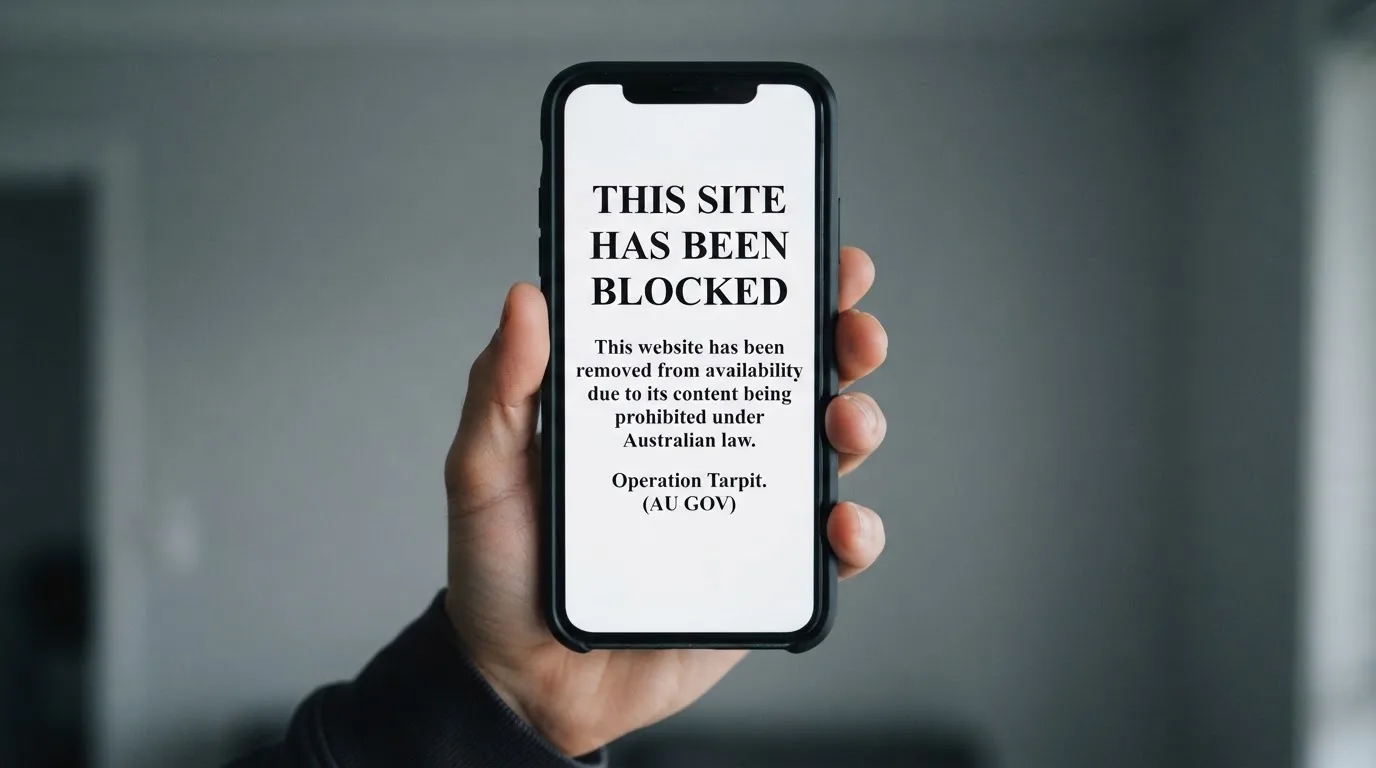
Enforcement runs through the Australian Communications and Media Authority. The ACMA investigates complaints, issues formal warnings naming the operator and the breach, and can direct Australian internet service providers to block illegal sites at the DNS level. By June 2026 the ACMA had asked ISPs to block 1,751 illegal gambling and affiliate marketing websites since the first blocking request in November 2019 — six and a half years of accumulated blocks from a regulator that started with a quieter footprint in 2017. More than 230 unlicensed services have left the Australian market entirely since the 2017 strengthening.
The blocking is not symbolic. A site the ACMA names can be unreachable from Australian connections within days, sometimes hours, and any balance a player leaves on the blocked site is, in practice, stranded — there is no Australian complaints body with jurisdiction over the operator, and the site has no obligation to refund what a player had on the account at the moment of blocking. H2 Gambling Capital’s 2025 report estimates Australians lose around A$3.9 billion a year to illegal offshore sites, and the share of gambling going through legal Australian channels has fallen from 74 per cent in 2021 to 64 per cent — a drift the regulator is trying to reverse by cutting access rather than by chasing individual players.
The individual player is not the target. The IGA aims at the provider; nobody has been jailed for placing a bet from a kitchen table in Hobart. The cost falls on the operator and, downstream of enforcement, on the player whose funds are stuck on a blocked site.
The 2026 reform wave, and what it changes
The Interactive Gambling Amendment (Gambling Reform) Bill 2026 passed Parliament on 19 August 2026. Its advertising and inducement measures commence on 1 January 2027 — law with a start date, not yet in force on a page dated 2026. The headline effect is to tighten the rules around how licensed Australian wagering operators can promote their services — bonus offers, sign-up inducements, the kind of marketing that has filled Australian sports broadcasts for years. What it does not do is legalise online casino, which remains prohibited. Players who read the bill as a softening of the prohibition are reading past the operative clauses.
A separate reform that is already operating: from 11 June 2024, credit cards, credit-related products and digital currency cannot be used to fund licensed Australian online wagering, with penalties of up to A$247,500 for operators who breach. Legal deposit routes for licensed wagering are debit card, bank transfer, PayID/Osko and BPAY. An offshore casino asking an Australian for a credit card or a crypto deposit is operating outside the Australian rules on payment as well as on the underlying product, and a refusal to fund the account that way is the player paying attention.
Player wellbeing: the rules that bite before and after the bet
Age, identification, and the on-floor reality
The minimum age for entry to either Tasmanian casino is 18. Identification is checked at the door — a driver’s licence, a passport or a Proof of Age card. The check is not performative. Federal Group’s venues are licensed under Tasmanian gaming law and are audited by the Tasmanian Liquor and Gaming Commission; a venue that admitted an underage patron risks its licence, and the venues do not admit them.

The same law brought mandatory cashless gaming cards to Tasmania’s hotel and club poker machines from December 2025, with default loss limits of A$100 a day, A$500 a month and A$5,000 a year, raisable only after a minimum 24-hour cooling-off wait. The Tasmanian Liquor and Gaming Commission oversees the system. No casino rollout date had been set as of September 2024 — the casino floors still run on cash, but the rule is moving in that direction and a player planning a multi-day visit should expect it to land.
Self-exclusion, both the registered kind and the venue kind
BetStop, the National Self-Exclusion Register, has been live since August 2023 and binds every Australian-licensed online and phone wagering service. A punter who registers with BetStop is blocked at the platform level from every Australian-licensed bookmaker for the period they nominate. What BetStop does not cover is offshore casino — those sites have no obligation to check the register, and most do not. A punter using BetStop to control online gambling is controlling the licensed part of the market, not the unregulated part.
Venue self-exclusion is the older tool and still the one that covers the casino floor. A player who asks either Wrest Point or the Country Club to ban them from the premises is recorded in the venue’s own exclusion register and is physically refused entry for the period agreed. Federal Group runs the scheme across both its venues, so a self-exclusion registered at Wrest Point is honoured at the Country Club as well. The scheme is also the route into more structured help: Gambling Helpline Tasmania, run by Anglicare Tasmania’s Gamblers Help Service, takes calls on 1800 858 858 around the clock and can arrange a venue self-exclusion over the phone without the player having to walk into the venue and ask in person. In-person counsellors are based in Hobart, Launceston, Devonport and Burnie.
The counselling line is not just for people in crisis. It takes calls about a partner’s gambling, a family member’s spending, a workplace concern about a colleague — anything that touches gambling and is causing friction. The first call costs the caller nothing and is not recorded against their name anywhere.
Money: what winnings mean at tax time
A recreational gambler’s winnings are not assessable income under section 6-5 of the Income Tax Assessment Act 1997, and losses are not deductible. The rule applies whether the play is at Wrest Point or on a credit-card-funded offshore account. The exception is the small number of Australians who carry on a business of gambling — professional poker players, sports bettors whose activity rises to that level — and they sit outside the simple rule and need advice from a tax professional. For the rest, the ATO does not want to know about a pokies win, and a punter who hears otherwise from an offshore site’s marketing is being told something the ATO does not endorse.
Land-based alternatives around Australia — context, not a substitute
South Australia: Adelaide Casino and what surrounds it
Adelaide Casino, known commercially as SkyCity Adelaide, sits inside the heritage-listed Adelaide railway station building on North Terrace and is the only casino licensed in South Australia under the Casino Act 1997. The floor carries 90 gaming tables and 950 gaming machines; the table-game monopoly was extended to 30 June 2035 under a licence formalised on 11 October 2013, which also permits expansion up to 200 tables and 1,500 machines subject to redevelopment. A 2015-2021 Riverbank precinct redevelopment, worth about A$330 million, added the EOS by SkyCity tower with 120 hotel rooms and an expanded gaming floor.
For a Tasmanian weighing whether to fly to Adelaide instead, the relevant comparison is not Adelaide’s floor against Wrest Point’s — both are licensed, both are run to Australian standards, both enforce the 18-plus rule. The comparison is distance. A Hobart-to-Adelaide flight costs time and money that a Hobart-to-Sandy-Bay trip does not, and the case for travelling is the destination, not the gaming.
South Australia’s regulatory frame is also worth knowing: the Independent Gambling Authority and the Liquor and Gambling Commissioner oversee Adelaide Casino, and the state sets a minimum gaming-machine return-to-player rate of 87.5 per cent and a general A$5.00 maximum bet on machines outside the casino. Adelaide Casino itself is exempt from that maximum-bet limit — the casino floor runs to the venue’s own house rules. South Australian gaming-machine losses outside Adelaide Casino totalled about A$0.92 billion in 2022-23, roughly A$497 per adult.
Queensland: from Treasury to the Star Brisbane
Treasury Casino in Brisbane, operated by Star Entertainment Group and housed in the historic Treasury Building, opened as a casino in April 1995 and closed on 25 August 2024 to make way for the new Star casino at the Queen’s Wharf precinct. The Star Brisbane began a staged opening at the A$3.6 billion Queen’s Wharf development on 29 August 2024, with the main casino floor and premium gaming rooms opening first.
Queen’s Wharf opened amid concerns about the licence position of its lead partner. In late 2022, the Queensland Government, acting on an independent review by former Court of Appeal judge Robert Gotterson, found Star Entertainment unsuitable to hold its Queensland casino licences after concluding it had misled regulators and failed its anti-money-laundering duties. Star was fined A$100 million on 9 December 2022, with a 90-day suspension of the Treasury Brisbane and Star Gold Coast licences deferred to 1 December 2023 to allow remediation. A Tasmanian considering a mainland trip should know the operator that runs the casino has a current regulatory cloud over it, even if the casino floor itself is open.
Queensland had 21,122 gaming machines operating in 351 venues in October 2023 — a market roughly four times the size of Tasmania’s outside the casino, and the gaming-machine density is part of why the regulator there has been willing to act on Star.
The games on the floor: what to expect at Wrest Point and the Country Club
Tables and their variants
Both Wrest Point and the Country Club run standard Australian casino table games. Blackjack anchors the floor at most sessions, with multiple stake levels on adjacent tables so a player can move up or down without changing the room. Roulette comes in both the single-zero and the double-zero configuration at the higher-stake tables; the lower-stake electronic roulette terminals run continuously. Baccarat operates as both the full punto banco version and the mini-baccarat smaller-table version; a player who has only played baccarat online will find the pace slower and the etiquette more formal than the screen version prepares them for. Craps appears at Wrest Point more reliably than at the Country Club — a function of table count rather than a structural difference, and worth checking before driving up for it specifically.
Poker rooms run scheduled tournaments and cash games. The cash-game mix rotates; tournaments are published on the venue’s website and on the standard Australian poker listing sites. Players used to a poker room that never closes will notice that both venues wind the room down to a single cash table in the small hours, and shut it entirely on the overnight gap. Tournament structures follow Australian Poker Tour conventions rather than the World Series of Poker structures that an American-trained player might expect.
Electronic gaming machines and the pokie culture
Electronic gaming machines — pokies in the local vernacular — make up most of the floor at both venues and most of the money lost there. The standard Tasmanian pokie runs to a return-to-player rate set by the venue within the regulatory minimum; there is no published RTP per machine that the player can read on the cabinet in the way an online slot page lists it. The Federal Group machines cover the full range — classic three-reel, five-reel video, and the linked progressives that pool a jackpot across machines in the same venue and sometimes across both venues.
What players used to online slots will notice immediately: no autoplay, no turbo mode, no bonus-buy feature on a pokie cabinet, because Tasmanian gaming law does not permit them on the venue floor. The spin is one button press and one outcome, and the rate of play is governed by the machine, not by the player. That changes the rhythm of a session in ways an experienced online player does not always anticipate — the session is slower, the choices are fewer, and the time-on-device figure that drives most of the bankroll maths shifts accordingly.
Live tables and what ‘live’ means on the floor
The phrase ‘live dealer’ means something different in an Australian casino than it does online. Online, a live dealer is a video stream from a studio, usually offshore, with the player betting through a web interface. On the floor at Wrest Point or the Country Club, a live dealer is a person standing across a green felt table from the player, dealing physical cards or spinning a physical wheel. The two products share a name and almost nothing else. A player who has only played live-dealer blackjack online will find the on-floor version closer to a table-game session than to a streamed product — the dealer is not a brand, the shoe is not a software feature, and the dispute-resolution path is the floor supervisor rather than a chat window.
The landscape table: offshore brands the ACMA has named
Eleven brands appear below because the ACMA itself issued formal warnings over them for offering prohibited services to Australians. They are not ranked, and they are not endorsements — appearing here is what the regulator has said about them, in the regulator’s own words.
| Brand | ACMA action and date | Operator named by the ACMA | Subject support |
|---|---|---|---|
| RocketPlay | Formal warning, March 2026 | Pulsup Ltd | — |
| Level Up Casino | Formal warning, May 2022 | Dama N.V. | listed |
| Woo Casino | Formal warning, March 2025 | Dama N.V. | listed |
| Spirit Casino | Formal warning, May 2025 | Dama N.V. | — |
| National Casino | Formal warning, July 2025 | Consolutetish S.R.L. | listed |
| Bizzo Casino | Formal warning, July 2025 (prior warning 2022) | Consolutetish S.R.L. | — |
| Ignition Casino | Formal warning, July 2025 | Bamboo Media | — |
| Instant Casino | Formal warning, February 2025 | EOD Code SRL | — |
| Jackbit | Formal warning, April 2026 | Ryker B.V. | — |
| Casino Intense | Formal warning, April 2025 | Sterplay Holding Ltd | listed |
| Sky Crown | Formal warning, September 2022 | Hollycorn N.V. | listed |
The spread is wider than the names suggest. A single operator — Dama N.V. — sits behind three of the brands on the list, and has been on the receiving end of ACMA formal warnings in May 2022, March 2025 and May 2025 for different products running on related corporate structures. The repetition is the regulator’s message: a corporate rebrand does not reset the warning record, and the ACMA tracks the operator behind the site rather than the brand on the front of it.
RocketPlay
Pulsup Ltd received a formal ACMA warning in March 2026 for RocketPlay, on top of an earlier May 2022 warning to Dama N.V. that covered RocketPlay among six brands. A player drawn to RocketPlay by a bonus offer is being drawn to a site the regulator has named twice; the Australian-facing URL is on the ACMA’s record, and the site is exactly the kind of product that gets added to a blocking request when the regulator decides to escalate from warning to action.
Level Up Casino
Dama N.V. received a May 2022 warning covering Level Up Casino alongside five sister brands. The site appears in third-party listings but the ACMA action is the relevant fact for an Australian player: a brand named in a regulator’s warning is not one to evaluate as if the warning did not exist.
Woo Casino
Dama N.V. drew a further formal warning in March 2025 over Woo Casino, after the May 2022 batch. The recurrence pattern at Dama N.V. — a 2022 round and a 2025 round, on related products — is the ACMA’s documented enforcement history with that operator.
Spirit Casino
Dama N.V. drew a further formal warning in May 2025, this time over Spirit Casino. The pattern at the operator is a series of warnings on adjacent brands over a three-year window, with the Australian-facing presence still active at the time of each warning.
National Casino
Consolutetish S.R.L. drew a formal warning in July 2025 over National Casino. The brand surfaces in third-party Australian-facing reporting, which is what makes the warning material: a brand visible to Australian eyes through affiliate channels is exactly the kind the ACMA names.
Bizzo Casino
Consolutetish S.R.L. drew a formal warning in July 2025 over Bizzo Casino, on top of a 2022 warning to TechSolutions (CY) Group Limited and TechSolutions Group N.V. that already covered the same brand. Two warnings across two operators means the brand has moved through at least one corporate change while continuing to target Australian customers, and the regulator has tracked it across both.
Ignition Casino
Bamboo Media drew a formal warning in July 2025 over Ignition Casino. The brand has been visible to Australian-facing affiliate marketing for years; the warning is the ACMA’s record of what that visibility amounts to in regulatory terms.
Instant Casino
EOD Code SRL drew a formal warning in February 2025 over Instant Casino. The brand’s marketing reach and the warning date line up closely — a brand that surfaces in front of Australian customers in early 2025 and is on the ACMA’s record within weeks of doing so.
Jackbit
Ryker B.V. drew a formal warning in April 2026 over Jackbit and a sister brand, CasinOK. The brand is recent enough on the ACMA’s list that any affiliate presence is current rather than historical.
Casino Intense
Sterplay Holding Ltd drew a formal warning in April 2025 over Casino Intense. The brand appears in third-party listings; the ACMA action sits beside those listings as a separate, regulator-published fact.
Sky Crown
Hollycorn N.V. drew a formal warning in September 2022 over Sky Crown and a sister brand, Blue Leo. The 2022 date is the oldest on the list, and a player evaluating the brand is evaluating one that has been on the ACMA’s record for the longest time of any in this set.
The blocking rate — what the ACMA’s accumulated blocks actually mean
The math here shows the scale of the regulator’s reach. The ACMA asked Australian ISPs to block its first illegal gambling website in November 2019. By June 2026 the running total reached 1,751 blocked sites and affiliate pages — six years and seven months of accumulated blocks, on a regulator that took on the role in earnest after the 2017 amendments.
That works out to a band rather than a single figure. Divided evenly across the elapsed time, the implied average sits at roughly 260 blocked sites per year — but the rate is not even. The early years were slower, as the ACMA built its investigative apparatus and the blocking-request mechanism matured; the years from 2023 onward have been faster, as the number of offshore operators targeting Australia multiplied and the ACMA’s response tempo kept pace. A reader who treats the average as a steady-state rate will under-read the current pace; a reader who treats the recent pace as the new normal will over-read it against the long-run trend. The honest framing is a band that runs from the long-run average up to the recent tempo, with the current blocking round of 12 sites in a single June 2026 request sitting comfortably within the upper end of that band.
What the band means for a player is that the regulator’s machinery is active and getting more so. A site the ACMA names today is more likely to be on a blocking list in three months than a site the ACMA named in 2019 was at the equivalent point — the regulatory throughput has improved. A balance left on a site that gets blocked is a balance that becomes harder to recover as the blocking tempo rises, because the operator’s incentive to refund an Australian player at the moment of blocking falls as the blocking becomes routine rather than exceptional.
What a Tasmanian player should actually do
The page’s verdict on the question depends on what the question is really asking. For a Tasmanian wanting to play at a casino, the answer is Wrest Point if the trip is from the south or east, and the Country Club if the trip includes Launceston, the Tamar Valley or the north-west. Both venues are licensed under the same operator, both enforce the 18-plus rule, and both sit inside the Tasmanian gambling-harm framework with cashless card reform coming to the casino floor in due course. A visitor who books a room at Wrest Point and plays the rooftop bar on a non-gaming night is doing the thing the venue is built for.
For a Tasmanian considering an offshore online casino as an alternative, the answer is that the alternative is not legal and not safe. The Interactive Gambling Act 2001 prohibits the offering, the ACMA enforces it through warnings and blocking, and a balance left on a blocked offshore site has no Australian complaints path back to the player. The bonus offers that draw a player to an offshore brand in the first place are exactly the kind of inducement the 2026 reform legislation will tighten from 1 January 2027 for the licensed Australian side — the offshore side will continue to spend what the licensed side is being told it cannot.
For a Tasmanian whose gambling has stopped being fun, the help line is 1800 858 858, free and answered around the clock by Anglicare Tasmania’s Gamblers Help Service. The first call does not commit a caller to anything, and the line also handles calls from family members and friends who are worried about someone else’s gambling. BetStop covers the licensed Australian online wagering market; venue self-exclusion covers the casino floor; the help line covers the rest.
Frequently asked questions
What is the name of the main casino in Tasmania?
Tasmania has two licensed casinos rather than one: Wrest Point Hotel Casino in Hobart, which opened on 10 February 1973 as Australia’s first legal casino, and the Country Club Casino and Resort in Launceston, which opened in 1982. Both are operated by Federal Group under the same Tasmanian casino licence, so the choice between them is a question of location rather than operator.
Where is the casino in Tasmania located?
Wrest Point sits on the Derwent River at Sandy Bay, about four kilometres south of Hobart’s CBD. The Country Club sits on the outskirts of Launceston, roughly a fifteen-minute drive from the city centre, in a resort setting with a golf course and grounds rather than in the city core. Both are reachable by car, taxi or rideshare from their respective airports.
What is the minimum age to enter the casino in Tasmania?
Eighteen. Identification is checked at the door of both Wrest Point and the Country Club, and a venue that admitted an underage patron risks the licence that authorises the casino to operate. The same age threshold applies to entry to the gaming floor specifically — a visitor can dine or drink in the venue’s bars and restaurants without showing ID, but crossing onto the gaming floor triggers the check.
Does the casino in Tasmania offer table games such as blackjack and baccarat?
Yes. Both Wrest Point and the Country Club run blackjack on multiple stake levels, roulette in both single-zero and double-zero configurations, baccarat in full punto banco and mini-baccarat versions, and craps at Wrest Point more reliably than at the Country Club. Poker rooms run scheduled tournaments and cash games, with the cash-game mix rotating. Electronic gaming machines — pokies — make up most of the floor area at both venues.
Are there hotels within walking distance of the casino in Tasmania?
Wrest Point is itself a hotel, so the closest option is zero walking distance. The Country Club is also a resort, with on-site accommodation. Travellers wanting a non-casino hotel within walking distance of Wrest Point are limited; most off-site options in Hobart sit in the CBD, which is a short drive or a longer walk along the riverview path. In Launceston, several CBD hotels are a short drive from the Country Club rather than walking distance, given the resort’s semi-rural setting.
Can Australians legally play at an online casino instead of visiting the casino in Tasmania?
No. The Interactive Gambling Act 2001, strengthened by the Interactive Gambling Amendment Act 2017, makes it an offence to provide online casino games to a person in Australia. No state or territory issues a licence for online casino games. The Australian Communications and Media Authority enforces the prohibition through formal warnings and by directing Australian internet service providers to block illegal sites — by June 2026, 1,751 sites had been blocked since November 2019. An individual player is not prosecuted, but an offshore site gives no Australian consumer protection, no complaints body and no recourse if a withdrawal is refused, and a balance on the site can become inaccessible if the site is blocked.